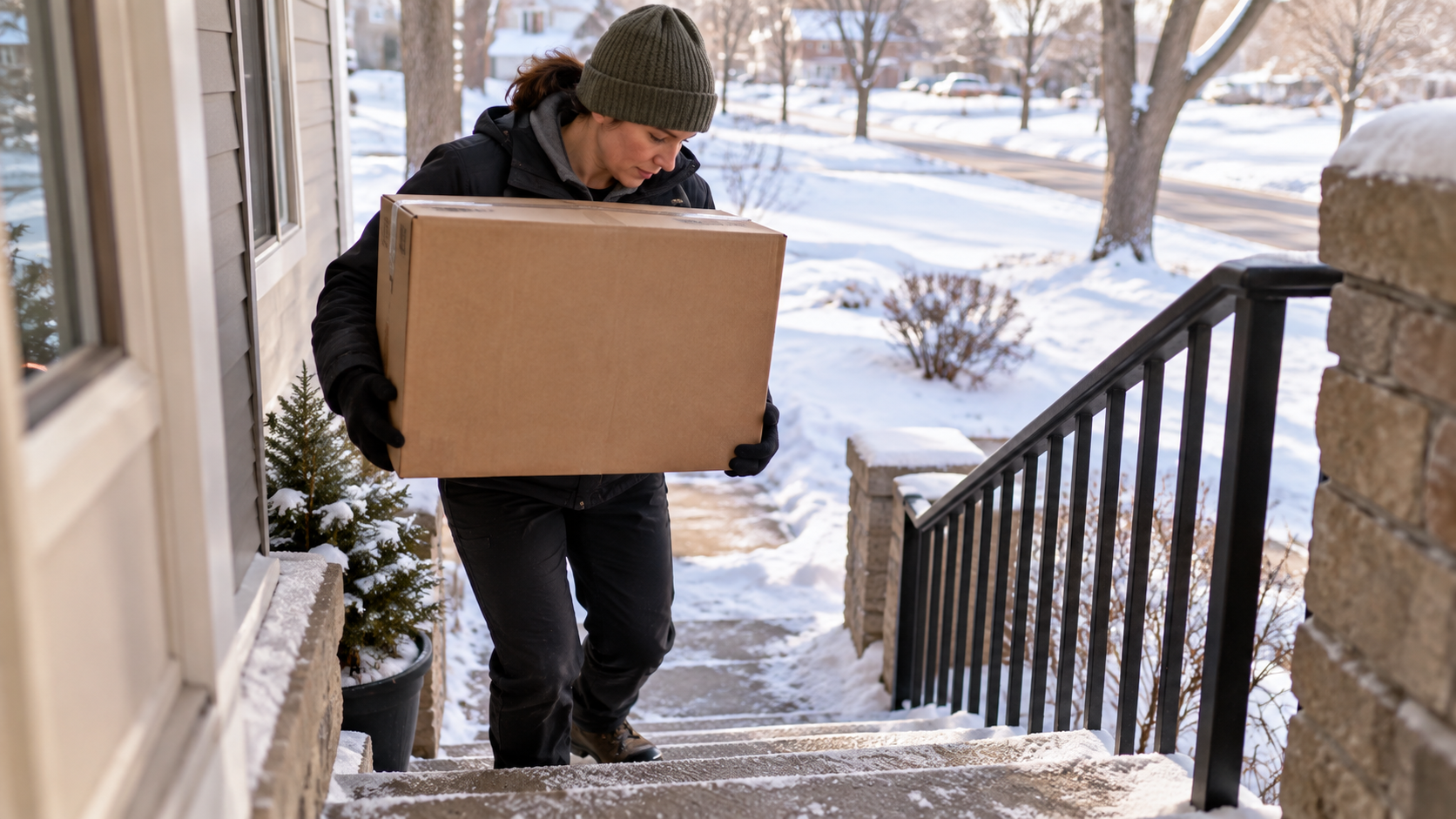
A driver picks up a wide carton and approaches a short exterior stairway. The carton is manageable on level ground, but it hides the first two steps. The driver can see the building door above it and might be tempted to move forward by memory. The unseen steps, landing, and edge of the carton make that a different task from carrying the same parcel across a clear sidewalk.
The decision is whether the driver can see and use the stairway while controlling the item. Carrying a parcel on stairs with a blocked view calls for a pause before the first step, not a trial step to learn where the stair begins. The driver may be able to change the hold, use an approved aid, arrange permitted assistance, or ask for a different authorized handoff. If none restores a workable path, the driver should report the constraint instead of recording a completed delivery.
OSHA's materials-handling guidance recommends reducing the size of a carried load on stairs and discusses equipment designed for stair transport. Those are general principles. The driver cannot shrink a sealed customer package or use a device simply because it exists. The actual parcel, stairway, employer training, and recipient instructions determine what method is available.
Make a stairway visibility check before lifting
A stairway visibility check starts with the parcel still supported at a controlled location. Look at the stair flight, first step, landing, railing, door, and the space where the package would be set down or handed over. Check for other people using the stairs. A route that looks clear from the vehicle may have an unseen turn or a door that swings across the landing.
Walk the path without the parcel if the site allows and the driver can keep the item secure. Notice uneven treads, wet surfaces, snow, poor lighting, clutter, and a landing too small to turn with the carton. NIOSH's slip, trip and fall guidance recommends keeping stairs and walkways clear of trip hazards. The driver does not need to diagnose a building-code violation to recognize that a loose object or blocked step changes the carry.
Then test the view from the position in which the parcel would actually be held, without stepping onto the stairs. Can the driver see the next step and the landing? Is the parcel so wide that the feet, rail, or approaching person disappear from view? A clear view over the top of a box while standing still may vanish once the driver looks down or turns. If the sight line is lost, change the handling method before moving.
Separate package size from package weight
A light but wide carton can hide the stair edge. A narrow but heavy parcel may leave the view clear while creating another handling concern. The driver should not use weight alone to decide whether a stair carry works. Shape, grip, center of mass, and the height at which the item must be held all affect visibility and control. A damaged handle or shifting contents can make a previously workable hold unreliable.
NIOSH lists lifting bulky loads among manual-handling risk factors. That observation does not specify a safe weight or size for this driver. It supports checking the whole task. A parcel can be within a posted role lifting limit and still block the next step. Conversely, a visible path does not prove a heavy parcel can be carried alone.
Do not open a sealed customer package to make it smaller. If the shipment has several separately labeled items, each may be moved under the employer's multi-item procedure, but this article concerns a single item that blocks the view on a stairway. If the parcel itself cannot be handled with sight of the steps, the driver needs an authorized aid, another worker, or a changed delivery plan rather than a promise to concentrate harder.
Test a different hold on level ground
Before selecting an aid, see whether the employer-approved carrying method allows the parcel to be held lower, closer, or at a different orientation while retaining a secure grip and visibility. Test that position on level, stable ground. Do not rotate the carton in a way that violates an orientation label, damages its contents, or makes its weight shift unexpectedly. Do not carry it so low that it strikes a step or prevents normal foot placement.
A different hold is useful only if it works through the entire stair flight and handoff. The driver must be able to see the first step, successive treads, landing, and door area while maintaining control. If turning at the landing raises the box into the sight line again, the hold has not solved the route. A parcel set on a railing or balanced on a knee is not a stable test of the method.
Check whether one hand remains available for the handrail when the employer's method and the parcel permit it. If the package demands both hands and the stairs require a rail for secure movement, seek another method. Do not assume that having one free hand automatically makes the carry safe; the view and grip still matter. The goal is a controlled movement that fits the actual stairs, not a particular posture copied from a generic lifting tip.
Use stair equipment only when it fits the site
OSHA discusses stair-climbing hand trucks as one way to transport materials on stairs. A delivery driver should use only equipment supplied or approved for the job and operated under training and manufacturer instructions. A standard cart may be suited to level ground but unsuitable for a stair flight. Do not drag it by force or improvise a device from loose straps.
The equipment must fit the parcel and stairway. Check whether the package can be secured to the device, whether the stairs and landings allow the device to move, and where it will rest while a door is opened. An aid that blocks the entire stairway can create a hazard for others. The driver may need a second person under the employer's procedure, but two people cannot overcome an inaccessible landing simply by sharing the load.
If equipment is available only at a depot, do not report “no safe route” as though no aid exists anywhere. Report the precise situation: the item blocks sight of the steps, the on-vehicle cart is not stair-rated under company rules, and the available stairway has a narrow turn. That gives dispatch a basis to arrange a trained assist, different equipment, or another permitted handoff.
Work through one exterior-stair example
Imagine a driver with a wide, single-piece carton for a second-floor entrance. The exterior stairway has eight steps and a small landing by a door that swings outward. The parcel's label requires it to stay upright. On level ground, the driver can hold it, but the upright carton hides the first few steps and the driver's feet. No authorized stair device is in the vehicle.
The driver keeps the carton secured while inspecting the stairs without it. The steps are clear, but the landing leaves little room to turn as the door opens. A lower carry tested on level ground improves the view of the first step, yet the carton still hides the landing when the driver looks toward the door. The driver has not solved the route. They contact the employer's route or safety channel with the parcel identity, the visibility problem, the narrow landing, and the absent approved aid.
Suppose the recipient offers to meet at a ground-level entrance. The driver verifies that the alternate handoff is allowed for this shipment, confirms the recipient under the delivery process, and completes the required proof before recording delivery. If the ground-level meeting is not authorized or cannot happen, the parcel remains under the applicable custody procedure for a revised attempt. The driver does not leave it on the stairs because the recipient suggested “just set it down.”
Change one detail: the stairway is indoors and has a wide landing. The driver still needs a clear view and a permitted method; the wider landing may make an approved aid workable. Change another: rain has made the exterior treads slick. A method that looked usable earlier may need to be reconsidered. These are invented facts for a decision example, not a description of a particular building or employer policy.
Plan the parcel handoff at stairs
A parcel handoff at stairs should identify where the driver will stop, who may receive the item, and how proof of delivery will be recorded. A recipient on an upper landing may expect the parcel at the door; a driver cannot unilaterally change the destination to the bottom step. Conversely, a request to leave a box on a stair tread may create a trip hazard and may be outside the allowed delivery location. Confirm any alternate point through the employer's rules and recipient instructions.
If a person offers to help carry, verify whether that role is permitted. A customer may be willing, but the driver should not shift the physical task to an untrained person as an improvised solution. An authorized coworker or building staff member may have a defined process; ask dispatch when uncertain. Before handing the parcel to anyone, confirm the identity and required acknowledgment under the route workflow.
Keep the package within the driver's control until an approved transfer. Setting it down on a landing while returning for a scanner, opening a door, or looking for a helper may leave it unattended in a busy passage. If a stable permitted staging point exists, use it under the employer's procedure. Otherwise, return the parcel to a controlled location and coordinate the handoff before trying again.
Check the way down as well as the way up
The driver must leave the delivery point after handing over the parcel. The stairway may be clear on ascent but crowded on descent. Keep the return route in view, use the handrail where appropriate, and avoid stepping backward to photograph a proof-of-delivery location. A proof image is not worth losing sight of the landing edge. Take it only from a position and direction allowed by the workflow and safe for the site.
If an aid was taken upstairs, plan how it will come down empty. A stair device that can carry a parcel upward still needs to be controlled on descent. Do not leave company equipment at the recipient's location without authorization. If a coworker assisted, coordinate the return so neither person is stranded managing the device or an open door alone.
The route may have another parcel at the same stop. The driver should not assume the first successful carry proves the next one will work; its shape or weight may be different. Recheck visibility and the landing for each distinct item. This article's decision is tied to the actual parcel and stairway at that moment, not to a general statement that the address is “safe for stairs.”
Decide at the stair foot, not halfway up
The foot of the stairs is the place to test the plan because the parcel can still be kept on a stable level surface. A driver halfway up a narrow flight has fewer options for changing the grip or turning around. Before beginning, locate a permitted place to pause if the door is locked or another person enters the stairway. If there is no such place, coordinate access first. Do not rely on a recipient appearing at exactly the right moment to take the carton from the top step.
Check the parcel's path through the landing as a single movement. A hold that preserves sight of each tread might still block the view of a narrow landing edge. The driver should be able to explain how the parcel will be carried, where the feet will go, and where the package will rest while the door or recipient is handled. If the answer changes to “I'll figure it out at the top,” the plan is not ready.
If the driver discovers an unexpected obstruction after starting, stop at a stable position if one exists and follow the employer's safe-response procedure. Do not rush past the obstruction to finish the ascent. If there is no stable place to set the item down, the situation needs trained assistance; improvising a handoff over the rail may create a second hazard. Reporting the unexpected condition is more useful than silently repeating the same attempt.
Coordinate assistance without losing custody
Help should solve the actual constraint. One coworker may be able to carry an approved smaller item while the driver handles another, but that does not change the view blocked by a single sealed carton. A trained two-person method might control that carton, subject to the employer's procedure and the stairway's width. Both people need a place to stand, a shared route, and a clear signal for starting and stopping. A helper at the top cannot safely receive a package if the driver must climb unseen steps to reach them.
When assistance is arranged, identify who will hold the parcel, who will manage the door, and who will complete the scan or acknowledgment. Those roles prevent the item from being left unattended while the driver retrieves a device or phone. If building staff offers to move the package instead, confirm whether transferring it to them is an authorized handoff. A helpful person is not automatically the recipient named by the shipment.
If assistance cannot arrive during the stop, preserve the parcel and communicate the next authorized plan. Give dispatch the access details that would let another driver or crew avoid the same blind carry. An exact description of the stair flight, landing and item shape is more useful than “heavy box,” especially when the key problem is sight of the steps rather than weight alone.
Report an unworkable stair carry precisely
When no approved method preserves a usable view and secure control, stop the attempt and report the constraint. State the parcel identity, stair location, what part of the path is hidden, whether the stairs are wet or obstructed, what approved equipment is present, and whether an alternate authorized handoff was offered. Avoid claiming a universal safety rule from one photograph. The responsible team needs enough detail to choose equipment, assistance, a different time, or another route decision.
Keep the item status accurate. If the parcel never left the vehicle, say so. If it was brought to the foot of the stairs and returned, record that movement under the employer's process without marking delivery. Do not use a “recipient unavailable” code if the recipient was present and the physical route was the unresolved issue; ask which available status describes the actual outcome.
If a fall, near miss, damage, or pain occurs, use the employer's incident-response process and preserve the relevant facts. This article cannot diagnose an injury. It can help the driver identify the point before a blind step becomes an incident: the view of the next tread or landing is gone, and the handling method has not restored it.
Close the stop on the actual handoff
A completed stop needs the authorized recipient or location, the required item scan or acknowledgment, and a truthful record of where the parcel went. A plan, a message saying help is coming, or a parcel at the stair foot is not a completed handoff. If a ground-level transfer is approved, record that actual location and recipient according to the platform's options. If the item returns with the driver, preserve its identity for the next attempt.
Drivers comparing jobs can use the Saint Paul delivery driver Careers hub and the published delivery job-offer review guide to ask what equipment and assistance are provided for stair deliveries. At the live stop, the driver should be able to see the next step and landing throughout the carry, keep control of the parcel, and complete an authorized handoff. If any part cannot be arranged, the right result is a precise report and a new method, not a blind climb.