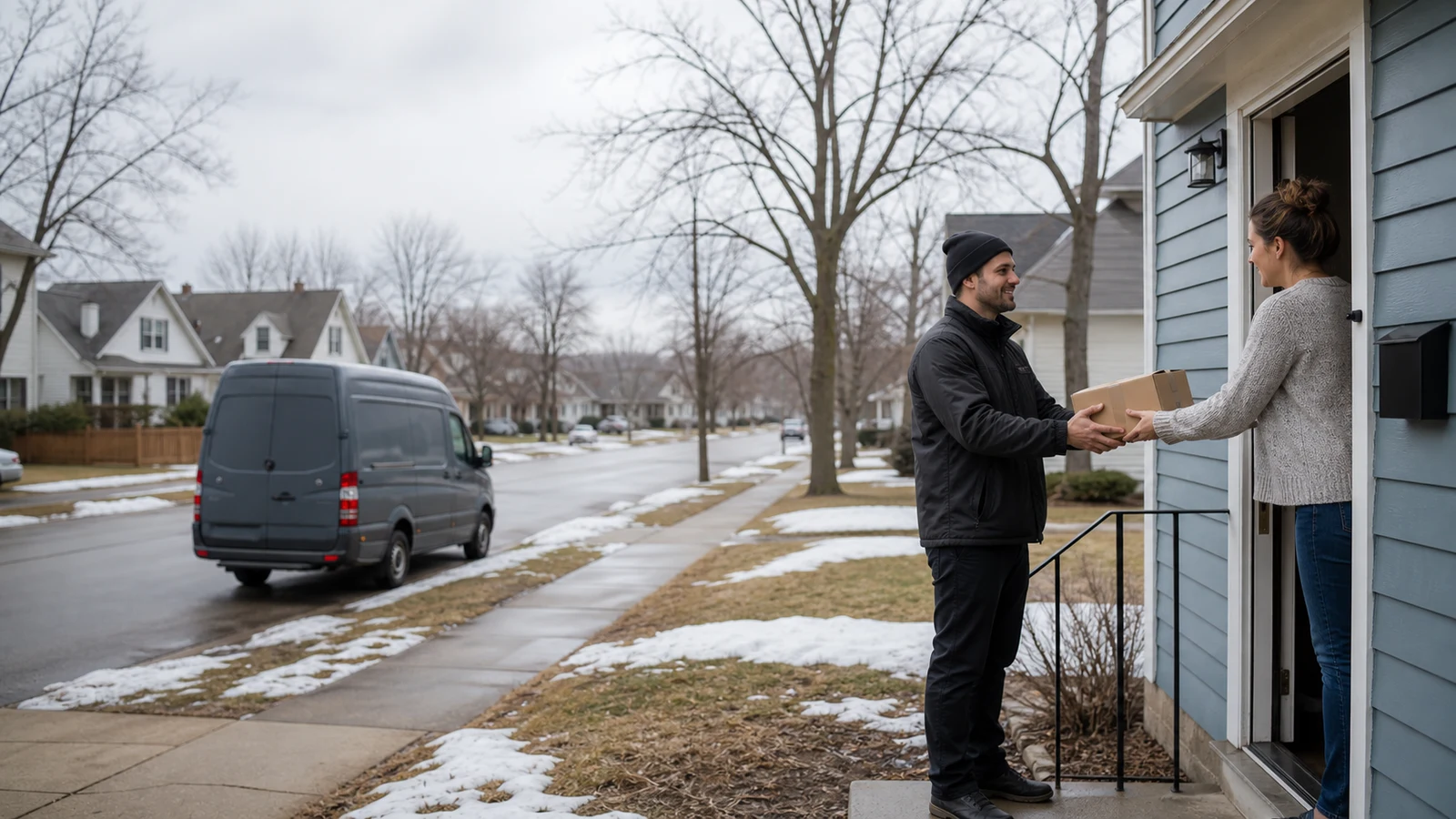
The short answer is that contact can range from no conversation at a completed stop to a brief exchange for access, a signature, or a question. The amount depends on the employer’s service model, the route, recipient availability, and the instructions attached to each delivery. A role can involve little total conversation while still requiring calm, accurate communication at the moments that count.
For a job seeker, customer interaction in Saint Cloud delivery driver jobs is best understood as a series of short handoffs rather than a promise of either solitude or constant customer service. Before applying, ask how often drivers call or message recipients, how signature stops work, who answers delivery disputes, and when a driver should leave instead of continuing a difficult exchange.
People who are still comparing the broader field can begin with delivery driver jobs Saint Cloud MN. That overview and this guide answer different questions: one supports a wider job search, while this page helps you judge whether the human contact inside a delivery role suits the way you prefer to work.
Contactless Delivery Communication: Count The Moments That Need A Response
Many deliveries can be completed without meeting the recipient, yet the communication work does not disappear. Contactless delivery communication may take the form of an arrival notice, an access question, a placement update, or a record of an incomplete attempt when the applicable instructions call for it. The exchange happens at a distance, but accurate choices and records still shape what the recipient understands.
The important distinction is between conversation and communication. Conversation requires two people to respond in real time. Communication can be one-way and procedural: a status update may tell a recipient what happened without inviting a discussion. Someone who enjoys independent work may be comfortable with that pattern even if they would dislike extended service conversations throughout the day.
Silence also does not give a driver permission to improvise. If a recipient does not answer, the right next step depends on the work instructions. It might be appropriate to wait, use an approved contact channel, document an attempt, choose an allowed placement, or leave with the item. A candidate should learn the decision boundary rather than assume every unattended stop works the same way.
These questions can reveal how much remote contact belongs to a role:
- Which events permit or require a call, message, or arrival notice?
- Does the work system supply approved wording or protected contact details?
- What is the process when an entry instruction is unclear or a recipient cannot be reached?
- Who handles a later report that a delivered item cannot be found?
Consider a simple access problem. A driver reaches the correct destination but cannot enter the delivery area. The customer-contact part is not an open-ended attempt to solve the property’s access system. It is a bounded task: check the authorized instructions, use the allowed channel if one is provided, wait only as directed, and record the outcome. That boundary protects accuracy and keeps the driver from making promises outside the role.
During a job conversation, focus on where an unresolved contact goes next. Repeated outreach can make an otherwise quiet role feel service-heavy when the courier retains the problem until someone answers. By contrast, several short notices may feel lighter when a standard message closes the courier’s part and another function receives the exception. Raw interaction counts hide that difference.
Recipient Signature Handoff Etiquette: Keep The Exchange Clear And Bounded
At a signature stop, customer contact becomes visible but usually has a narrow purpose: establish that the required handoff can occur, present the signature method, and complete or decline the stop according to the instructions. The driver does not need to turn the moment into a sales conversation. A clear greeting and a direct explanation of what is needed are often more useful than extra small talk.
Good recipient signature handoff etiquette respects both the delivery rule and the recipient’s space. The driver can identify the purpose of the visit, explain that the item requires a signature under the assigned process, and give the person room to respond. If a required condition is not met, the driver should describe the available next step without shaming the person or inventing an exception.
These short lines show the appropriate scale of the exchange:
- Opening: “Hello, I have a delivery that calls for a recipient signature.”
- Direction: “Please use the signature field when you are ready.”
- Boundary: “I cannot complete this handoff under the instructions I have, so I will record the attempt through the work process.”
An actual employer may use different wording, equipment, or verification steps, so examples are not scripts to memorize. Their value is the shape of the response: state the task, avoid assumptions, and explain only the action you can take. If a recipient asks why a signature is required, a driver can point to the delivery instruction without guessing about the sender’s reasons or a policy the driver cannot verify.
Someone assessing customer interaction in Saint Cloud delivery driver jobs should ask about the share of stops that require an in-person handoff, not merely whether signatures ever occur. It also helps to ask what happens when the named person is unavailable, whether another person may accept under the applicable instructions, and where questions are transferred. The answers show both the likely contact volume and the discretion expected at the door.
Before deciding that signature contact is a poor fit, separate brief structure from social intensity. A person who dislikes spontaneous conversation may still be comfortable with a repeated, clearly defined request. By contrast, someone who enjoys talking with people may still dislike enforcing a handoff condition. The better fit question is whether you can remain courteous while following a limit that the recipient may not welcome.
Proof Of Delivery Customer Questions: Separate Facts From Decisions
A completed stop can create a second kind of contact: a recipient may ask where an item was placed, whether the record was updated, or what happens after a reported problem. The driver’s useful knowledge is usually limited to what the driver observed and entered through the approved workflow. Questions about refunds, replacements, account decisions, or sender policies may belong with another team.
Use proof of delivery customer questions as a prompt to name only the evidence available at that stop. Permitted details might include the placement location, the attempt time, or the recorded action. None of those observations grants authority to decide a claim, guarantee an outcome, change an order, or interpret a policy, so the answer should end where the verified record ends.
A practical response can sort the question into three destinations:
- Answer directly when the question concerns a fact the driver personally observed and is permitted to share.
- Document the issue when the workflow calls for a note, exception record, or report.
- Transfer the question when it requires account access, policy interpretation, money, replacement decisions, or investigation.
The strongest answer is often modest. “I placed the item in the location recorded for this stop” is narrower and more reliable than speculating about what happened afterward. “I can document your concern, but I cannot decide the claim” is more helpful than suggesting a result that another person or system controls. Accuracy keeps a short exchange from becoming a larger misunderstanding.
Privacy is another useful boundary. A delivery record may contain details that should not be displayed casually, especially if a device or screen includes information from other stops. Candidates can ask how customer information is protected during a handoff and whether contact takes place through a work-managed channel. The answer matters even when conversations are rare because one careless moment can expose more than the current stop requires.
Responsibility changes the weight of customer interaction in Saint Cloud delivery driver jobs even when each exchange is short. Compare three endpoints: the moment a courier’s factual explanation ends, the moment a support function receives a dispute, and the point after which a completed route no longer generates direct follow-up. Those boundaries reveal more than a simple estimate of minutes spent talking.
Doorstep Complaint De-Escalation: Stay Useful Without Owning The Dispute
A complaint can begin with an issue the driver did not cause and cannot resolve, such as a concern about timing, condition, instructions, or a prior notification. The driver’s task is not to win an argument or accept blame on behalf of an unknown party. The useful goal is smaller: understand the immediate concern, state the action available within the role, and prevent the exchange from becoming more confusing.
Effective doorstep complaint de-escalation starts with a neutral acknowledgment. A sentence such as “I understand that you are concerned about the condition of this item” recognizes the concern without confirming an unverified cause. The driver can then identify the next permitted step, such as documenting the observation or directing the person to the designated support path, if that is what the employer’s process requires.
A calm sequence can keep the moment bounded:
- Listen long enough to identify the specific delivery issue without interrupting to defend yourself.
- Repeat the narrow concern in neutral words so the recipient can correct a misunderstanding.
- State one action you are authorized to take and one question that must go elsewhere.
- End the exchange when the action is complete or when continuing would be unsafe or unproductive.
The final limit matters. Courtesy does not require a driver to remain in a threatening interaction. If a person blocks departure, makes a threat, or creates another immediate safety concern, the driver should move to safety and follow the applicable workplace and emergency procedures. A job seeker can ask how drivers report aggressive encounters and who becomes responsible after a report is made.
Personal fit depends less on having a perfect phrase than on staying accurate under pressure. You may be suited to this contact if you can hear frustration without mirroring it, avoid making a promise just to end the conversation, and transfer a problem without sounding dismissive. You may want more detail before applying if unclear authority or repeated conflict would make it hard to stay composed.
Taken together, the contact level is not captured by a single label such as “independent” or “customer-facing.” Estimate it through four concrete signals: the frequency of recipient notices, the share of live handoffs, the breadth of explanations assigned at the doorstep, and the destination for an exception after it is recorded. Current role materials or an employer conversation should supply those answers because practices can differ.
Readers ready to explore a careers page can continue through recipient signature handoff etiquette. Verify the listed location, duties, contact expectations, and application details on the current page before acting; this general guide does not establish that any role is open or that a particular employer uses the workflows described here.