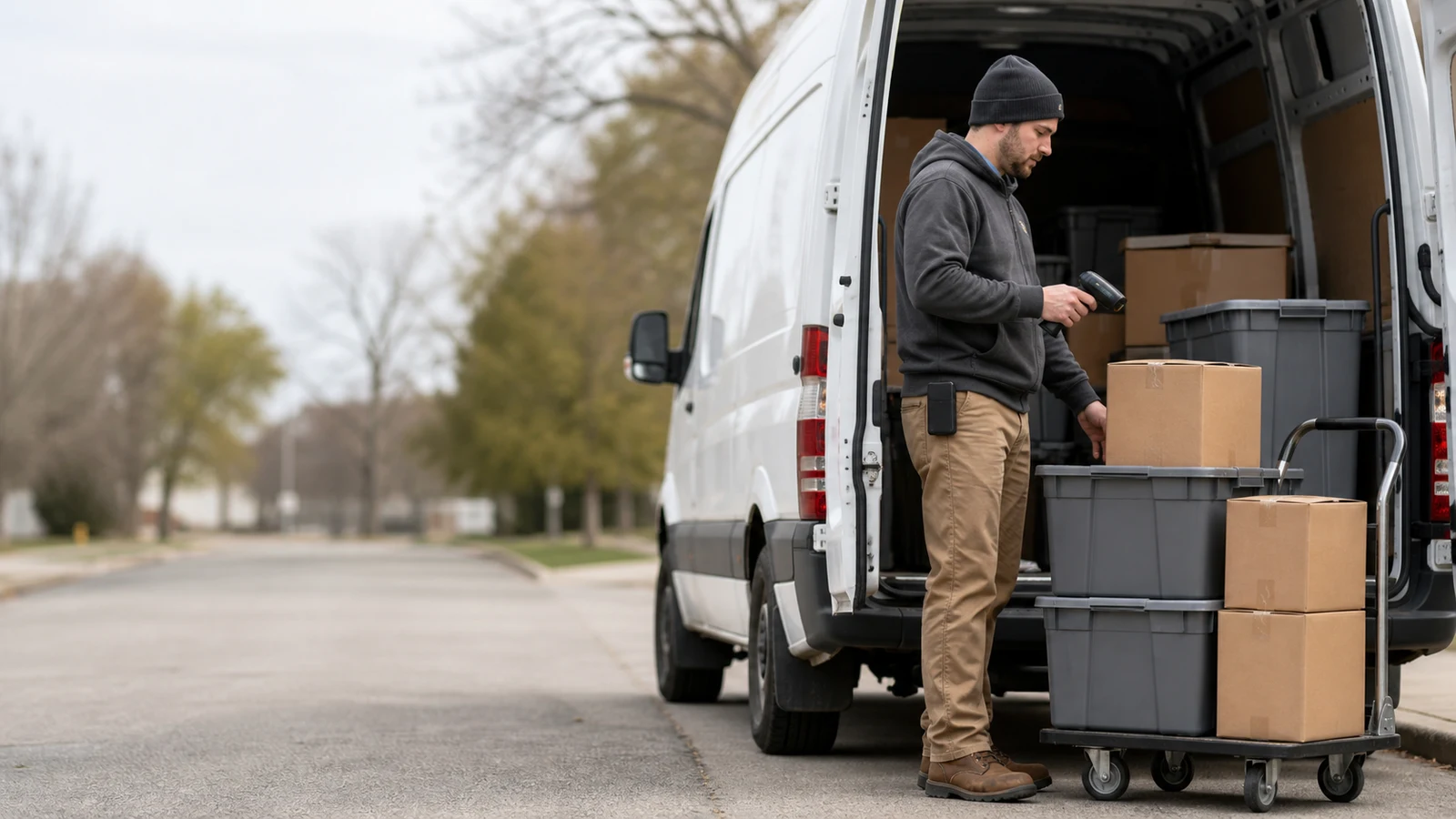
Delivery work becomes easier to understand when the gear is viewed as one connected system rather than a pile of accessories. A scanner records what happened to a parcel, a tote keeps a group of items together, a cart or dolly changes how that group moves, and a mounted phone keeps navigation and communication visible. Each tool solves a different problem, yet a poor setup in one area can interrupt the others. This guide explains how to assess the tools themselves, the handoffs between them, and the small setup decisions that help a driver maintain an orderly flow from vehicle to delivery point.
A practical review of delivery driver tools and equipment Saint Cloud MN should begin with three questions: What information must be captured, what items must be controlled, and what device must remain usable? Those questions create a repeatable decision path. First identify the package event that needs a record. Next choose a carrying method that fits the parcel group and the path ahead. Then confirm that the phone and scanner will stay powered, reachable, and secure. Because operating systems differ, the sequence works as an evaluation lens rather than a claim about the contents of a specific vehicle.
Handheld Parcel Scanner Duties Begin With Event Accuracy
A parcel scanner is best understood as an event-recording device. The physical action of reading a barcode may take only a moment, but the important result is the digital status attached to that scan. A device may ask for a parcel identifier, a stop selection, a delivery status, or another confirmation determined by the organization using it. Because workflows vary, the screen prompt is more authoritative than a general habit. A deliberate user pauses long enough to confirm that the displayed parcel and the real parcel match before moving to the next action.
Within a set of delivery driver tools and equipment Saint Cloud MN, the scanner often acts as the point where physical handling meets recordkeeping. That makes timing important. Scanning too early can separate the record from the actual handoff, while scanning after several parcels have moved can make it harder to remember which item produced an alert. A clean sequence keeps one parcel, one screen response, and one physical action together. When a barcode does not read, repeated blind attempts are less useful than checking whether the code is folded, wet, dirty, covered, or being viewed at an awkward angle.
Handheld Parcel Scanner Duties At The Handoff Point
Useful scanner discipline is built around checkpoints. Before leaving the vehicle, the driver can compare the item in hand with the stop shown on the device. At the delivery point, the driver can complete only the prompts that apply to that moment. Before walking away, the driver can check for an unresolved warning or an unsubmitted screen. The exact buttons and status names may differ, but the logic remains stable: verify the item, respond to the live prompt, and confirm that the device accepted the event.
- Match The Visible Label To The Active Stop Before Carrying The Parcel Away.
- Keep The Barcode Flat Enough For The Scanner To Read Without Covering It By Hand.
- Read Error Messages Before Repeating An Action Or Selecting A Different Status.
- Return The Device To The Same Secure Location After Each Completed Interaction.
Exception handling is where careful scanner use matters most. A damaged label, duplicate-looking package, device timeout, or unexpected prompt is a signal to slow the sequence down. The safest general response is to preserve the connection between the parcel and its on-screen record while following the applicable procedure shown or provided by the organization. Guessing at a status can create a record that no longer describes the physical event. A driver evaluating a role can therefore ask how scanner exceptions are identified and where the official resolution steps appear.
Readers who want to place this equipment discussion beside a broader role overview can review delivery driver jobs Saint Cloud MN. That comparison is most useful when it remains precise: this page addresses tool flow, while the linked guide provides wider job context. Any current employer-specific expectations should come from the employer or the destination page, not from assumptions about the scanners described here.
Delivery Tote And Dolly Use Creates A Moving Work Zone
Good delivery tote and dolly use begins before anything rolls. A tote controls separation: it can keep small parcels from spreading across a cargo area or combine items that belong to one movement. A dolly or cart controls force: it lets wheels carry a suitable load across a suitable surface. Those functions are related but not interchangeable. A tote does not make a heavy group safe to lift, and a wheeled aid does not prevent loose items from shifting. The useful question is whether the chosen combination controls both the contents and the movement path.
Grouping should be readable at a glance. A tote that contains unrelated stops may save space but create extra searching, while a tote packed above its rim can hide labels and allow items to fall. A simple grouping rule—such as keeping a small stop together or separating parcels that need different handling—makes the container serve the next decision. The container should also remain identifiable after it moves. If several similar totes are present, their position or approved marking method needs to make sense to the person who will retrieve them.
Delivery Tote And Dolly Use At Curbs And Entries
The route from vehicle to destination determines whether wheels are helpful. Smooth pavement may favor a cart, while stairs, deep snow, a narrow doorway, or an uneven edge can turn the same cart into an obstacle. Saint Cloud conditions can change the surface underfoot, so the decision belongs to the actual path rather than to a fixed preference. Before unloading, a driver can visually trace the path, note transitions, find a stable stopping point, and decide whether the parcels should stay together or move in smaller groups.
- Inspect The Path For Steps, Slopes, Soft Ground, Ice, Door Width, And Turning Space.
- Choose A Tote, Dolly, Cart, Or Smaller Hand-Carried Group That Fits That Path.
- Place Dense Items Low And Keep Loose Parcels From Extending Into The Wheels.
- Stop On A Stable Surface Before Opening A Door Or Reorganizing The Load.
- Account For Every Container And Tool Before Returning To The Vehicle.
A dolly is most predictable when its load stays inside the footprint and the operator can see the path. Tall stacks may reduce trips but also block sightlines or shift during a turn. A tote is most useful when its handles, base, and sides are intact and the contents do not interfere with the grip. These observations do not replace equipment-specific limits or workplace instructions. They provide a quick field test: if the load cannot remain controlled through a turn, threshold, stop, and restart, the grouping needs to change before movement begins.
Tool return is part of the movement cycle. An empty tote left at a doorway, a folded cart placed loosely in the cargo area, or a dolly blocking access to the next parcel creates a new problem after the delivery is complete. Assigning each item a consistent storage position reduces searching and makes missing gear easier to notice. The position should keep the tool from rolling, falling, covering labels, or obstructing access. The exact securement method depends on the vehicle and equipment supplied, so a prospective driver should look for the documented method rather than inventing one.
Driver Phone Mount And Charging Setup Protects Continuity
A reliable driver phone mount and charging setup has three parts: placement, retention, and power. Placement determines whether the display can be checked without holding the device or blocking the driver’s view. Retention determines whether bumps, turns, and repeated removal loosen the phone. Power includes the cable, connector, adapter, and charging source, not just the battery icon. The goal is a stable workspace in which the device remains accessible for approved functions while the vehicle is safely positioned and the user follows applicable rules and organizational procedures.
Mount selection is not only about clamp strength. The phone must fit with its case attached, the charging port must remain reachable, and the release mechanism should not require wrestling with the mount. A vent mount may interact with airflow and vent movement; a suction mount depends on a clean, compatible surface; another fixed position may have its own visibility constraints. Instead of assuming one style is universal, test whether the display stays readable, the device stays retained, and important controls and sightlines remain clear.
Driver Phone Mount And Charging Setup Before The First Stop
A useful setup check happens while parked, before the device is needed. Seat position comes first because it changes reach and viewing angle. The mount can then be adjusted, the phone seated, and the cable routed so it does not cross a control, snag during exit, or pull sideways on the connector. After power is connected, the charging indicator should be observed rather than assumed. A cable can appear connected while a loose adapter, worn plug, or incompatible power source prevents charging.
- Set The Viewing Angle From The Normal Seated Position While The Vehicle Is Parked.
- Confirm That The Mount Grips The Phone Without Pressing Unintended Buttons.
- Route The Cable Away From Pedals, Steering Controls, Door Seals, And Exit Paths.
- Verify Active Charging And Check That The Connector Stays Seated After Mounting.
- Keep Any Approved Backup Cable Organized Where It Can Be Identified Without Searching.
Heat and cold can reveal weaknesses in a phone arrangement. Direct sun through glass may warm a device, while winter temperatures can affect how the battery and cable behave. Airflow, screen brightness, navigation use, and repeated disconnection can also change power consumption. The practical response is observation: notice whether the battery percentage is rising, holding, or falling during normal use. If the setup cannot maintain useful charge, identify whether the likely cause is the source, adapter, cable, connector, device position, or workload before replacing parts at random.
Cable discipline protects the entire workflow. A very long loose cable can catch on clothing or gear; a cable stretched tightly can damage a connector or pull the phone out of position. A short, controlled route with enough slack for normal movement is easier to inspect. Connectors also collect lint and moisture, so a charging problem is not always an electrical-source problem. Cleaning or repair should follow device guidance rather than improvised methods. Where an organization provides devices or accessories, its reporting and replacement process controls.
Delivery Tote And Dolly Use Helps Compare Workflows
The strongest equipment review examines handoffs, not isolated objects. A scanner needs a secure home while both hands guide a dolly. A tote should not cover the label needed for the next scan. A phone cable should not run through the area where a cart is removed. A folded tool should not occupy the place where completed or unresolved parcels are kept distinct. Walking through a fictional stop can expose these conflicts: identify the parcel, scan at the proper event, select the carrying aid, travel the path, complete the handoff, and return every device to its assigned place.
A prospective driver can use that walkthrough to form focused questions without assuming a particular employer’s process. Ask which items are issued, which device carries the official prompts, how carts are secured between uses, how damaged totes are removed from service, and where charging problems are reported. Answers should be evaluated against the actual equipment and published procedure. The value of the questions is not that one answer fits every operation; it is that each answer reveals whether the full tool chain has a defined home, a defined use, and a defined response when something fails.
Driver Phone Mount And Charging Setup Questions Worth Asking
Equipment readiness can be summarized with a compact test. Can the scanner record the correct parcel event without losing its physical connection to the item? Can the tote or wheeled aid control the selected group over the real path? Can the phone remain mounted, powered, reachable, and clear of controls? Can every tool return to a secure location afterward? A “no” identifies the next adjustment. This test is more useful than collecting accessories because it focuses attention on the point where the workflow would otherwise break.
For someone researching delivery driver tools and equipment Saint Cloud MN, the central lesson is that readiness comes from coordination. Scanners protect event accuracy, containers protect grouping, wheeled aids support controlled movement, and phone gear supports continuity. None of them replaces attentive judgment or the instructions that govern a specific workplace. Together, however, they provide a clear way to observe a delivery process and ask better questions about how its physical and digital parts connect.
Handheld Parcel Scanner Duties Point To The Next Step
Career research should move from general equipment knowledge to verified role information. To continue, review handheld parcel scanner duties on the linked careers page and use that destination for any current details it publishes. Compare those details with the tool-chain questions in this guide, then confirm anything role-specific through the appropriate employer source. That creates a grounded next step without treating common equipment practices as a promise about openings, procedures, hardware, or outcomes.