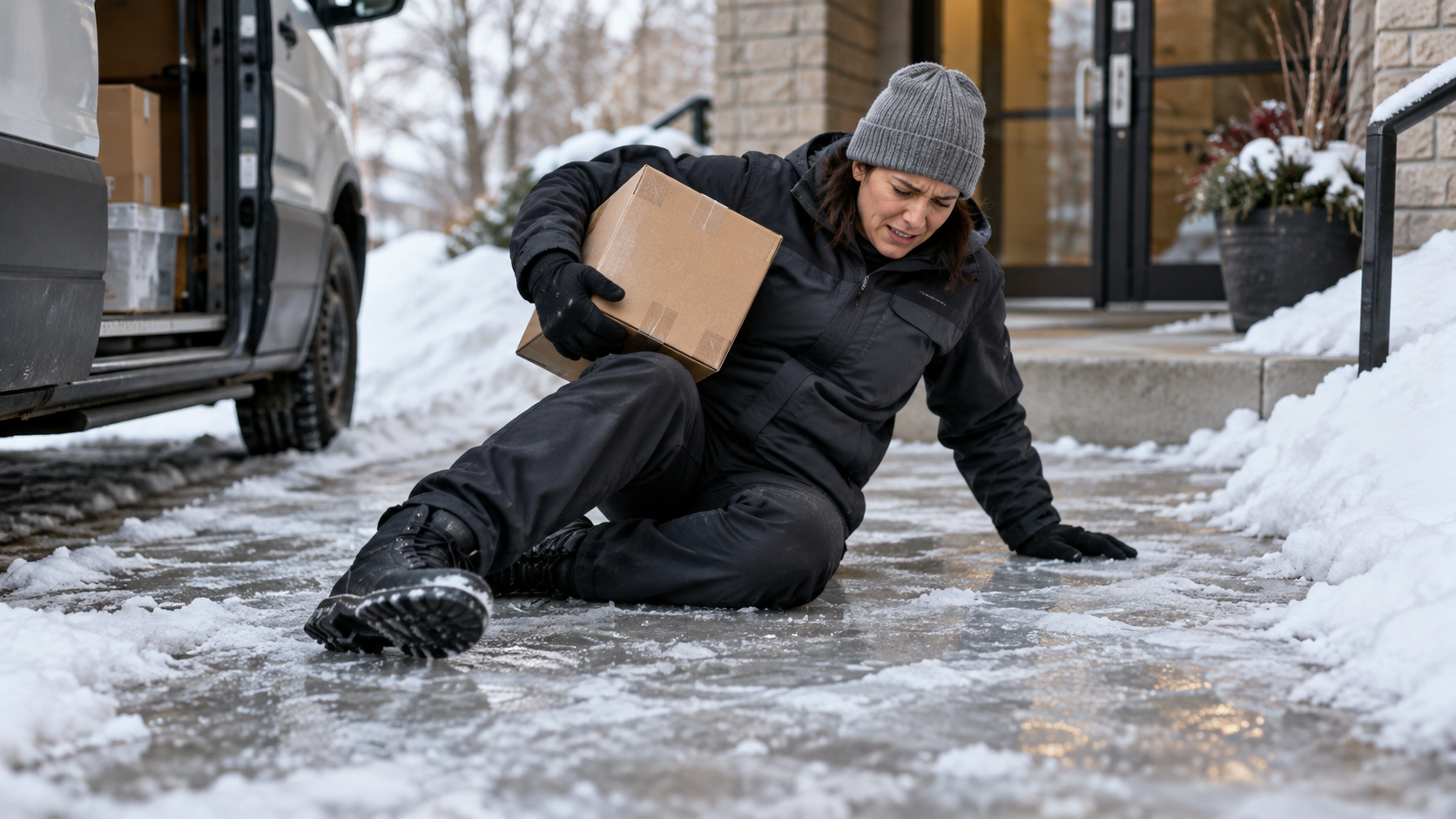
A driver steps from a vehicle toward an apartment entrance and slips on a patch of ice. The parcel remains in hand, but the driver lands hard and is unsure whether an ankle is injured. The stop card is still open, the entrance is nearby, and the route has more deliveries. Finishing the stop immediately can seem simpler than stopping to report the fall. A useful response begins with the person, then records the scene and parcel state before those details change.
To document a fall at a delivery location, get to safety, seek medical help when needed, and notify the employer promptly. Record where and how the fall occurred, what surface or obstruction you actually observed, who saw it, and what happened to the parcel. Use the designated work incident channel, preserving the time sequence rather than trying to write a polished account later. The route owner should decide whether another driver or vehicle is needed while the injury question is addressed.
The Minnesota Department of Labor and Industry's claim-process guidance tells an injured employee to notify the employer, seek medical attention if needed, and report the injury to a supervisor as soon as possible. NIOSH's slip, trip, and fall guidance addresses common hazards. Neither source can diagnose the driver or decide responsibility for this particular walkway. The article focuses on a truthful first account and practical route control.
Check the person before the parcel
Stay still long enough to assess whether you can move safely. A fall can cause pain, dizziness, or a head injury even when clothing and the parcel look intact. If there is severe pain, difficulty moving, loss of consciousness, or another urgent concern, call emergency services or ask someone nearby to do so. Follow medical advice rather than a route deadline. Do not force yourself to stand or drive because the delivery is only a few steps away.
If you can move safely, reach a secure position away from traffic and the surface that caused the fall. Tell dispatch or the designated supervisor what happened and whether you need medical assistance. You do not have to diagnose an injury to report symptoms. “I fell on the entry path and my right ankle hurts when I put weight on it” is more useful than “I am probably fine.” If symptoms change, update the owner and seek care as advised.
The parcel can wait in a safe, controlled place under the employer's instruction. Do not mark it delivered because you reached the property. If someone offers to take it while you are hurt, follow the assigned recipient and handoff rule before changing custody. A worker-safety event should not become an inaccurate delivery record.
Build a fall incident timeline
The fall incident timeline starts before the impact. Record the approximate arrival time, where the vehicle was parked, which path you took, what you carried, and what you noticed about the surface. Then describe the slip or trip, where you landed, your immediate symptoms, and when you notified the supervisor or sought help. Mark times approximate if you did not check a clock. The order matters more than an invented exact minute.
Separate firsthand observations from later information. “I saw ice beside the curb after I stood up” is different from “the ice caused me to fall,” if you did not see it before losing balance. A building worker may say the walkway was salted earlier; record that as their statement, not as a fact you verified. Photographs or maintenance records may later clarify the condition. Your first account should preserve what you knew when you knew it.
If a medical provider later gives a diagnosis, keep that in the appropriate health or claim process rather than rewriting the first scene note as though you knew it at the curb. Likewise, a later weather report may help investigation but should not replace the conditions you personally encountered. The timeline can grow with attributed updates while leaving the original observation intact.
Create a delivery site hazard record
A delivery site hazard record describes the exact place another person might encounter the same condition. “Ice at the building” is vague if there are three entrances. Name the approach, stair, curb cut, mat, ramp, or doorway, and the direction of travel. Describe lighting, weather, surface condition, and any obstacle you observed. If you can do so safely and the employer permits it, take a scene photo from a safe position before the condition changes.
Do not put yourself back on the ice to create a better photograph. A colleague or supervisor may be able to document it later. If another person is using the walkway, alert them to an immediate hazard when safe, without claiming authority over the property. The employer may need to warn later drivers or choose a different access point. Give dispatch the location while the route is active; a report read tomorrow may be too late for the next worker.
Do not overstate what the scene proves. A wet patch, loose mat, or uneven step may be visible, but the fall can involve several factors. Describe footwear, load carried, and movement truthfully if the incident form asks. The safety owner can evaluate prevention without requiring the driver to assign blame at the scene.
Notify the employer promptly
Use the employer's injury or safety channel and tell the route owner. One notification may not reach both the person responsible for employee care and the person responsible for parcels. The Minnesota DLI guidance emphasizes prompt employer notice and medical attention when needed. Ask who will complete the formal work injury report and what information the driver must provide. Do not assume a customer-service route note is a workplace injury report.
Provide the stop, time, location, symptoms, and immediate needs. If you are unable to continue driving, say so plainly. A supervisor can arrange relief without waiting for a definitive diagnosis. If you receive a case number or claim contact, record it through the authorized process. Keep medical details within the appropriate channel; a broad route chat does not need your full health history.
If the first supervisor is unreachable, use the designated backup contact. Do not postpone notice until you have finished the route or returned to the depot. If medical help is urgent, seeking it takes priority; the employer can be notified as soon as practical. Preserve the actual sequence in the incident record rather than adjusting times to make notification appear earlier.
Ask the person receiving the report to confirm where the formal injury record will live and who will follow up. A phone call may start the response, but the safety or claim team may need a written account. If the driver cannot complete a form because of the injury, say so and ask how the facts will be recorded. Do not have someone else write a first-person statement that you have not reviewed.
Protect parcel custody and stop status
The fall may have interrupted an attempted delivery. Check whether the parcel is still in your hand, on the ground, in the vehicle, or with an authorized recipient. A package that landed on a wet surface may need inspection under the employer's damage process. Do not open it without permission. Record the item ID and physical state separately from the injury details.
Do not use a delivered status simply because the parcel reached the entrance. If a recipient took it before the fall, record the actual handoff and any required proof. If the package remained with you, it is still in your custody until an authorized transfer or return. If the app upload was underway when you fell, the destination result may be uncertain. Ask support to reconcile it before a second write.
Dispatch may reassign the route while you receive care. Count the remaining parcels and identify any that are damaged or have uncertain status. A replacement driver should receive the actual load and route history through the approved handoff. The fall report can reference the affected stop without copying the entire customer route into a safety case.
Work through an icy-entry example
Imagine a Saint Paul driver parked legally near a four-unit building after a light freeze. Carrying one parcel, they step onto a walkway and slip beside a downspout. They land on a knee and keep the package in their arms. They move to a safe spot, notice pain, and call their supervisor. The route remains at stop 11, with the parcel undelivered. The driver records the walkway's exact side, the downspout location, the visible ice after the fall, and when help was requested.
The supervisor arranges another driver and asks the first driver to seek medical assessment under the employer's process. The replacement receives the parcel and remaining load with a counted handoff. Dispatch warns the replacement about the icy path and decides whether another authorized entrance can be used. The incident note records the driver injury response; the route record shows the parcel transfer and eventual delivery or return. Neither record should pretend the first driver completed stop 11.
Now change one fact: the driver did not see ice, but a loose rubber mat folded underfoot. The report should state the mat's position and the driver's movement, not preserve the original ice theory. If a building employee later says the mat was moved after the fall, add that attributed statement. The first driver's observations remain separate from the later account.
Record witnesses without collecting extra data
A resident, coworker, or building employee may have seen the fall or the walkway condition. Ask for witness contact information only as the employer's incident process permits. Do not photograph a person's ID or collect unrelated personal details. Record their name or role, what they said they saw, and whether they agreed to be contacted through the proper channel. If they declined, say so without pressuring them.
Keep statements attributed. “Concierge said the mat was curled before I arrived” is not the same as the driver seeing it curled before the fall. A witness may have seen only the aftermath. A precise account helps the safety or claims owner ask follow-up questions without relying on a generalized “everyone saw it” note.
If the property has camera footage, tell the employer or claims owner that a camera may cover the walkway. Do not demand access from the building or promise a resident the footage will be used in a particular way. Authorized personnel can request it and preserve the chain of evidence. The driver should focus on prompt notice and factual description.
Keep photos and medical information controlled
Photographs of the surface, footwear, parcel position, or visible injury may be relevant when the employer's process requests them. Use the designated upload or claim channel. Avoid posting the scene publicly or sending pictures to a personal group for opinions. A scene photo can include address labels, residents, or building access details unrelated to the fall. Frame it around the relevant condition when possible without distorting what happened.
Medical records belong with the care provider, claim administrator, or other authorized recipient under the applicable process. A route supervisor may need to know whether you can work, but not every detail of treatment. Ask where documents should be sent. If you receive a work restriction, give it to the person responsible for scheduling and safety through the proper channel rather than casually discussing it in a route chat.
If an evidence upload fails, keep its attempt time and ask whether the work system accepted it before sending again. A personal backup may create uncontrolled copies. Follow the employer's alternate method, making sure the official case has the relevant file. Preserve the original image if instructed; do not edit it to make the ice, mat, or injury appear clearer than it was.
Check fitness before continuing
Pain can worsen after the first minutes. If you are considering continuing, follow medical advice and the employer's return-to-work instruction. A driver who cannot walk safely, use the pedals comfortably, or concentrate should tell the supervisor. The route can be delayed or reassigned. Do not use the absence of a visible bruise as proof that driving is safe.
The vehicle may still be at the stop. If you need transport for care, tell dispatch where the vehicle, keys, device, and parcels are. Do not leave a loaded vehicle unsecured because the next driver is “on the way.” Ask who will take custody and when. If the location is unsafe, seek assistance from the employer or responders rather than trying to move the vehicle while injured.
When a clinician or employer later clears a return, confirm the actual route assignment. The first driver may no longer own the parcels, and the app may show a stale stop list. A return to work is not a reason to repeat a scan or take back a package without a documented handoff.
Follow up on the hazard and case
After the immediate care and route transfer, check the incident case for receipt and an owner. Ask what the employer is doing about the walkway for the next assigned delivery. It may contact the property, change the approach, or use another safe method. Do not declare the surface repaired because someone acknowledged the report. A later driver needs a current instruction while the condition remains.
If new symptoms appear, update the appropriate medical and employer contacts. Do not change the original timeline to fit the later symptom. Add the new time and fact. If the parcel's route status is corrected later, keep that operational update in the delivery record rather than rewriting the injury account.
The incident may involve formal claim documents beyond the driver's first note. Minnesota DLI's guidance explains that the employer has reporting responsibilities in the workers' compensation process. Ask the employer or insurer for the correct form and contact, and seek qualified advice for a disputed legal question. The driver's immediate contribution is a prompt, accurate account and a record of the notice given.
Ask about fall response when comparing driver jobs
Applicants can ask how the employer handles slips or falls at customer locations. Who takes the first call? How are remaining parcels secured? Is there a backup driver? Where are scene photos and medical restrictions submitted? How are site hazards passed to later drivers? A practical answer names the channels and owners before an injured person has to improvise from a sidewalk.
The Saint Paul delivery driver Careers hub provides local role context. The published delivery job-offer review guide can help candidates ask about safety and support expectations. An active driver should use the employer's current injury, route, and evidence procedures and seek medical help appropriate to the actual condition.
A good first fall record answers where, when, and how the event occurred, what the driver experienced, what the surface looked like, and what happened to the parcel. It names who was notified and when. Later evidence and medical findings can be added with their own dates. That preserves a clear account for both the worker-safety response and the delivery route without asking an injured driver to solve every claim question at the scene.