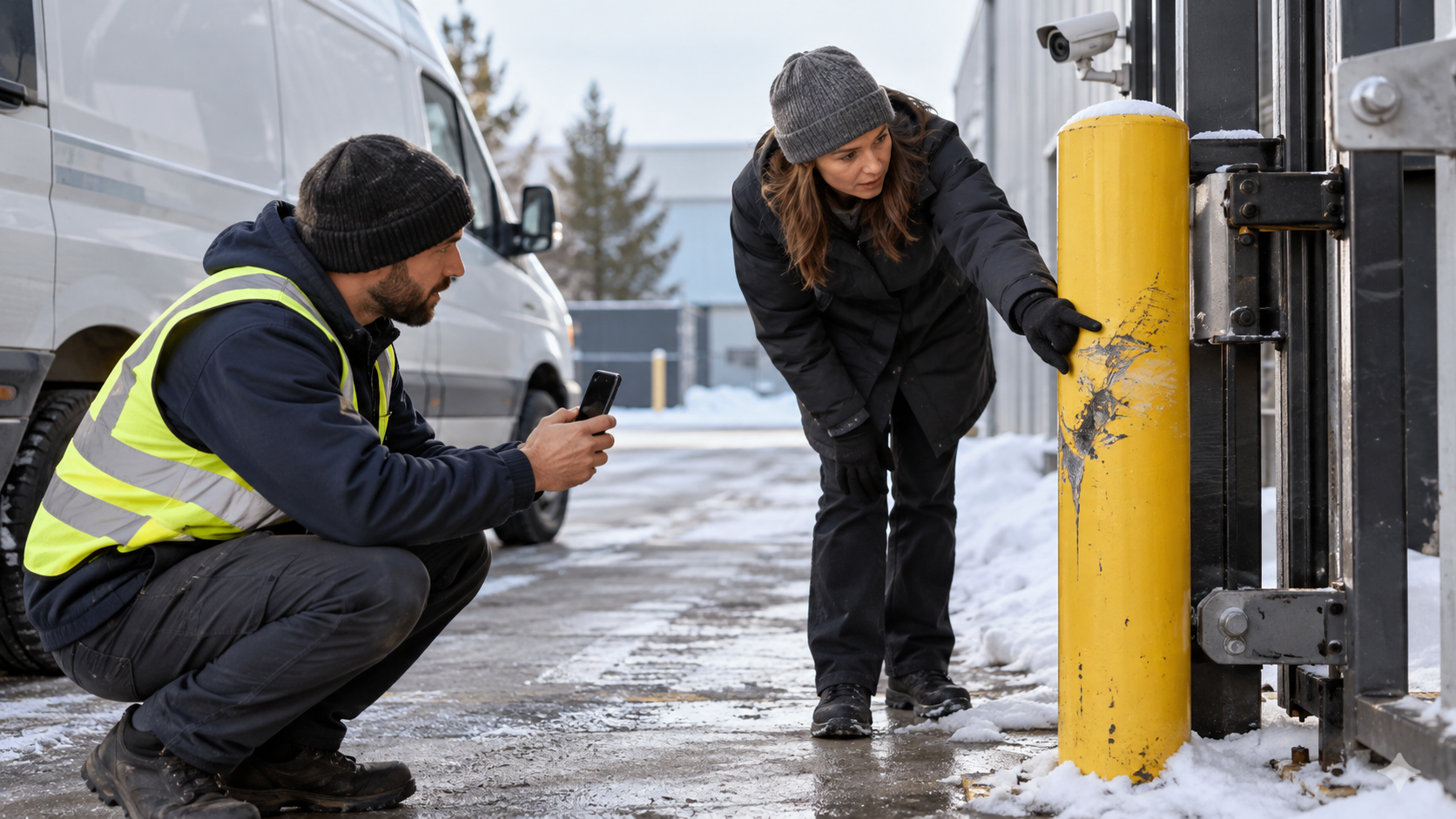
A building manager approaches a driver after a delivery and says the van struck a loading-gate post. The driver did not feel an impact and does not yet see damage on the van. The manager points to a fresh-looking mark, while a camera may cover the lane. The driver needs to take the claim seriously without converting it into a confirmed collision or dismissing it because they did not notice contact. A precise first record keeps those possibilities open for the person authorized to investigate.
To document a property damage allegation on a delivery route, get the vehicle and people to a safe position, record exactly what the other person alleges, and separately record what you observed. Notify the employer's safety, vehicle, or claims owner promptly. Preserve the relevant time, location, route, vehicle, and possible evidence sources. If you know or have reason to know an actual collision occurred, follow the applicable collision duties as well; do not wait for a claims review to address immediate legal or safety obligations.
OSHA's incident-investigation guidance supports a fact-based review of workplace events. Minnesota's collision statute sets duties when a vehicle collision occurs, including relevant property-damage circumstances. Neither source decides whether this van hit this post. The driver provides a truthful account and lets the authorized claims and official processes determine what the evidence establishes.
Secure the scene before discussing fault
If the van is moving, stop at a safe place. Check whether anyone is injured and whether the alleged damaged object creates a hazard. A bent gate, loose rail, or leaking utility fixture may need immediate property or emergency help. If traffic is blocked or a person is hurt, use official assistance. Do not stand in the van's path to debate the mark with the complainant.
If the allegation concerns a vehicle collision, follow the actual stop and information duties that apply in Minnesota. A driver should not drive away solely because they think the mark is old. Conversely, a person pointing to damage does not authorize them to detain or search the vehicle. Use the employer and official contacts when facts or obligations are unclear. Record where the van was when the allegation was made and whether it moved before photographs were taken.
Do not pay cash, promise a repair, or sign a fault statement at the curb unless the employer's authorized process directs it. Be courteous and take the claim seriously. A useful response is that you will report the concern through the company channel and give the appropriate case or contact path. Truthful cooperation does not require an instant conclusion about cause.
Build a property damage claim record
The property damage claim record should identify the claimant or reporting person, their role, the property said to be damaged, where it is, when they say it happened, and what they said they saw. Use their words when reasonably remembered, marking a quotation as approximate if necessary. Record when you received the claim and who else was present. A manager's statement is important evidence, but it remains a statement until checked.
Next, write your own observations separately. Did you see a fresh mark, loose part, or debris? Did you feel or hear contact? What was the van's route through the area? What side of the vehicle was nearest the object? If you do not know, say so. Avoid replacing a gap with a confident “no contact” merely because no alarm sounded. A slow scrape can be quiet; an old mark can also look new.
Include route and stop ID, vehicle ID, driver, approximate times, and any responder or employer case number. Use the work incident channel. Do not put a customer's address and the manager's phone number into a personal note just because the incident form is slow. The authorized owner should be able to find the delivery record from the stable stop identity.
Ask when the reporting person first noticed the damage, if it is safe and appropriate to ask. They may have seen the van touch the property, found a mark afterward, or heard about it from a coworker. Those are different accounts. Record the answer with its source, without cross-examining the person or trying to obtain a confession that the mark was old. The employer's investigator can follow up. A driver's first job is to preserve the allegation accurately enough that later questions can be asked.
If several people speak at once, identify who made each statement. “Manager says contact occurred; dock worker says they saw only the van depart” is clearer than “staff disagree.” Do not choose one account in the first note merely because that person sounded more certain. The report can contain conflicting evidence while the case owner determines what happened.
Inspect without changing the evidence
When safe and permitted, look at the alleged damage and the corresponding area of the van. Note visible marks, height, direction, paint transfer, dirt, or absence of apparent contact. A photo can help if taken from a safe position and uploaded to the approved system. Include a wider view showing the gate and van path as well as a close view of the mark when possible. Do not scrub the van or touch the post to test whether paint comes off.
An apparent match in color or height is not proof of causation. A mismatch may be informative but still needs review. Describe what the image shows, not a verdict. If the van must be moved for safety, record its original position before the move when feasible and follow responder instructions. Do not stage it back in place later to create a cleaner photograph.
If you cannot inspect the site because the property owner asks you to leave or the area is unsafe, record that limit. The claims owner can seek access or photos later. Do not trespass into a closed area to verify an allegation. The first report can be complete about what the driver knew even when the physical evidence remains unavailable.
Make an evidence preservation request
An evidence preservation request may involve vehicle cameras, dashcam footage, telematics, dock cameras, delivery scans, or maintenance records. Tell the employer's authorized owner the relevant time window and camera location. Do not personally download or alter footage unless the process assigns that task to you. A routine overwrite can erase useful evidence, so prompt notice matters even when the allegation seems doubtful.
If a building manager mentions a camera, record where it points and who controls it. Do not demand access, promise that the company will pay, or ask the manager to post footage publicly. Claims or official responders can request it through the proper channel. If a witness offers a photo, route it to the authorized case owner and record who supplied it.
Preserve relevant messages and route records by reference to their work-system IDs. A stop completion time may show when the van was nearby, but it does not prove the exact path or contact. An app route map may be approximate. Let the investigator compare sources while the driver maintains a clear firsthand timeline.
Time zones and device clocks can complicate a later comparison. Give the approximate local time of the maneuver and note any time shown on the route app, camera, or dock log without assuming they are synchronized. The claims owner can align them. If a camera overwrites quickly, prompt notice of the narrow window matters more than the driver's attempt to obtain the footage personally. Do not send a screenshot of the entire route to establish one time when the accepted stop record can be referenced.
Work through a loading-gate example
Imagine a Saint Paul driver leaves a business dock after a signed handoff. The property manager says the van backed into a gate post. The driver recalls backing slowly but felt no impact. They stop safely, check people and the gate, photograph the post and rear corner under the employer's procedure, and notify the vehicle and claims owner. The report records the manager's allegation, the driver's path and observations, the time, vehicle ID, and the possible dock camera.
Dispatch pauses the route long enough to decide whether the van needs inspection. The delivered parcel remains delivered because its handoff was verified; the property claim does not undo that event. The remaining parcels stay in the driver's custody unless an authorized transfer occurs. The driver does not mark another stop attempted to account for the delay.
Now change one fact: a visible scrape on the van aligns with the post and the driver remembers a bump. There is now reason to treat the event as an actual collision. The driver follows Minnesota's applicable collision duties and the employer's collision response, not only the allegation workflow. The original manager statement remains part of the case, but the new evidence changes the next required action.
Keep delivery facts separate from property facts
A property complaint and a delivery event may occur at the same stop, but they answer different questions. The parcel may have been handed to a receiver before the alleged damage, left at an approved point afterward, or still be in the van. Record the actual parcel movement through the route system. Do not alter proof or status to make the property incident easier to explain.
If the driver was still scanning when the manager approached, the app submission may be uncertain. Preserve the attempted action and ask support to check the accepted state before another write. A claim that the van touched a gate does not prove whether a proof image uploaded. Keep the route record and claims record linked by time and stop ID, with each holding its own evidence.
If the alleged damage causes a site closure or another driver cannot use the dock, tell dispatch. That may affect later deliveries independently of fault. The route owner can choose another authorized access point or delay while the property owner secures the area. Do not direct another driver through a damaged gate based on an assumption that it still works.
Do not resolve the claim at the curb
The reporting person may ask for an insurance card, supervisor's number, or immediate admission. Follow the employer's information-sharing instructions and any applicable legal duties. Give required details accurately. Do not disclose customer route information, personal coworker contacts, or speculative policy limits. The claims owner can provide the formal channel for estimates, repairs, and follow-up.
If the manager is angry but not threatening, keep the conversation brief and factual. If they block the driver, threaten harm, or demand a package as collateral, move to safety and use the threat procedure. An allegation can become a separate safety incident. Do not trade a parcel or private data to settle a property dispute.
If police attend, provide truthful observations and the available vehicle and case information. A police report may be one source in the claims process, not a substitute for notifying the employer or securing parcels. Record the agency and reference when provided. Avoid claiming that the absence of a citation proves the van caused no damage.
Report uncertainty and later findings
An allegation may be resolved by footage showing no contact, a maintenance record showing older damage, or evidence that the van did strike the object. Add each new finding with its source and time. Do not rewrite the driver's first note as though the conclusion was known from the start. The timeline should show how the understanding changed.
If the claim remains open, keep a named case owner and next action. A supervisor saying “we'll look into it” is not a final finding. Ask whether the vehicle can continue, whether footage has been preserved, and whether the property owner has a contact path. The driver may finish the route while the insurer reviews the claim, or the van may be held for inspection. The actual instruction controls.
Do not contact the property owner privately after shift to argue about the damage. Use the claims channel. A private message can produce inconsistent statements and leave the employer unaware of a changed allegation. If the property owner contacts the driver directly, forward the new information through the case and avoid making promises outside authority.
If the property owner later supplies a repair estimate, treat it as claim information for the authorized owner, not proof that the van caused the damage. The estimate may describe necessary work but not the event's cause. Likewise, a photo of the post taken after the van left may show condition without showing when it arose. These distinctions should be stated plainly in the case. The driver need not evaluate repair prices or insurance coverage from the route.
Check the vehicle before continuing
Even if no impact is confirmed, an allegation involving the van merits a safe vehicle check under the employer's procedure. A loose mirror, damaged light, tire issue, or bent step can affect roadworthiness. If the manager points to a low post, inspect the corresponding area without crawling under an unsafe vehicle. Report visible defects and ask the vehicle owner whether the van may continue.
If the van is taken out of service, arrange a controlled parcel handoff. Count remaining items, identify any uncertain scans, and record the receiving driver or depot. Do not treat the claims case as the route transfer record. The two processes share the vehicle and time, but each needs its own accepted outcome.
If the van continues, tell dispatch when the driver actually departs and which stop comes next. A claims delay is not a failed delivery attempt. Customer-facing updates should use the route owner's approved language. Keep the next parcel's status tied to what happens at its own stop.
If another vehicle is assigned, verify its route and driver identity before scanning new stops. An allegation may cause the original van to be inspected while the digital route remains active. The replacement driver should receive the accepted stop history, remaining parcel count, and any uncertain event. A vehicle swap does not establish the claims outcome, and a claims case does not automatically reconcile delivery records.
Ask about property-claim support when comparing roles
Applicants can ask how an employer handles allegations that a driver damaged a gate, lawn, railing, or parked vehicle. Who receives the first report? How is camera footage preserved? Who speaks to the property owner and insurer? Can a driver get a case acknowledgement? A clear path helps drivers report uncertainty honestly instead of feeling they must instantly admit or deny fault.
The Saint Paul delivery driver Careers hub provides local role context. The published delivery job-offer review guide can help candidates ask about vehicle and claims support. Active drivers should follow their employer's current incident process and Minnesota's applicable collision duties when actual contact is known or reasonably suspected.
A good first record preserves two voices: what the reporting person alleges and what the driver personally saw, heard, and did. It names the vehicle, place, time, possible evidence, and parcel custody. The claims owner can investigate without a rushed curbside verdict. If later facts establish a collision, the response expands accordingly while the original account remains intact.