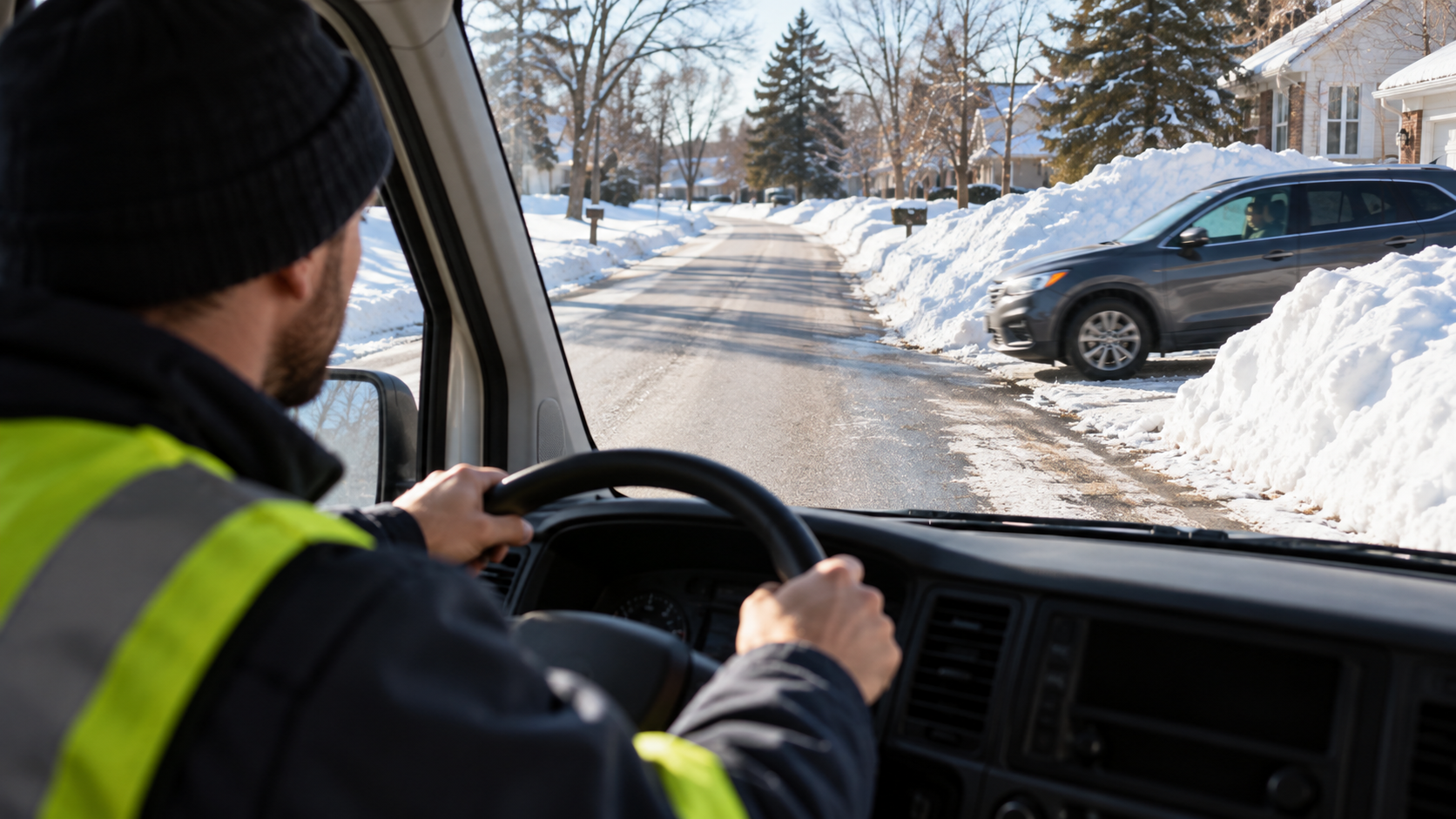
A van brakes hard when a vehicle emerges from a driveway hidden by a snowbank. Neither vehicle makes contact. No parcel falls and no one reports an injury. The driver could simply take a breath and continue. Yet another driver may approach the same driveway under the same conditions tomorrow, and the first driver's account may be the only timely description of the hazard. A near miss is most useful when it produces a specific safety action rather than a vague story about a close call.
To handle a delivery driving near miss with no damage, first get to a safe position and confirm that there was no contact, injury, or property damage. Check the load and vehicle only when it is safe. Report the location, sequence, and contributing condition through the employer's safety channel, separating observed facts from guesses. Ask who will review the hazard and what change, if any, should affect the current route or future drivers.
OSHA's hazard-identification practices describe near-miss reports as useful inputs for recognizing hazards. That is general workplace guidance, not a special legal classification for a delivery driver's event. If the driver discovers actual contact, an injury, or damage, the response changes; Minnesota's collision duties may apply. The first job is to establish which event occurred, then use the correct process.
Make the immediate safety check
After the evasive action, drive or stop only as traffic and the vehicle allow. Do not pull into a live lane to begin a report. Use a safe location, set the brake, and check yourself and any passenger. A hard brake can cause a delayed ache or move a loose parcel even without a collision. If anyone is hurt or another vehicle or object was struck, treat the event under the employer's collision and emergency procedures rather than the no-damage near-miss workflow.
Look for visible vehicle or load changes when it is safe to do so. A parcel that shifted off a shelf may need inspection or securement; the near miss may have caused a package issue even though no vehicle was damaged. Do not open sealed packages to check contents without authorization. If you cannot confirm the load state at the roadside, tell dispatch what remains uncertain and inspect at an approved safe place.
Take a moment to regain attention before continuing. A driver startled by the event may need a break or supervisor support. Tell the route owner if you cannot safely drive. There is no value in producing a safety report while immediately entering the next hazardous turn without a clear plan.
If another road user stops to speak with you, keep the exchange brief and safe. You can confirm whether anyone needs help and whether contact occurred without debating fault in a traffic lane. If their account differs from yours, record the difference and notify the supervisor. Do not let a social exchange replace the physical check for damage or the employer's reporting process. A calm conversation can be useful, but a near-miss classification still rests on verified facts.
Confirm that no collision occurred
The distinction between a near miss and a collision depends on facts, not on whether the vehicles look damaged. Ask whether your vehicle touched another vehicle, pedestrian, cyclist, fixed object, or property. Consider whether a mirror, step, or load made contact that was not visible from the cab. If you are unsure, report the uncertainty and seek the employer's instruction. Do not label the event “no contact” solely because you heard no impact.
If another person reports that contact occurred, take that statement seriously and use the appropriate collision response while facts are checked. A scrape may be difficult to see from one angle. If someone reports an injury after the initial check, update the event and seek help. The near-miss report should not become a way to avoid an actual collision duty.
When there is genuinely no contact, injury, or damage, the driver can focus on hazard reporting and route safety. That does not mean a police or claims process is automatically needed. Follow the employer's policy for near misses and any official instruction given at the scene. Avoid making legal conclusions from a short article or from another motorist's opinion.
Write a delivery near miss report
A delivery near miss report needs the date, approximate time, route, precise location, direction of travel, what the driver observed, what action they took, and how the event ended. A useful account might say: “Northbound on the service road, the right-side driveway view was blocked by a snowbank; another vehicle entered; I braked and stayed in my lane; no contact observed.” That tells a reviewer where to look and which condition may recur.
Record weather, light, road surface, lane markings, sight lines, and temporary obstructions only when they mattered. A photograph of a snowbank from a safe, legal position may help if the employer requests it. Do not stop in traffic or photograph a stranger's face to make the report more dramatic. The report should support prevention, not accumulate unnecessary personal data.
Separate the other person's action from your interpretation. “Vehicle entered from the driveway” is observable. “The driver was distracted” may be a guess unless you actually saw reliable evidence. Likewise, describe your own speed and distance as approximate if you did not measure them. A candid account of your maneuver is more useful than a claim that every reaction was perfect.
Identify the repeatable hazard
The event's value lies in what might happen again. Was a turn blocked by parked trucks, a snowbank, poor lighting, a blind driveway, or a routing instruction that sent vehicles through a narrow lane? Did the driver approach too quickly for the available sight distance? Could a loading location be changed? The report should distinguish a one-time movement by another road user from a stable condition that the employer can address.
Do not force every near miss into an infrastructure explanation. Sometimes the useful control is a driver behavior change, such as approaching a recurring driveway more slowly or choosing a safer place to stop. The supervisor may also find that the route plan, vehicle setup, or schedule created pressure. The driver should report the facts without protecting a preferred explanation.
If the hazard belongs to a public road or another property, the employer may not be able to fix it directly. It can still adjust route guidance, change a stop approach, notify the appropriate owner, or train drivers on the condition. Name the location clearly so someone can verify whether the same risk applies to other routes.
Map the point of surprise, not only the nearest street address. A large property may have several driveways, and the unsafe view may occur only on the northbound approach. Identify the lane, turn direction, and where a driver first has enough sight distance to react. If a route instruction names the wrong entrance, include that discrepancy. A reviewer who visits the right building but the wrong driveway may conclude there is no hazard. The details help separate a route design issue from a temporary snow or parked-vehicle obstruction.
The driver can also report whether a safer alternative was actually available at the time. “I could have used the west entrance” is different from “the west entrance was locked.” Do not propose a detour through private property without approval. The safety owner can compare alternatives against vehicle size, legal turns, delivery access, and traffic conditions before changing route guidance.
Ask for a hazard control follow-up
A hazard control follow-up should name who will review the report, what action is being considered, and when the driver should expect a route instruction. “Be careful there” may be too vague if the blind driveway is part of a repeated assigned approach. A concrete result could be a revised turn, a different loading point, a note to slow before the sight obstruction, or an escalation to the property or roadway owner. The right action depends on the actual hazard.
The driver does not need to design the whole safety program. Ask whether the report was received and whether the current route should change. If the same stop is coming later that day, a timely dispatch decision matters more than an end-of-week summary. If the issue affects only future routes, make sure the safety owner has the location and observation needed to assess it.
Do not treat a submitted report as proof that a control was installed. A hazard can remain while the review is open. Use the current safe route instruction and alert the next driver if the employer's handoff process requires it. If the promised control does not appear, follow up with the case reference rather than assuming someone else noticed.
A useful follow-up also tests whether the chosen action reaches drivers at the point of need. A note in a safety portal that nobody checks before turning into the driveway may have little effect. Ask how the route app, dispatch briefing, or stop instruction will show the new approach. The employer may choose another method, but the driver should know where to look. If the instruction arrives after the next route is already underway, tell the owner so timing can be improved.
If the report closes with “no change,” ask for the reason and the current safe approach. The reviewer may find that the apparent hazard was temporary or that the proposed detour creates a different risk. The driver does not need agreement on every suggestion, but they do need a clear instruction for the next assigned visit. Record the outcome against the original location and case.
Keep route and parcel status accurate
A near miss may delay deliveries, but it does not itself make a stop attempted, failed, or completed. Tell dispatch the last verified stop, next stop, and whether the load is secure. If a parcel shifted or was damaged during braking, report that as an item condition under the separate package workflow. The safety report should link to the route only where necessary.
If the event happened during a scan or proof upload, the app state may be uncertain. The driver may have set down the device before seeing confirmation. Preserve the attempted action and ask support to check the accepted record before another write. The near-miss label does not establish what the delivery system received.
If the vehicle must be checked or the driver needs relief, arrange the route handoff through dispatch. Record physical parcel custody separately from the near-miss narrative. A replacement worker needs the load and route state, while the safety owner needs the hazard sequence. One vague “close call” message cannot serve both purposes.
Work through a snowy-driveway example
Imagine a Saint Paul driver traveling past a row of businesses after fresh snow. A snowbank narrows the view of a shared driveway. A car noses out; the driver brakes hard and stops without contact. They move to a safe parking area, check themselves and the load, and find no injury or damage. They record the driveway location, direction of travel, snowbank position, other vehicle movement, and their braking response in the approved near-miss channel.
Dispatch sees that the same approach appears on another driver's afternoon route. The supervisor may ask for a different approach or warn the second driver while a longer-term review is opened. The first driver should not write “snowbank removed” or “route fixed” unless that result is verified. The report has value even before the control is chosen because it identifies a place and condition that can be checked.
Now change one fact: after parking, the driver sees a fresh scrape on the van's mirror and a similar mark on a parked vehicle. The event is no longer a confirmed no-contact near miss. The driver updates the report and follows the collision process, including the applicable Minnesota duties and employer notification. The earlier observation of a blind driveway remains relevant, but it does not replace the actual contact response.
Avoid blame language in the first account
A near-miss report is easier to use when it records behavior and conditions without declaring a villain. “Another vehicle crossed the lane line” is more precise than “reckless driver nearly killed me” when the driver cannot know the other person's intent. The same applies to the reporting driver: state whether you were turning, braking, or looking for an address rather than editing your actions out of the story.
This matters because supervisors may compare multiple reports from the same location. A consistent description of where visibility fails can reveal a route design problem. A series of emotional labels may conceal the common geometry. Human reactions belong in the account when they affect fitness to continue, but the hazard analysis should rely on observable details.
Do not withhold a near miss because you fear it will be treated as a collision or a disciplinary admission. Use the employer's actual reporting policy and state the facts. If the report process seems unsafe or punitive, raise that concern through the designated safety or worker channel. An unreported recurring hazard can surprise the next driver.
Check repeated reports and later conditions
The same near miss may recur in different weather or traffic. If the driver later encounters the location after a control is introduced, report whether the relevant condition changed. A route note saying “use west approach” is useful only if that approach is still available and safer. If construction closes it, the safety owner needs a fresh observation, not an assumption that the old fix still works.
Avoid repeating the original report unchanged each time a driver passes the location. A new event should add new facts: date, conditions, actual evasive action, or a failed control. If nothing happened, a brief hazard observation may be enough under the employer's process. The aim is to help the owner judge whether the risk persists and which response is working.
If another worker reports an actual collision at the same place, link the near-miss case through the official safety channel. Do not edit the old report to make it predict the later event perfectly. Its original time-stamped observation is valuable as it was. The later incident has its own facts and duties.
Ask about near-miss support when comparing driver jobs
Applicants can ask whether an employer has a near-miss channel, who reviews it, and how a driver learns of a route change. Can a driver pause a stop that appears unsafe? How are seasonal hazards such as snowbanks or poor lighting communicated to the next route? These questions show whether the operation turns drivers' observations into usable guidance.
The Saint Paul delivery driver Careers hub provides local role context. The published delivery job-offer review guide can help a candidate ask about safety support and route expectations. The employer's current policy controls how a driver files and follows a near-miss report.
An event with no impact can still identify a precise hazard. The driver checks that no collision or injury occurred, records the observed sequence, and asks for a named safety follow-up while keeping the delivery route accurate. If later facts show contact or harm, the driver changes process promptly. The report should help the next worker approach the same place with better information.