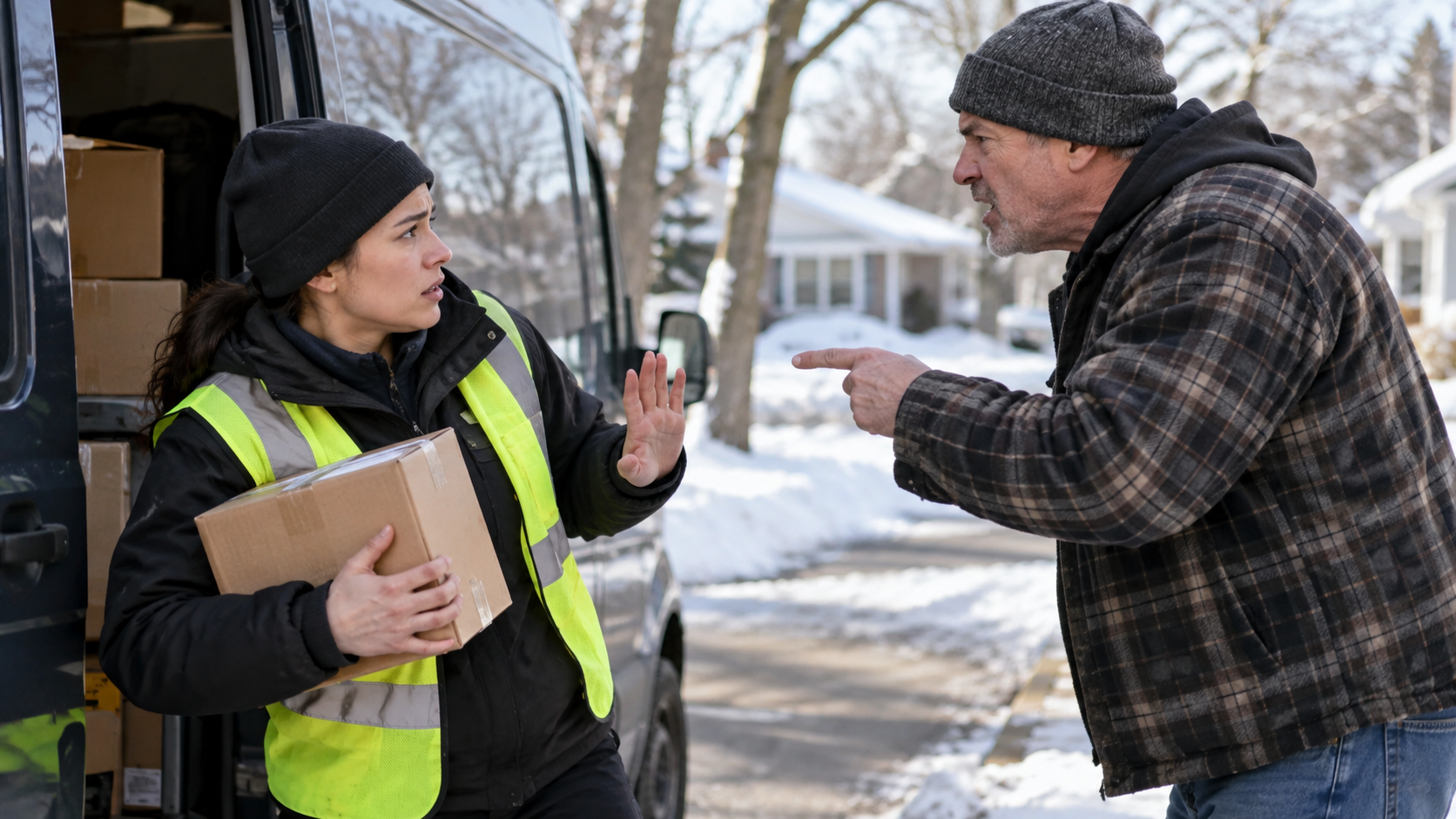
A driver parks for a delivery and a person approaches, angry about the vehicle's position. The person steps closer, blocks the path to the van, and says the driver will be hurt if they do not leave. The parcel is still in the driver's hand. Whether the person is a customer, neighbor, or stranger is not yet clear. The driver needs a response that protects them without inventing a completed delivery or turning an argument into a physical contest.
To handle a threatened confrontation during a delivery stop, prioritize a safe exit and seek emergency help if danger is immediate. Do not argue over the package or parking space while someone is threatening you. Once safe, notify the employer's designated safety and route contacts, preserve the exact words and actions you observed, and confirm the parcel's location. The route owner can decide whether the stop is held, reassigned, or attempted later under a safer plan.
NIOSH's workplace-violence material treats threats and violence as occupational safety concerns. NIOSH has also identified customer violence and robbery as delivery-worker risks. Neither source supplies a universal script for every encounter. The safe action depends on the person's behavior, exit options, immediate danger, and the employer's training. A driver should use emergency services when the threat warrants it rather than waiting for a route ticket to be reviewed.
Recognize when the interaction becomes a threat
A complaint about parking can be handled through ordinary conversation when the person is not threatening. The situation changes when someone threatens harm, moves to block an exit, reaches for the driver or parcel, displays a weapon, or follows after the driver tries to leave. Do not wait for physical contact before treating the stop as unsafe. The driver does not need to prove the person intended to act on the threat before moving away.
Describe behavior rather than assigning a label in the first report. “The person said, ‘I will hit you,’ stepped between me and the van, and raised a fist” is more useful than “aggressive customer.” If the driver cannot recall exact words, say they are approximate. Avoid guessing whether the person was intoxicated, mentally ill, or connected to the recipient. The employer and responders can investigate identity later.
If the person simply asks a question or disputes a delivery status without threatening behavior, use the normal customer or access process. Safety reports should not turn every difficult conversation into a threat. A factual threshold helps protect drivers while keeping the record credible.
Use safe stop withdrawal
The safe stop withdrawal is a move toward a place where the driver is less exposed, such as the vehicle, a staffed location, or another safe public area, when that path is open. Keep distance and avoid sudden actions that escalate the encounter. Do not push past someone blocking a narrow doorway to rescue a parcel. If the vehicle cannot be reached safely, do not force your way to it. Call for help from the position available.
Do not chase a person who takes a parcel or tries to run away. Do not use the package as a reason to remain in a dangerous area. An employer may have specific de-escalation training; follow it if safe to do so. A short, neutral statement that you are leaving and will contact support may help, but no script guarantees safety. The driver's attention should stay on an exit and immediate help.
If danger is immediate or a weapon is involved, call emergency services. Provide your location and the behavior you observed. Follow dispatcher instructions. Once police or other responders take over the scene, cooperate and give accurate facts. Do not resume deliveries because the person walked away until the route owner and, where relevant, responders have cleared the next step.
If the driver cannot safely speak on the phone, use the emergency options available and the employer's training when possible. Do not stay in view of the threatening person just to complete a detailed route report. The first communication can be short: exact location, immediate danger, and whether anyone is hurt. A fuller account can follow after the driver is secure. Tell responders about the loaded vehicle or package only when it helps them manage the scene; do not make parcel recovery their first task while someone remains at risk.
Account for the parcel after reaching safety
When safe, identify the parcel's actual location. It may still be in the driver's hand, in the vehicle, at the doorstep, or with a person who took it. Do not mark the stop delivered because the parcel reached the property before the threat. A delivery status should describe the real handoff or drop under the task's rules. If the person grabbed the item, report that physical event without calling the person an authorized recipient unless they were verified.
If the driver left the parcel while withdrawing, tell dispatch where it was last seen and why it could not be retrieved safely. Do not return alone to recover it while the threat may remain. The route owner can coordinate a responder, supervisor, or later recovery. A new scan cannot make an unsafe custody gap disappear.
The rest of the load also matters. If the vehicle is accessible, secure it under the employer's instructions. If it is blocked or the keys are with the driver at another location, tell dispatch. The route may need a relief worker or controlled transfer. The safety decision comes first; parcel accounting follows as soon as the driver can provide it safely.
Make a threat incident report
A threat incident report should include route and stop ID, time, location, where the driver and person stood, the words and actions observed, whether the person touched anyone or took property, and how the driver reached safety. Record any witness or responding officer reference. Note whether the driver reported injury or distress that affects fitness to continue. Keep firsthand facts distinct from what a witness or coworker later said.
If a vehicle or parcel was involved, identify it through the work system rather than copying a full customer label into a personal note. The report should say who was contacted and when. A police case number and an employer safety ticket may be separate records; link them by reference if the process allows. Do not assume one automatically reaches the other.
Report a description only to the extent it helps authorized responders identify the event. Avoid speculative personal traits or accusations. A person may be a building employee, resident, or unrelated passerby. If their role is unknown, say so. The goal is to preserve what happened, not to write a verdict at the curb.
Use the correct route exception
An unsafe stop should be recorded under the employer's actual safety or threat procedure. Do not choose a customer-refusal or inaccessible-address code if it misstates the event. The customer may have had no involvement at all. If the app lacks a suitable option, ask dispatch for a linked note and a safe status. A wrong code can generate a misleading customer message and make a later attempt harder to plan.
Give the route owner the last verified completed stop, the affected parcel's custody, and whether any app action was attempted during the encounter. If a proof upload or scan was interrupted, its acceptance may be uncertain. Support should reconcile the destination state before another write for the same package. The first driver should not replay a scan from a safe location to make the route card look tidy.
The next delivery on the route may be safe, but the driver may not be ready to continue. Tell the supervisor honestly whether you can drive. The employer can reassign stops or arrange support. A schedule target does not override the driver's safety or the need for a truthful incident record.
Work through a parking dispute example
Imagine a Saint Paul driver stops in an approved loading area outside an apartment building. A person approaches and says the van is blocking them. The driver begins to explain, but the person steps into the driver's path, threatens to hit them, and reaches toward the parcel. The driver moves away without debating the parking rule, reaches a safe staffed lobby, and calls for emergency help if the threat is immediate. They tell dispatch where the van and parcel are.
The driver reports the person's words as closely as remembered, their movement, the time, and the route stop. The package remained in the driver's hand, so it is undelivered. Dispatch holds the stop and decides whether a later attempt needs another entry or staff support. The person may not be the recipient; the driver does not identify them as such merely because they were near the building.
Change one fact: the person grabbed the parcel before the driver withdrew. The safety response remains the priority, but the custody report changes. The driver gives the last known item location and observed taking to the employer and responders. They do not mark the package delivered unless an authorized recipient handoff is independently established. A theft or loss investigation may follow, but the driver should not confront the person to retrieve it.
Keep customer contact controlled
The customer may ask why the parcel was not delivered. The driver should use the employer's approved customer-facing channel and let the route owner decide what to disclose. Avoid accusing a named resident based on a person's presence at the stop. A customer-facing message can state that the delivery could not be completed safely and that support will provide the next instruction, if the employer authorizes that wording.
Do not call a customer from a personal number to ask whether the threatening person lives there. That may reveal the driver's private contact and escalate a dispute. Dispatch or safety staff can handle verification. If the customer independently reports a confrontation, preserve their account separately from the driver's observations. The two may differ without either being edited to fit the other.
If an authorized recipient later offers to meet at another location, the route owner must confirm that the alternate method is safe and permitted for the package. A threat at one entrance may affect the whole property for that shift. Do not return alone because the customer says the person has left. A named supervisor should own the reattempt decision.
Preserve evidence without creating new exposure
If the vehicle has a camera, body camera, or work-app log, tell the safety owner what time window matters. Do not edit or delete footage. A driver should not stay near the threatening person to record a better video. A photo or recording is useful only when it can be made safely and under employer policy. Your firsthand description is evidence even without an image.
Witnesses may be willing to speak to a supervisor or officer. Record their name or role and contact only as the approved process allows. Do not ask bystanders to publicly post footage or identify the person on social media. A public accusation can expose customer location and complicate the response. Use the designated report and any official case number.
If the driver's phone or scanner was damaged or taken, report that separately as a device and data concern. Route addresses, access notes, and pending scans may be involved. The safety team handles the confrontation; security and dispatch may need to protect device access and reconcile route events. Keep those facts linked but distinct.
Plan a safe reattempt or route change
The employer should decide whether the stop can be attempted again, by whom, at what time, and with what support. A warning on the stop card should describe the observed threat and current instruction, not label an entire building permanently dangerous based on one event. If a different entrance is proposed, verify that it is permitted and does not place another driver in the same person's path.
Do not assign the original driver to return as a test of whether the person is gone. The driver may need care, time, or a different route. If the threat was directed at a particular worker, that fact matters to the safety plan. A replacement driver should receive the case reference and relevant risk without a personal text containing the customer's details.
If responders or building management provide a new fact, add it to the incident record with its source and time. Do not rewrite the first driver's account. A safety plan can change as evidence develops. The next driver needs the current plan and the original hazard context, not a rumor that the situation was “handled.”
Review whether the person could approach the vehicle at a different stop on the same block. A reattempt plan may need more than a new doorway if the confrontation involved the driver or van rather than the specific entrance. Dispatch can choose a different time, worker, or approved pickup method. The driver should describe what the person said and where they moved so the safety owner can assess that broader exposure. Do not independently map or follow the person's movements after leaving the scene.
Check the driver's condition after the event
A threat can leave a driver shaken even without physical contact. Ask for medical or other support under the employer's process if symptoms or distress affect safe driving. If there was a shove, fall, or injury, use the injury-reporting and care workflow. Do not hide a physical event inside a generic customer complaint. The supervisor should know whether the driver can operate the vehicle and make sound route decisions.
If the driver took a break or left the route, record the vehicle and parcel custody. A route handoff should identify which stops were verified, which were held, and which items physically transferred. The employer's safety case and delivery route may have different owners; both need the event's actual time and location.
Follow up on the case after the immediate danger passes. Ask who owns the reattempt and what information, if any, should be shown to future drivers. A report acknowledgement is not the same as a safety plan. If the driver's work assignment changes because of the event, use the official schedule or supervisor channel rather than relying on informal promises.
Ask about threat support when comparing driver jobs
Applicants can ask what a driver should do when a person blocks an exit or threatens harm during a stop. Is there a quick safety contact? Can a driver leave without a penalty for an incomplete delivery? Who decides the reattempt and customer communication? How are drivers trained to preserve a truthful route record while withdrawing? These questions reveal whether the operation has a usable safety path.
The Saint Paul delivery driver Careers hub provides local role context. The published delivery job-offer review guide can help a candidate ask about safety and dispatch support. An active driver should follow the employer's current threat and emergency procedures and seek official help for immediate danger.
The stop's outcome can be recorded after the driver reaches safety. First establish distance and help, then report what the person did, where the parcel is, and which route action remains open. A named safety owner can plan the next attempt. The driver should not have to choose between personal safety and an accurate delivery history.