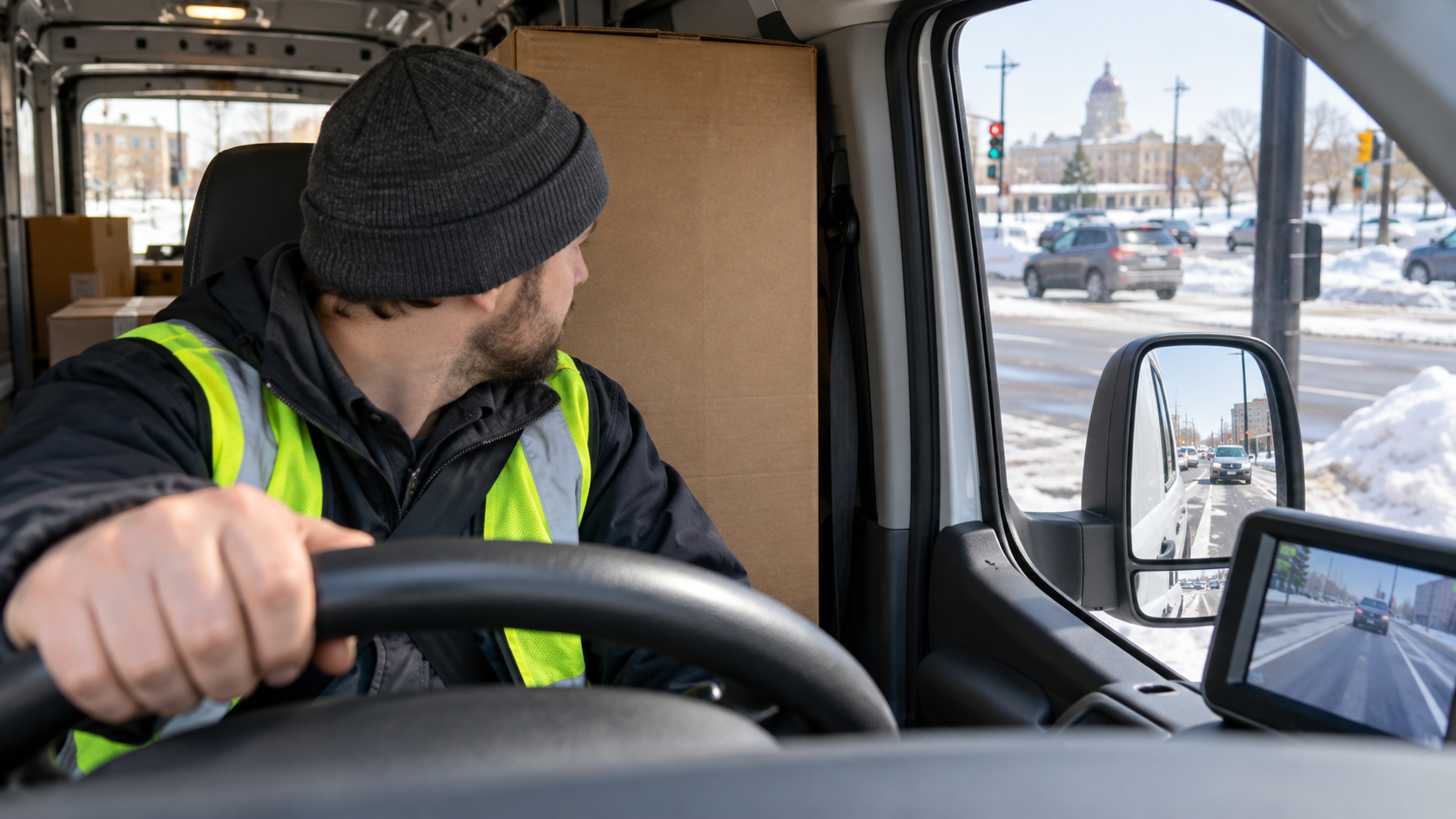
A driver places the last tall parcel behind the cab and sits down to leave. From the driver's seat, the parcel cuts across part of the right-side window. A rear camera display still works, and the side mirror reflects the next lane. The question is whether those working views answer the right problem. The camera shows the area behind the van; it does not restore the missing view through the side window at an intersection.
A Minnesota delivery driver cargo visibility check starts from the actual driving position. The driver identifies which view or control the load affects and whether the item can shift into a worse position. A parcel fitting inside the vehicle proves only that it fits. It does not prove that the driver can see what the route requires, reach the controls, exit normally, or keep the load in place.
This is a placement decision before movement, or after a stop if the load has shifted. It is separate from asking how much weight a van can carry, whether an oversized pickup may be accepted, or whether a camera has malfunctioned. A working camera can coexist with a badly placed load. The driver should correct the placement or ask for an approved loading plan before taking the vehicle onto the road.
Begin the check from the driver's normal seat position
Set the seat and mirrors as they would be used for driving, then look ahead, to both sides, and through the available rearward system while the van is parked. Identify a specific obstruction: a box at the passenger window, a stack rising above the partition, loose parcels at the footwell, or freight pressed against a mirror sightline. “The van seems crowded” does not tell a loader what to move. “The top box blocks the lower right corner of my side-window view” does.
Do not lean unusually far forward or sideways to make a blocked view appear usable. A driver may briefly change posture to inspect a blind area at a stop, but a loading decision should work with a normal seated position and the vehicle's intended mirrors and displays. Check the view at the angle used when entering traffic or turning, not only while looking straight down an empty aisle. The parked test will not reproduce every road condition, but it can reveal an obvious problem before departure.
Keep the assessment about what is visible and what is not. It is easy to say “I can still see enough” when the next stop is nearby. The useful question is whether the blocked area contains information the driver needs for an ordinary maneuver. If the driver cannot answer confidently, restow or get fleet direction. A short route does not make an uncertain view acceptable.
Describe cargo obstructing driver view by direction
When reporting cargo obstructing driver view, name the direction: forward through the windshield, left-side approach, right-side approach, mirror reflection, or rearward display. These are not interchangeable. A low box across the dashboard can interfere with a forward sightline. A tall package by the passenger-side glass may hide a pedestrian near a turn. Cargo covering a rear camera lens or display creates a different problem from a load that simply blocks a direct look through a rear window.
Check from the driver's eyes, then walk around the parked vehicle. From outside, confirm that the mirror housings, cameras, windows, lights, and doors are unobstructed by the load or its restraint. Do not reach into a moving traffic lane to examine a mirror. If the van is at a roadside stop, choose a safe place and ask for help through dispatch or fleet if the inspection cannot be performed safely.
The report should say whether the load was originally placed that way or shifted after departure. “Two cartons loaded behind the passenger seat now cover the lower right window” tells the team a starting placement needs revision. “The same cartons moved forward after a left turn” adds a securement concern. The second situation cannot be solved by pushing them back once without addressing why they moved.
Make a delivery van rear-view assessment carefully
A delivery van rear-view assessment needs to distinguish an intentionally enclosed cargo body from a new obstruction. Many vehicles cannot provide a direct view through a rear window when loaded or built with a solid partition. Minnesota's rear-view mirror rule addresses a motor vehicle whose construction or load obstructs the driver's rear view and calls for a mirror or other technology showing the highway for at least 200 feet behind. The rule is about the required rearward view, not a promise that every rear window must remain clear.
Use the equipment fitted to that vehicle as intended. Verify that the mirrors are adjusted and usable and that a required camera or display is functioning where the vehicle depends on it. If a display is dark, delayed, or covered, report the equipment fault as well as the load condition. Do not assume a camera repairs a blocked forward or side view. If a load obscures the rear window but the vehicle's required rearward view remains available through its approved equipment, describe that fact without declaring universal compliance; fleet can assess the vehicle and operation.
Reverse maneuvers deserve special caution. A rearward view that meets a roadway requirement does not reveal every person or low object immediately behind a van. Follow the employer's backing policy and vehicle manual, use a safe spotter where required, and avoid reversing when the view is uncertain. A cargo adjustment should not become an excuse to skip the usual backing checks.
Check controls, movement, and exit as well as windows
Visibility is the main question, but a load that reaches the cab may also interfere with steering, pedals, a seat belt, an emergency control, or a door. A small package on the floor can slide under a pedal even if it blocks no window. A tall box can tip forward at a stop and become an obstruction later. Secure the load under the employer's procedure and keep objects out of the driver's movement and exit path.
For covered commercial motor vehicles, 49 CFR § 392.9 addresses cargo and other objects blocking the driver's views ahead or to either side, interfering with arm or leg movement, restricting emergency accessories, or preventing ready exit. The rule's applicability depends on the vehicle and operation. The practical check applies more broadly: can this driver see, steer, brake, reach necessary controls, and exit normally with this particular load? The answer should be based on the actual loaded van.
Some vans have a partition that separates the cab from cargo. That partition may help keep packages out of the driving space when used correctly. It does not make an unstable load safe by itself or authorize stacking against a door or window contrary to the vehicle and employer instructions. If the load must be secured to fit, use approved restraints and anchor points. A driver's improvised cord across a passenger opening can create a new problem.
Work through a tall-parcel loading decision
Imagine a driver loading a van for a morning route. Six standard parcels fit on the shelves, and one tall boxed item stands near the right-side cab window. With the seat adjusted normally, the driver can see forward and in the right mirror but loses part of the view through the side glass. The first turn out of the station requires looking right across a sidewalk. The driver stops the departure process and names the blocked area to the loader or dispatch.
The team checks whether the tall item can be moved behind the partition and restrained in an approved position without exceeding the vehicle's load or blocking cargo-door operation. If it can, the driver repeats the seated view check and confirms the item cannot slide into the cab. If it cannot fit safely, dispatch may split the load or assign a suitable vehicle. The outcome depends on the actual van and employer process; a convenient route sequence does not justify leaving the box beside the driver's sightline.
Now suppose the parcel is low enough not to block the window, but its tie-down crosses the passenger door opening. The view has improved, yet the arrangement may still interfere with exit. The team needs another approved restraint plan. Suppose instead the load sits behind a solid partition and the rear window is unusable by design, while the fitted mirrors provide the required rearward view. That is a different assessment from a box newly covering a side window. The report should preserve that distinction.
Change the timing again: the tall item shifts toward the cab after a stop. The driver pulls over safely, reports the shift, and restows or gets help under the employer's cargo procedure. A departure check does not excuse a new obstruction that appears later. Record where the item moved and whether a restraint failed so the next loader does not repeat the arrangement.
Restow with custody and load order in mind
Moving one parcel can affect several other packages. Before opening a cargo door, choose a safe location and follow the company's loading and security rules. Identify the item to move and where it may be placed. Do not put it in a passenger footwell or an unsecured seat simply because that clears a window. A new location should preserve the view, keep the driver's space open, and prevent the package from shifting during ordinary travel.
If the item belongs at an early stop, route order may have encouraged the original placement. The driver can still put safety first. Dispatch can update the load plan or stop sequence if a different placement makes the package harder to retrieve. That operational inconvenience is different from permission to drive with the package beside the window. If the package cannot be restowed safely in this vehicle, a split load or different vehicle may be needed.
Maintain parcel identity while changing positions. A package moved to another van requires a real custody handoff, not just a route-board change. A package still in the original van should not be marked delivered or transferred. The visibility report need only identify the load item enough for the employer to understand the placement; it should avoid exposing customer addresses in a general maintenance channel.
Report an unresolved sightline before the route moves
A useful report includes vehicle ID, route ID, safe location, the load item or stack involved, the direction of blocked view, and what normal seated check revealed. Add whether the item is secured and whether it shifted. State which repositioning steps were tried under the employer's procedure, without claiming a fix that has not been verified. “I moved the parcel behind the partition, secured it with the approved restraint, and can now see the right-side approach from my normal seat” is a completed observation. “I think it will probably stay” is not.
Tell dispatch what work is affected: not departed, stopped between deliveries, or waiting for a replacement vehicle. Tell fleet if a mirror, camera, seat adjustment, partition, or restraint is damaged. A cargo-placement problem and an equipment fault can happen together, but they need separate facts. Describe the equipment symptom in the fleet report and the blocked sightline in the loading report so neither issue disappears when the other is fixed.
If the view remains blocked after approved restowing, ask the responsible person for a decision. The driver should know whether to leave cargo behind, change vehicles, wait for a loader, or hold the route. Record the decision source and time. An instruction sent to “make it fit” does not answer which view is blocked or how the driver can operate the van. Give the decision-maker the specific sightline and load facts again if needed.
Reassess the van as parcels leave and new ones enter
A load changes during the day. Removing parcels from one shelf can leave a tall item without the support it had at departure. A pickup may occupy the only open floor space. A driver who made a sound loading decision at the station should check again when the arrangement changes. The check can be brief while parked: look for a parcel leaning toward the cab, an item that shifted across a mirror sightline, or a loose restraint that no longer holds the remaining stack.
An early delivery may create an opportunity to restow an awkward item, but moving it to an empty shelf still requires securement. A half-empty vehicle can allow cargo to travel farther before it strikes another object. If the employer uses a defined loading zone or restraint method, use it for the new configuration. Record a shift or failed restraint when it occurs; the next route needs to know whether the initial load plan failed or the cargo became unstable after several stops.
For a pickup, assess the new item's dimensions before accepting it into the van. The question here is where the accepted item can ride without blocking the driver, not whether the route has enough theoretical cubic space. If no safe place exists, contact dispatch and follow its pickup exception or vehicle plan. Do not place a package against the side glass for a short trip with the intention of moving it later. The first turn after pickup is still part of the route.
Use a stationary check to test a proposed fix
After restowing, sit in the normal driving position again. Check the same direction that was blocked and confirm that the parcel will remain in its new place under the approved restraint method. A picture from outside the van can document placement, but it cannot show exactly what the driver sees from the seat. Conversely, a seated view can look clear while the load is loose behind the driver. Both observations matter.
If a second employee helps, ask them to stand only in a safe area while the driver checks sightlines. There is no need to stage a live traffic maneuver to prove the fix. The driver can identify the blocked direction from the stationary vehicle, then follow the employer's normal departure and intersection procedure when the route resumes. If the view remains ambiguous because of the vehicle's design or the load's shape, ask fleet or a supervisor to inspect the actual configuration before departure.
Do not record “visibility fixed” merely because a carton has moved. State the change: “Tall parcel relocated behind the partition, secured at the designated points, right-side window view checked from driver's seat, no mirror or camera obstruction observed.” The observations are specific enough for the next person to understand what was checked. They also make a later problem easier to investigate without pretending the first arrangement was safe.
Close the check with the vehicle's actual configuration
The final account should state what configuration the van has when it moves: where the tall parcel went, how it is restrained, what view was checked, and whether fleet cleared any equipment concern. If the load was split, identify which vehicle has the moved items and when custody changed. If the vehicle was held, keep the route open with a named dispatcher or loader responsible for the next action.
Drivers comparing delivery roles can use the Saint Paul delivery driver Careers hub and the published delivery job-offer review guide to ask how a team handles oversized or poorly placed cargo. On a working route, the decisive question is concrete: what does the driver lose sight of from the normal seat, and what approved change restores a usable view without creating another hazard?