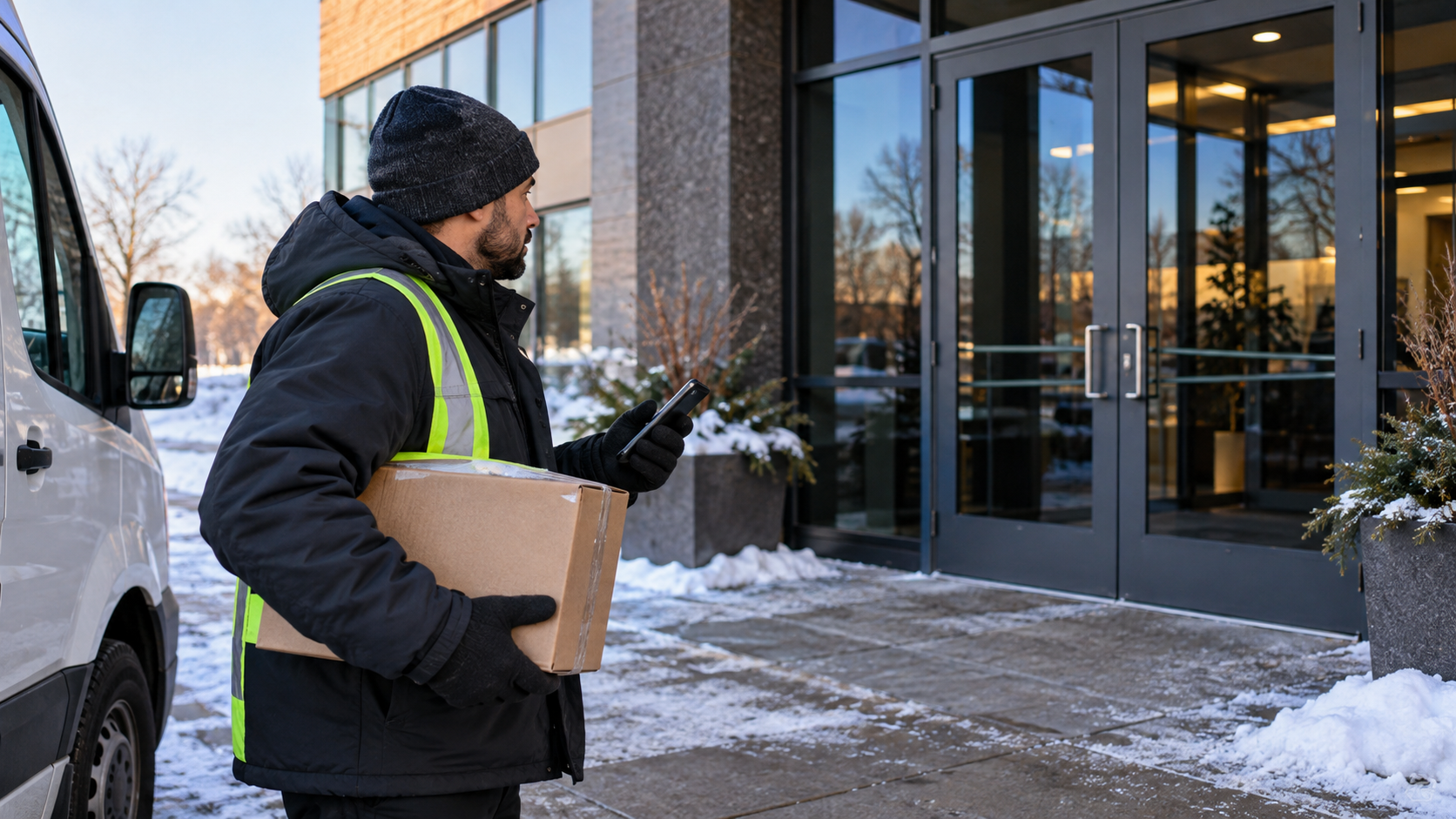
The route says to deliver during business hours. You arrive at the entrance named in the instructions, and the doors are locked. A sign gives different receiving hours, or the lobby is dark while people are still inside the building. A Minnesota delivery driver closed building entrance decision starts with three separate questions: Is there a safe, lawful place to hold the vehicle? Is another entrance authorized for this parcel? What can you honestly report if access cannot be arranged? The route's scheduled time does not by itself open a locked door.
Do not leave the vehicle in a travel lane while you work through the problem. Find a lawful stopping place, read the current signs, and follow your employer's contact process. An expected entrance may have changed hours, a receiving desk may have moved, or a temporary closure may be in effect. You need an answer tied to this address and this delivery, not a guess based on a previous stop at the same building.
This guide covers a closed expected entrance during an otherwise scheduled delivery window. It does not determine which door is the correct public entrance at a multi-tenant property; that is a separate search problem. It also does not prescribe a particular employer's route status or claim that every closed door justifies a failed attempt. Those decisions depend on the delivery instructions and the actual access options you verify.
Confirm the closed delivery entrance you were assigned
Before calling the building closed, confirm the street address, suite or receiving name, and entrance described in the task. A property can have a public lobby, a loading dock, a tenant door, and a service corridor with different hours. A door labeled with the building's name may not be the door specified for deliveries. Check the route note against the actual sign and the entrance location. Do not walk through a secured area simply because it appears to lead toward the recipient.
A closed delivery entrance is a specific observation about the assigned door at the time you arrived. It is not proof that every authorized handoff point at the property is closed.
Read any posted hours carefully. A sign may say the dock closes at 3 p.m. while the public lobby remains open until 5 p.m. That does not automatically make the lobby an acceptable parcel handoff point. Conversely, a locked lobby at 2 p.m. does not prove the dock is closed. Record which door you checked, the time you checked it, and the words on the sign. If the sign looks temporary or contradicts a saved route note, preserve both observations so dispatch can see why the instruction failed.
Use a contact method already authorized for the delivery: the listed recipient, building desk, dispatch, or employer support channel. Ask a specific question: “The west receiving door is locked at 2:20. Is there an authorized entrance for this parcel, and who will accept it there?” A broad question such as “Where do I go?” can lead to a casual suggestion that does not establish permission to leave the package. If the contact offers a different entrance, confirm its address or side of the building and the handoff point before moving the vehicle.
A security guard or another tenant may know that people usually enter through a side door. Their information can help you locate a contact, but it may not authorize that person to receive this shipment. Ask who controls the space and whether the named recipient or employer instructions permit the handoff. A driver should not place a parcel inside a door that happens to open and then describe it as accepted by the intended party.
Choose a lawful place to pause and investigate
When the door is closed, the stop may take longer than planned. The vehicle still needs a lawful place to stand. Minnesota Statutes § 169.34 identifies various prohibited stopping and parking locations, including a driveway and locations near an intersection crosswalk. Check the actual curb signs and vehicle position. The statute does not give delivery drivers a general exception to block access while they call dispatch.
Move to an authorized space before making a longer call or checking a building directory. If a loading zone is available, read its hours, vehicle conditions, and duration. A short loading allowance may not cover a prolonged search for an open entrance. Do not use hazard lights as a substitute for lawful parking. If you cannot find a safe place near the address, tell dispatch that access investigation and parking are both unresolved. The employer may need to change the stop order or arrange another time.
The NIOSH work-driving safety page offers broad context for avoiding preventable road risk on the job. Its practical relevance here is that a locked door should not push a driver into a rushed curb choice. The page does not decide whether a particular curb is lawful or whether a package may be left unattended. Apply the current signs, local rules, and employer instructions to those questions.
If the parcel requires a cart, consider the walking path from any alternate parking area. A legal space several blocks away may still be unusable for an oversized or heavy load if there is no safe route to the entrance. Report that distinction. “No legal parking within the vehicle's loading range” is more useful than “building closed” when the door is only part of the access problem. Do not leave the van where it blocks a dock while you look for a separate place to park.
Check alternate building access without assuming permission
An alternate building access path might be a staffed lobby, a scheduled loading dock, a side receiving room, or an entrance named by the recipient. Check the path against the shipment's instructions and the site contact's authority. The fact that a door is open does not answer whether a package belongs there. Confirm the handoff location, who will take responsibility for the parcel, and any required proof of delivery under your employer's process.
The alternate can also be time-limited. A dock might open at 3 p.m., but your route may not permit waiting until then. Ask dispatch whether to return later, deliver a different stop first, or transfer the parcel under an approved procedure. Do not turn an expected wait into an unrecorded personal choice that disrupts other deliveries. Give the dispatcher the actual hours posted and the distance from a lawful parking place so a useful decision can be made.
If a building contact offers a parcel room or mail area, confirm that the recipient and delivery instructions allow that drop. Some rooms are intended for tenants or particular carriers. A keypad code given by a stranger does not establish that the area is authorized for this shipment. If access requires a credential you do not have, say so and ask for an approved route. Never follow an employee through a secure door on the assumption that being let in equals permission to leave a package.
If the recipient asks you to leave the parcel outside the closed door, follow the employer's rules for unattended delivery and any shipment-specific restrictions. If those rules do not permit it, explain the limit and ask for another authorized option. A driver cannot create a valid proof of delivery by photographing a parcel in a place the receiver did not approve. When the instruction is unclear, keep custody of the parcel until the responsible party resolves it.
Describe a closed door with enough detail to act
A useful report names the exact entrance and the obstacle. “West receiving door locked at 2:20; posted hours end at 2:00; lobby desk says it cannot accept vendor packages; vehicle is in the signed side-street loading space until 2:35” gives dispatch a timeline. It separates verified facts from possible explanations. You may suspect a holiday schedule, but do not report that as fact unless a sign or authorized contact confirms it.
Include what you tried through approved channels. You might have called the listed recipient twice, used the intercom, and contacted dispatch. State whether anyone answered and what they actually said. A ringing phone proves a contact attempt, not that the building refused delivery. If the intercom directory lists a different tenant name, verify the address before deciding the parcel is misaddressed. Keep customer and building details in the employer's authorized system rather than a personal public note.
Photographs can help when policy permits them and they can be taken from a safe, lawful position. A photo of posted receiving hours may resolve a disagreement about the route note. Avoid photographing people, access codes, or unrelated private information. If a picture cannot be taken without creating a safety or privacy problem, write the sign's wording and location. The goal is a reliable account, not an elaborate evidence collection exercise.
Document any new instruction with its source. “Dispatch asked me to return after 3 p.m.” is different from “I planned to return after 3 p.m.” The former records an approved plan; the latter is your proposal. If a site representative gives a new door or handoff point, note their role and the instruction in the approved route record. Do not present a passerby's suggestion as a direction from the recipient.
Decide whether to wait, return, or defer
Waiting is useful when a reliable contact says the entrance will reopen shortly, you can remain in a lawful space, and dispatch approves the effect on the route. A sign that lists another opening time may support a return plan, but it does not guarantee that a recipient will be present then. Consider the parcel's requirements, the remaining route, and the employer's delivery window. Tell dispatch the exact tradeoff rather than asking only whether you should wait.
Returning later can work when the driver can bring the parcel back in custody and the route can be resequenced. Confirm the new time, contact path, and whether a different entrance will be used. A vague note saying “try again” leaves the next driver with the same locked door. If the closure is recurring, ask for the receiving hours to be corrected in the route instructions. Preserve the old observation until someone verifies the new one; the building may change hours again.
Deferring the stop is appropriate when no authorized access can be arranged within the available period. Use the employer's actual status choices and describe the barrier. Do not mark a customer absent if you did not reach a customer contact point, and do not mark a delivery complete when the parcel remains with you. If the system has only a broad exception category, add the precise account in its note field or contact support to learn how to record it. The record should let another person understand why this delivery was not completed.
If the parcel must be transferred to another driver or returned to a station, use the employer's custody process. A locked door does not authorize leaving the parcel in an unsecured vehicle or handing it to an unverified person. Note who accepted custody and when the transfer happened. The next route plan should include the verified entrance and hours or an instruction to confirm them before returning.
Use a worked example to separate the options
Suppose a driver reaches a commercial building at 2:40 p.m. The route note says “deliver through loading dock, 9–5,” but the dock sign says receiving ends at 2:30. The driver is parked in a lawful, signed space for a limited period. The listed recipient does not answer, while a lobby attendant says the public lobby stays open until 5 but cannot take freight. Those facts do not establish an alternate handoff. The driver should report the dock hours, contact attempts, lobby limit, and parking deadline to dispatch before choosing the next step.
Now change one fact: the recipient answers and directs the driver to a staffed receiving desk on another side of the building. The driver confirms that desk accepts this parcel and can reach it from an authorized parking space. The stop may be completed through that route if employer instructions allow it. Record the new entrance for this delivery and ask whether it should be added to future route notes. Do not assume the side desk will always be staffed.
Change a different fact: the recipient says the desk will open at 4 p.m., but the driver cannot lawfully remain at the curb and dispatch has no room in the route for a return. The available choice is to retain the parcel and use the employer's deferral process. A scheduled “delivery by 5” label does not require the driver to wait in a prohibited location or invent a handoff. State why the route schedule and the building's actual receiving hours did not line up.
These examples are hypothetical. Real sites may have different rules, and an employer may use different status names. What transfers from one route to another is the decision sequence: verify the assigned entrance, find a lawful place to pause, seek authorized access, and report the actual outcome. A closed door is evidence of an access problem at a specific place and time, not a complete explanation of every option at the property.
Update the route note after the stop
If the closure revealed a recurring mismatch, send a concise correction to the person who maintains route instructions. Include the building address, the entrance, the posted or confirmed hours, the date observed, and the authorized alternative if one was verified. Ask who can approve the change. A note should not silently replace the old 9–5 dock instruction with a guessed schedule based on one day. A temporary event or staffing gap may have caused the closure.
Before the next delivery to that address, distinguish a confirmed receiving schedule from an observation about one visit. “Dock sign read 9–2:30 on October 21” tells the next driver what was seen. “Dock always closes at 2:30” claims a standing rule that may need confirmation from building management. If a dispatcher obtained a new written instruction from the recipient, record that source and its effective date. A driver returning next week should still read any current sign, because a route note can become stale. Where a special event or holiday caused the closure, mark it as a one-day issue so the ordinary schedule is not accidentally replaced.
If several drivers report the same closed door, the route owner can ask the recipient for a reliable receiving point and window. The first driver's job is to contribute an accurate observation, not to promise a permanent fix. Keep the unresolved access question visible until the employer confirms an instruction that a later driver can actually follow.
Drivers comparing jobs can ask how employers handle closed receiving entrances, access changes, and route exceptions. The published delivery job-offer review guide helps frame questions about route support. The Saint Paul delivery driver Careers hub offers broader role information. Neither page grants access at a particular building; the actual site contact and employer's instructions govern the handoff.
Keep the final route record specific. A completed handoff should name the authorized place and recipient or allowed drop method. A deferred stop should name the closed door, time, contact path, and custody of the parcel. That record protects the next attempt from repeating the same guess and gives the employer a concrete route problem to solve.