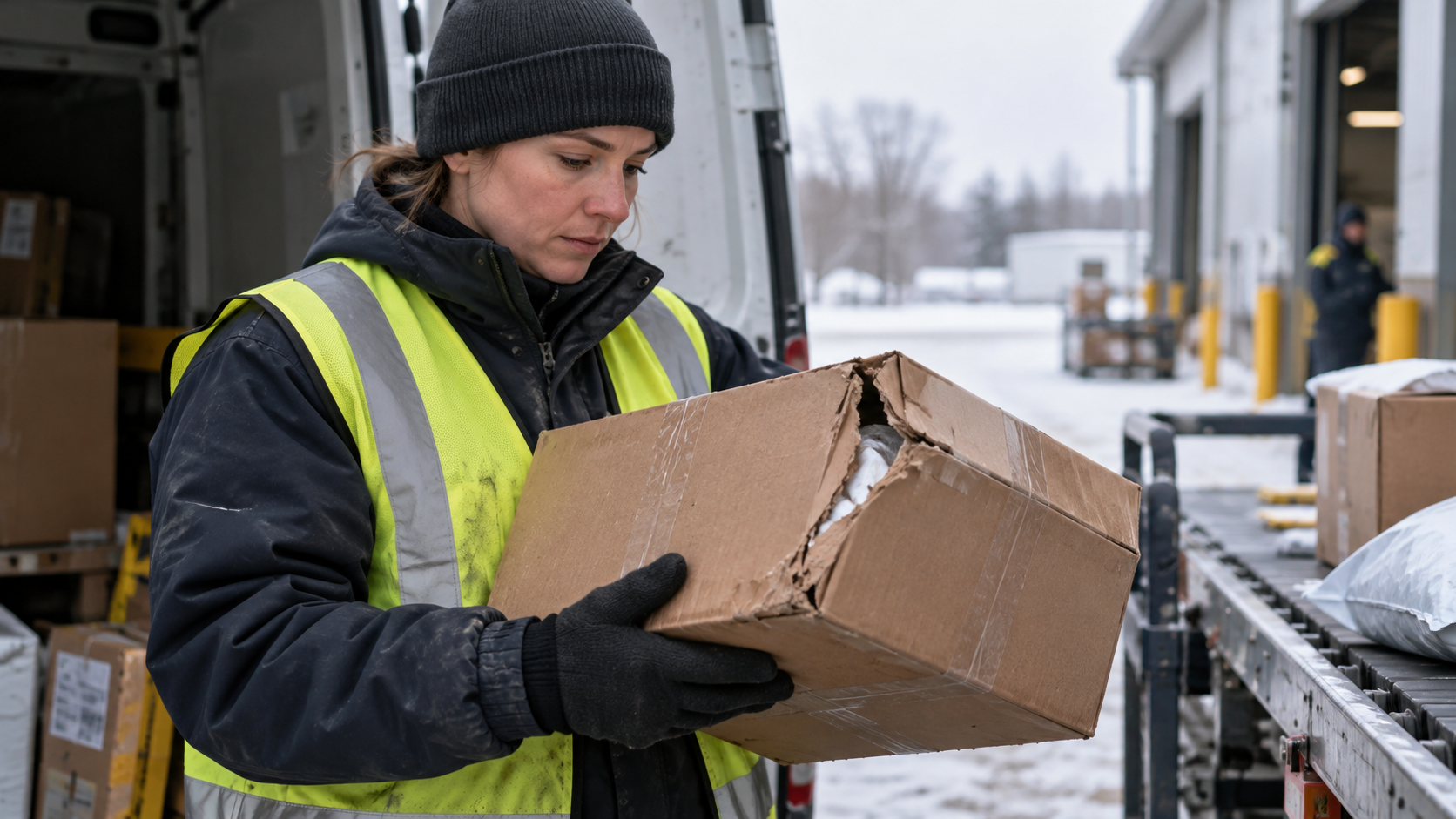
A driver collects a sealed return from a customer at 10:15. At the next stop, a tear in the carton becomes visible. The customer may have handed over a damaged box, it may have shifted during loading, or the driver may simply have missed the tear at the door. The driver cannot settle that question by changing the pickup event. A Minnesota delivery driver damaged customer return needs a new, time-stamped condition report tied to the original return ID and every custody transfer that follows. The original record should still say what the driver actually accepted and when.
The driver can report a condition discovered after collection without deciding who caused it, whether the contents are affected, or whether a claim will be paid. FedEx's claim guidance tells claimants to keep original packaging and contents until a claim is resolved. UPS's supporting-document guidance describes photographs and possible physical inspection for damage claims. Those examples show why original condition evidence matters. The driver's employer and the return service control the reporting and handling process.
Begin with the return's identity. The label or pickup code, pickup time, customer handoff, driver's acceptance, and any photograph or exception entered at the door are the baseline. A later damage report adds to that history. It should never quietly replace an accurate pickup scan with a different result just because the condition has changed or new information has appeared.
Write a damaged return condition report for what you can see
At a safe stopping point, identify the exact return item and describe the visible condition in ordinary words. “Two-inch tear on lower right carton seam, tape lifted, contents not visible” is more useful than “damaged.” If liquid is leaking, the box is crushed, or a seal is open, say where and how much you can observe without opening the package. Record the observation time and location. If the customer reported damage before pickup, separate the customer's statement from the driver's own observation.
A damaged return condition report should distinguish three times: the time of pickup, the time the damage was first seen or reported, and the time the report was submitted. Mobile coverage can delay a submission. Writing “noticed at 10:25, uploaded at 11:10 after connection returned” gives a later reviewer a usable sequence. Setting the observation time to the upload time would conceal the interval. Setting it back to the pickup time would imply an observation the driver may not have made.
Use the employer's approved photo process when it permits photos. Capture the return identifier and the affected area in the same authorized case, if possible, and add a wider view for context. Do not photograph unrelated customer property, private addresses beyond what the case requires, or the contents of a closed return. A close image of a torn corner cannot show whether the whole carton was sealed; a wider image helps interpret it. Keep the original file and its time information where the employer's system requires it.
If a customer says the item inside is broken, attribute that claim to the customer. The driver may be able to see a crushed carton but not the item inside. Write “customer said item was cracked before pickup” if that is what was said. Do not turn it into “item was cracked” without direct knowledge. A later claim reviewer may need both statements, but they are different kinds of evidence.
Avoid estimating a loss amount or choosing a damage cause from a menu merely to close the task. If the system requires a cause code that the driver cannot support, ask the supervisor or support team which code represents an unknown cause. Preserve the free-text observation. The report's job is to make the condition and uncertainty legible, not to reach a claim decision on the roadside.
Keep the return pickup custody history in order
The return pickup custody history starts when the customer hands over the item and the driver accepts it. Confirm that the return ID on the label matches the assignment. If the pickup contained two boxes, keep two item records even if the customer spoke of “the return” as one order. A damage report for Box B should not attach to Box A because both share a stop or customer name.
Next, identify where the item was between the handoff and the discovery. It might have been placed in a marked return section of the vehicle, moved during a route rearrangement, or transferred to a helper. Record only transfers that actually happened and the approved references available for them. A route map and a scan sequence may narrow the timeline, but neither can prove the condition at every minute. The purpose is to identify who had custody at each known handoff.
When the driver first notices damage, retain the package in the required secure area and follow the employer's handling instruction. If the package appears unsafe to move because of a leak, sharp object, or unknown contents, use the employer's safety escalation. Do not improvise by opening, repacking, discarding, or returning it to the customer without direction. A well-meant change to the package can destroy the evidence that a later review needs.
If a second driver takes over the route, hand over the actual item and the report reference. Note the time, location, recipient, and item ID through the approved tool. Tell the next driver whether the condition report is submitted or still queued on the device. The second driver should not inherit a vague “damaged return” note with no item number and no indication of whether the report reached the server.
At the station, get the item-level intake or exception receipt when the process supplies one. The station may place the return in a hold area for inspection, process it normally, or direct another action. The driver should record the receiving worker or intake reference and the physical handoff, then leave later disposition to the person or system that actually decides it. A station receipt proves an intake event; it does not, by itself, prove a claim outcome.
Do not rewrite an accurate pickup to explain later damage
Suppose the pickup app says “accepted” and has no damage note. Ten minutes later, the driver sees a torn seam. Editing the old event to say “damaged at pickup” would make the record appear more certain than the driver's observation. Add a new condition event stating when the seam was discovered. If the system offers an amendment, make it explicitly supplemental and preserve the original event ID, original timestamp, and reason for the amendment.
There is a different case when the pickup event itself is wrong. Perhaps the driver accidentally scanned the wrong return ID at the door. That requires the employer's correction process, with the mistaken event and the real item both identified. Do not use a damage exception as a shortcut to repair an identity error. A wrong-ID correction and a condition report answer different questions and should be traceable separately.
Likewise, a customer may call after pickup to say that the box was already crushed. The driver can add a time-stamped customer statement to the case if the approved channel accepts it. The new statement does not become a retroactive firsthand observation. State who made the claim, when it was received, and whether the driver had seen the same condition at pickup. That distinction matters when later photos show a different stage of damage.
If an app forces the driver to change the pickup status before it will accept a damage note, stop and ask support for the proper workflow. Capture the screen or error reference through the approved channel. A wrong status can trigger customer messages, route inventory changes, or a second pickup task. Preserve the true physical custody while the system owner resolves the limitation.
Preserve packaging and limit handling
Damage to outer packaging does not automatically mean the contents are damaged. A tear may reveal an inner box that still looks intact, or the outer carton may look fine while the customer reports a broken item. The driver should report visible packaging condition and attributed statements. Opening a return to inspect contents usually belongs to a designated inspection process, if one exists. Do not break a seal to satisfy curiosity or to make a more confident report.
Carrier claim guidance illustrates the value of keeping material together. FedEx tells claimants to retain original packaging and contents until the claim is resolved. UPS describes documentation and possible inspection. A driver working under another company's return process should follow that company's instructions, yet the practical lesson is similar: avoid throwing away tape, labels, filler, or a detached flap before an authorized reviewer determines what is needed. If pieces come loose, keep them associated with the same return ID.
Some damage creates an immediate handling problem. A wet carton may contaminate other parcels. A heavy item may be protruding through a corner. Move it only as required for safety and company procedure; record where it was placed and who authorized any special containment. A note such as “isolated in designated hold bin at 11:20 after notifying station lead” can explain why the package took a different path from other returns. Do not promise that a particular packaging method makes the item safe if the contents are unknown.
If the customer asks for the return back after the driver has accepted it, do not reverse the pickup informally. The company may have a defined cancellation, refusal, or release process. Confirm the item is still physically present, obtain direction, and record any authorized transfer back to the customer as a new event. Quietly deleting the pickup would erase the period when the driver held it.
Check whether the damage note reached the right case
Before closing the route, look for a case number or event ID linked to the return barcode. A photo sitting in a phone gallery is not an item-level report. A note attached to the customer stop may be ambiguous when several packages were collected there. Confirm the report is associated with the damaged item's own record and that the observation time, not merely the upload time, is visible to the team that will receive it.
Offline devices complicate this check. The screen may show a queued event while the central system shows none. Preserve the queued attempt's local ID, submission time, and any error. Ask the supervisor or support team to reconcile that exact attempt when service returns. Sending the same report repeatedly can create conflicting cases or time sequences. If the original never posts, the approved recovery should reference the failed attempt and preserve its text and attachments.
A successfully submitted note may still be attached to the wrong return. Compare the barcode, pickup stop, and item description with the case header. If the identifiers differ, flag the mismatch immediately and preserve both records. Do not copy the photo to a second case while leaving the first unexplained; a reviewer might read the same image as evidence about two boxes.
Where an employer's system has separate operational and claims teams, tell both through the authorized routing process if required. The station needs a safe physical disposition; a claims team may later need evidence. A driver should not assume that a route exception automatically opens an insurance claim. The supervisor can clarify who owns the next step, and the report should record that handoff without claiming the claim was accepted.
Use a two-box pickup to test the record
Imagine a customer gives a driver two sealed returns. Box A has a visible dent, and the driver records it at the door. Box B appears intact, and both are accepted under separate barcodes at 10:15. At 10:40, while unloading another stop, the driver notices a split seam on Box B. The driver photographs Box B under the approved procedure, records “split seam first noticed at 10:40; contents not visible,” and submits a supplemental condition event linked to B's barcode.
The driver should leave Box A's at-pickup dent note in place. Its condition was observed earlier and applies to another item. Box B's original acceptance also stays in place because the driver did take custody of it. The later condition note tells a reviewer what changed in the record without asserting when the seam first formed. At shift end, the station accepts B into a designated review area and issues an intake reference. That final receipt completes the driver's known custody interval.
Now change one fact: the customer calls at 11:00 and says Box B had a split seam before pickup. Add the customer's statement with the time of the call. It may help the reviewer, but it does not turn the driver's 10:40 observation into a 10:15 observation. If the customer sends a photo, route it through the approved customer-support channel and keep its source attribution. The driver should not insert it into the case as though it were the driver's own pickup photo.
Change another fact: the driver's 10:40 note remains queued offline when the station takes Box B at 12:00. The station receipt and physical handoff still happened. The driver tells intake the note is pending and supplies the local event reference. Support can later reconcile whether the original event posted. A duplicate report with a new timestamp could make it look as though the damage was first seen at station intake, losing a useful part of the timeline.
The example does not establish fault. It demonstrates a record that can answer narrower questions: which box was involved, what the driver saw, when the driver saw it, who held it afterward, and what remained unverified. Those answers are useful even when nobody can determine exactly when the carton split.
Separate return condition from final disposition
After station intake, a return may be held for inspection, repacked under an approved process, forwarded, sent back, or handled in another way. The driver should not choose one of those later outcomes in the pickup report unless authorized and actually involved. “Handed to intake in review area at 12:00” is a defensible last event for the driver. “Claim approved” or “sender received damaged item” would reach beyond that event.
The route app may collapse several stages into one broad “returned” status. Look at the underlying event and receipt before interpreting it. Was the item returned from the customer to the driver, from the driver to the station, or from the network to a sender? The same word can describe three different handoffs. The driver's report should name the specific people or locations in the known sequence instead of relying on the broad label.
If the station rejects intake because the return ID cannot be found, the driver still has the item. Keep the condition report and physical custody record open while support resolves the ID. Do not mark a station handoff that has not happened. If the station accepts it despite a device error, preserve the receiving person's receipt and the uncertain digital event so the system can be reconciled afterward.
For a driver exploring whether a role involves customer pickups and returns, the Saint Paul delivery driver Careers hub offers the current entry point. The published delivery job-offer review guide can help a candidate ask how return handling, equipment, and training are described before accepting a role. Those career questions are separate from the case-level report the driver must complete on a live route.
Close with a traceable handoff
Before leaving the station, compare the return ID on the package with the damage case and intake receipt. Check that the accepted pickup remains visible, the supplemental condition note identifies its actual observation time, and the receiving team has the item. If the app still shows the package assigned to the driver, report that mismatch with the intake reference. A clean route screen alone cannot establish physical custody.
Ask who owns an unresolved step when the note is still pending, a photo failed to upload, or the station has requested inspection. Record the named team and case reference in the approved channel. The driver should know whether another action is expected from them or whether the station has taken over. Do not mark a missing attachment complete because the package itself was handed over.
Keep the original pickup evidence, later condition observation, and station receipt together. That sequence lets someone review the case without inventing a point at which the damage occurred. If a later inspection finds something new, it can add its own event with its own observer and time. The return history stays useful because each person records the part they actually know.