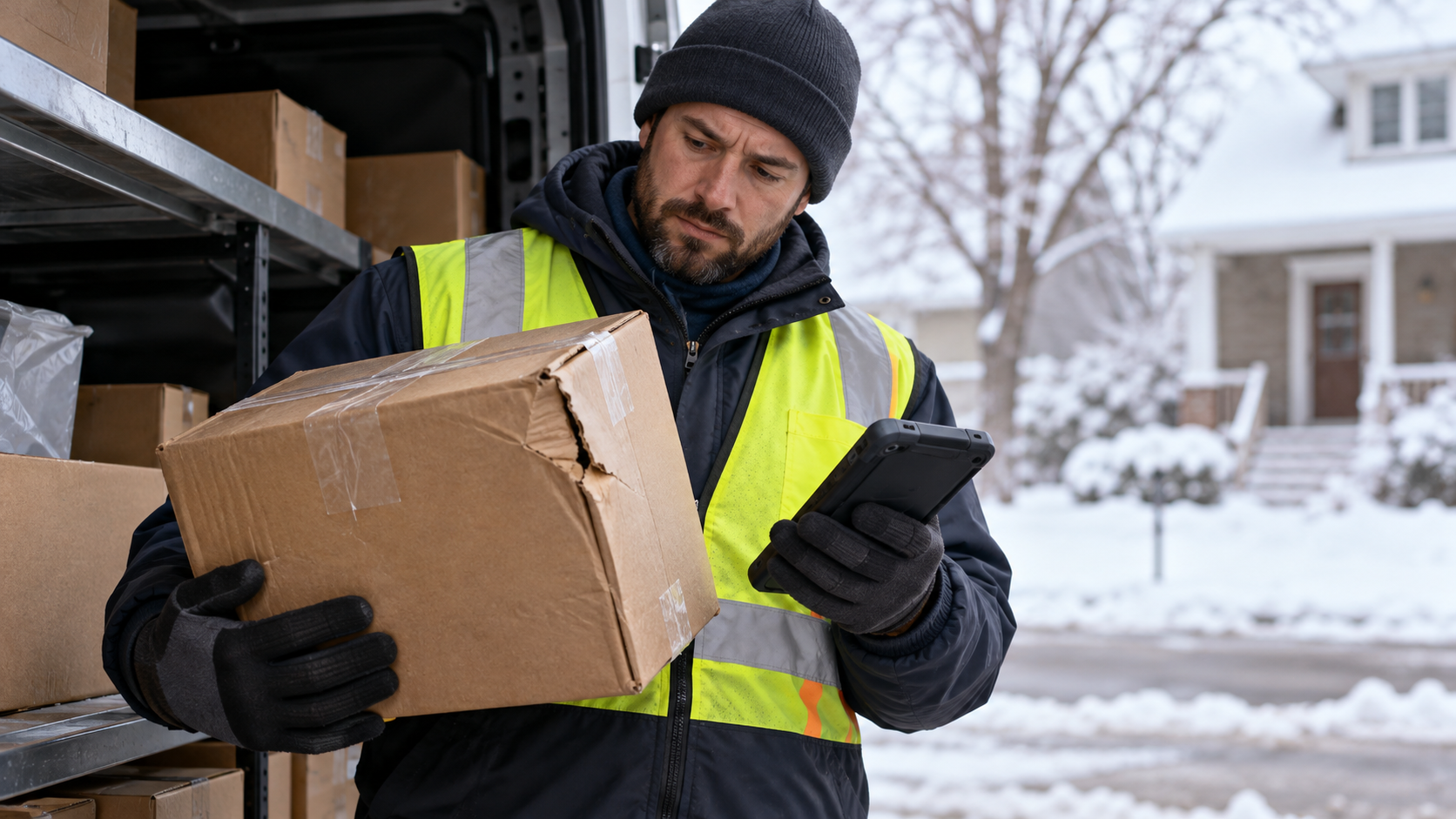
The route app shows a damage flag on a parcel. The box is still in the driver's vehicle, and no customer has accepted it. The flag does not explain whether the package is safe to handle, whether the outer carton is merely scuffed, or whether the item should be delivered. A Minnesota delivery driver damaged package before handoff case starts with the actual condition and custody, then follows the employer's approved decision path before any release to the recipient.
This is a pre-handoff guide. It does not tell a recipient how to file a claim after delivery, or how a driver should respond to damage discovered only after a customer opens a parcel. It also does not let a driver diagnose contents through a closed box. The driver can describe visible packaging, a leak, a broken seal, or an unusual sound without declaring that the product inside is ruined. The employer or carrier determines the proper damage category and whether the item can continue.
Carrier guidance shows that damage can affect both delivery handling and later evidence. A USPS Delivery Instructions FAQ describes a USPS-specific damaged-packaging process under that service, while FedEx claim guidance lists a photo of the damaged package as an example of possible documentation. Neither source supplies a universal driver workflow. The practical lesson is to preserve an accurate before-state and use the actual employer's handling and reporting instructions, rather than changing the condition story after the parcel has moved.
Read the existing damage flag before moving the item
Check what the app actually says. A flag may mean a station worker observed damage, a customer previously reported a problem, a photograph was attached, or a scan code was entered without details. These are possibilities, not facts about your parcel. Open the event history and identify the parcel ID, flag time, source, and description if the employer's system provides them. Then compare the record with the package in your custody. Do not assume the flag is stale, and do not assume every mark on the box was present when the flag was created.
If the flag belongs to a different barcode at the same stop, do not transfer it to the item in your hand. A multi-piece shipment can contain one damaged carton and one intact carton. Verify the exact identifier before any report, photo, or customer communication. If the screen has no item-level detail, tell dispatch that the damage marker is ambiguous. A stop-level warning may need clarification before the driver handles multiple packages differently.
The visible condition may have changed during the route. A box recorded with a crushed corner at loading may now have an open seam. Describe both the prior recorded condition and the current observation, with times where possible. Do not edit the first description as if it never existed. That sequence helps the system owner understand whether an additional event occurred after loading.
Some labels use “damaged” for a package that has been repacked or stabilized at the station. Check for an official rewrap, overpack, or release instruction before deciding what the label means. An improvised piece of tape applied by someone unknown does not provide the same assurance. If the instructions are missing, preserve custody and ask the supervisor to identify the approved condition and next action.
Make a pre-delivery damage report that stays observable
A pre-delivery damage report should describe what a person can verify without opening the parcel. Useful details include a crushed edge, torn outer wrap, exposed contents, liquid on the outside, a broken seal, or a label that has detached. Note the affected side and approximate extent in plain language. “Top seam open across half the box” gives more information than “badly damaged.” Do not describe an unseen electronic device as broken or an unseen bottle as shattered merely because the carton rattles.
Photograph the condition through the employer's approved tool when policy calls for it. Include the correct parcel identifier and enough context to show the affected area without exposing other customers' labels. If the app requires separate views, follow its instructions. Do not upload a stock photo or a later image of a repaired box as the original condition. A dated before-state can help later review, but the driver should not make unauthorized personal copies of customer packages.
Record where and when the condition was first noticed. If it was visible at loading, say so. If it was found while sorting after several stops, say that instead. Avoid assigning fault without evidence. “Observed at 10:12 while retrieving from upper shelf” is an observation; “station crushed it” is a conclusion the driver may not be able to support. A report that separates observations from assumptions is more useful to dispatch and claims staff.
If the package is wet, leaking, emitting an odor, producing dust, or showing another possible safety concern, stop ordinary handling and use the employer's safety procedure. Do not open it, sniff it to identify contents, or put it next to food or other parcels to make room. This guide cannot classify unknown contents or specify protective equipment. A supervisor needs the exact visible condition and location to direct safe isolation or specialist handling.
Resolve the damaged parcel handoff decision under policy
A damaged parcel handoff decision belongs to the employer's and shipment's rules. Some visible carton damage may be documented and still allow delivery; another condition may require return, inspection, or a controlled customer choice. The driver should not treat a damage flag alone as permission to leave the item at a door or as an automatic order to return it. Ask what action the current condition permits for this specific barcode.
Check any special service conditions before acting. A signature requirement, age restriction, or other controlled handoff still applies unless the system owner says otherwise. A damaged package should not be left unattended merely to avoid a difficult conversation. Conversely, a routine box with superficial scuffing may not need an invented exception that delays the customer. The observed condition and the employer's decision together determine the next step.
If the employer directs delivery, record the condition using the required code or note before handoff. Follow the authorized proof method for the actual transfer. If the recipient refuses the parcel, capture the refusal and retain custody under the employer's return process. Do not mark it delivered because the driver reached the door. Do not call a refusal a no-access attempt; a person was present and made a decision about the offered item.
If support directs return or station inspection before any customer contact, keep the package secured and document the route change. The customer has not received it. A return-to-station scan or receipt should connect the physical item with the earlier damage flag and report. A route card disappearing is not proof that the parcel reached a safe holding point.
Keep package safety separate from appearance
A dented corner and a leaking parcel can both be called “damage,” but they invite different handling. Do not group them under one routine response. Visible leakage, exposed sharp material, smoke, strong fumes, or unknown residue calls for the employer's safety escalation before further sorting. Keep people clear of a suspected hazard and follow site instructions. The driver should not improvise cleanup or decide the contents are harmless because the package label names a familiar retailer.
The driver may be able to inspect the outside without touching the damaged area. Note whether the outer packaging is intact, whether contents are visible, and whether the label can still be read. If a seal is broken, do not tape it shut to make the package appear unopened unless the employer directs an approved rewrap. A later recipient or investigator may need to know the original condition. Preserve that evidence while protecting the item from additional damage under policy.
Weather creates another distinction. A damp box after rain may need shelter and a condition note, but it does not prove the contents are wet. A parcel already soaked at loading should be reported before it is placed on a customer's porch. If the employer directs delivery, choose the authorized location and proof method; do not hide the wet side in a photo or omit the condition note to avoid a complaint.
If the package is too compromised to carry safely, say so. A driver should not risk injury by holding a leaking or structurally failed package against their body while looking for a supervisor. The employer's safety team can direct containment, equipment, and transport. This article supplies a reporting framework, not a universal hazardous-material procedure.
Document the actual customer contact
When the approved plan includes offering the parcel to the recipient, explain the visible condition plainly under the employer's communication rules. “The outer corner is crushed; the package was flagged before handoff” is more accurate than “the item inside is broken.” Avoid promising a refund, claim outcome, or replacement schedule the driver does not control. Point the recipient to the official support path if they ask about compensation.
If the customer accepts the parcel, follow the shipment's proof rule and record the actual receiver and time. A note about visible damage does not replace a signature when one is required. A signature does not erase the damage flag. Both facts should be preserved: the condition before release and the physical handoff. If the app offers a damage acknowledgment, use it only as policy directs and do not pressure a customer to sign a statement they have not read.
If the customer declines the parcel, record that specific refusal. Keep custody and follow the approved return or hold instruction. Do not leave the parcel nearby after a refusal or mark it as delivered to satisfy the route. The recipient's decision may affect the carrier's later investigation, so record the words or reason accurately without embellishment. “Declined because outer carton was open” is more useful than “customer angry.”
If nobody is available and the damaged item requires a hand-to-person decision, use the employer's attempt process. Do not assume the original drop instruction authorizes leaving a compromised parcel unattended. If policy allows an unattended delivery despite documented damage, follow the actual rule and proof method. The driver should not substitute a general preference for the shipment-specific instruction.
Keep proof of condition tied to the right parcel
A route may have several boxes at one address. Photograph and note the damaged barcode, not merely the stop. If one box is accepted and another is returned, each item needs its own outcome. A stop-level “delivered” label can hide the split. Check each parcel's status after the interaction and report a mismatch before leaving. The recipient's signature for an intact package should not be copied to a damaged package they refused.
Condition photos and delivery photos answer different questions. One records visible packaging before transfer; the other may show the authorized drop location. An image of a crushed corner in the van does not prove a customer received the item. A doorstep photo can prove location without showing the earlier damaged seam. Use the approved evidence fields for each purpose. If the app has only one attachment slot, ask support how to preserve both kinds of evidence.
Check whether the package label remains readable. A damage event can tear off a barcode and create an identity problem. Do not assign a nearby intact parcel's barcode to the damaged box. Keep it secure and use the employer's identification or relabeling process. A condition record is valuable only if it can be reliably tied to the item it describes.
If a photo upload fails, preserve the local attempt and ask how to reconcile it. Do not retake after the package has changed hands and present the new image as the original before-state. If the condition changed between photos, label the times accurately. The goal is an honest sequence, not a single tidy picture that hides an intermediate event.
Work through a flagged carton at a staffed building
Imagine a driver has two parcels for a business. The first is intact. The second carries a station damage flag and has a split outer seam, but no visible leakage or exposed contents. The driver verifies the two barcodes, checks the flag note, and photographs the split seam through the approved app. They ask dispatch whether the second parcel may be offered to the authorized receiving clerk or must return for inspection. The first parcel can be handled under its own instructions while that decision is pending.
Suppose support permits the damaged parcel to be offered with a condition note. The receiving clerk examines the outer box and accepts it. The driver records the clerk's actual handoff, required signature or receipt, time, and prior damage note for that barcode. The first parcel has its own proof. Neither signature should be attached to the other item, and the damage flag should not be silently removed after acceptance.
Change one fact: the clerk refuses the split box. The driver records the refusal and retains custody under the return process. “Attempted and refused due to visible damage” may be the accurate employer-defined outcome if such a code exists. “Delivered” is false because the clerk did not accept it. The intact parcel may still be accepted. A split outcome is normal when the two items have different conditions.
Change another fact: liquid appears at the split seam while the driver is waiting for instruction. This is a new safety observation. The driver stops the routine handoff, moves people clear as policy directs, and contacts the employer's safety channel. The earlier permission based on a dry split seam may no longer apply. Preserve the sequence of observations rather than revising the original note to imply the leak was present from the start.
Reconcile the damage flag and final custody
After the stop, the record should tell a later worker where the damaged item went. Accepted by an authorized recipient, refused and retained by the driver, returned to station, or held for inspection are different outcomes. Verify the barcode, condition note, proof, and custody transfer. If a station worker receives a return, get the approved receipt or scan. Do not leave a damaged item unrecorded on a shelf because the route app already shows an exception.
If the app still displays a damage flag after an accepted delivery, that may be appropriate history. Do not delete it just to make the item appear normal. If the status falsely says delivered after a refusal, report an exact correction incident. Preserve the before-state and actual custody so support can repair the record without inventing a handoff. A customer complaint or claim later may depend on which condition was documented before release.
For drivers evaluating an employer, the published delivery job-offer review guide can prompt questions about support during route exceptions. The Saint Paul delivery driver Careers hub offers local role context. During onboarding, ask who decides whether a flagged item can be offered, where condition photos go, and what receipt proves a damaged return.
A damage flag calls for a condition check and an owned decision before release. Record what is visible, keep the item safe, and document the actual recipient or return custody. That preserves a truthful trail even when the package's final claim outcome is decided later by someone else.