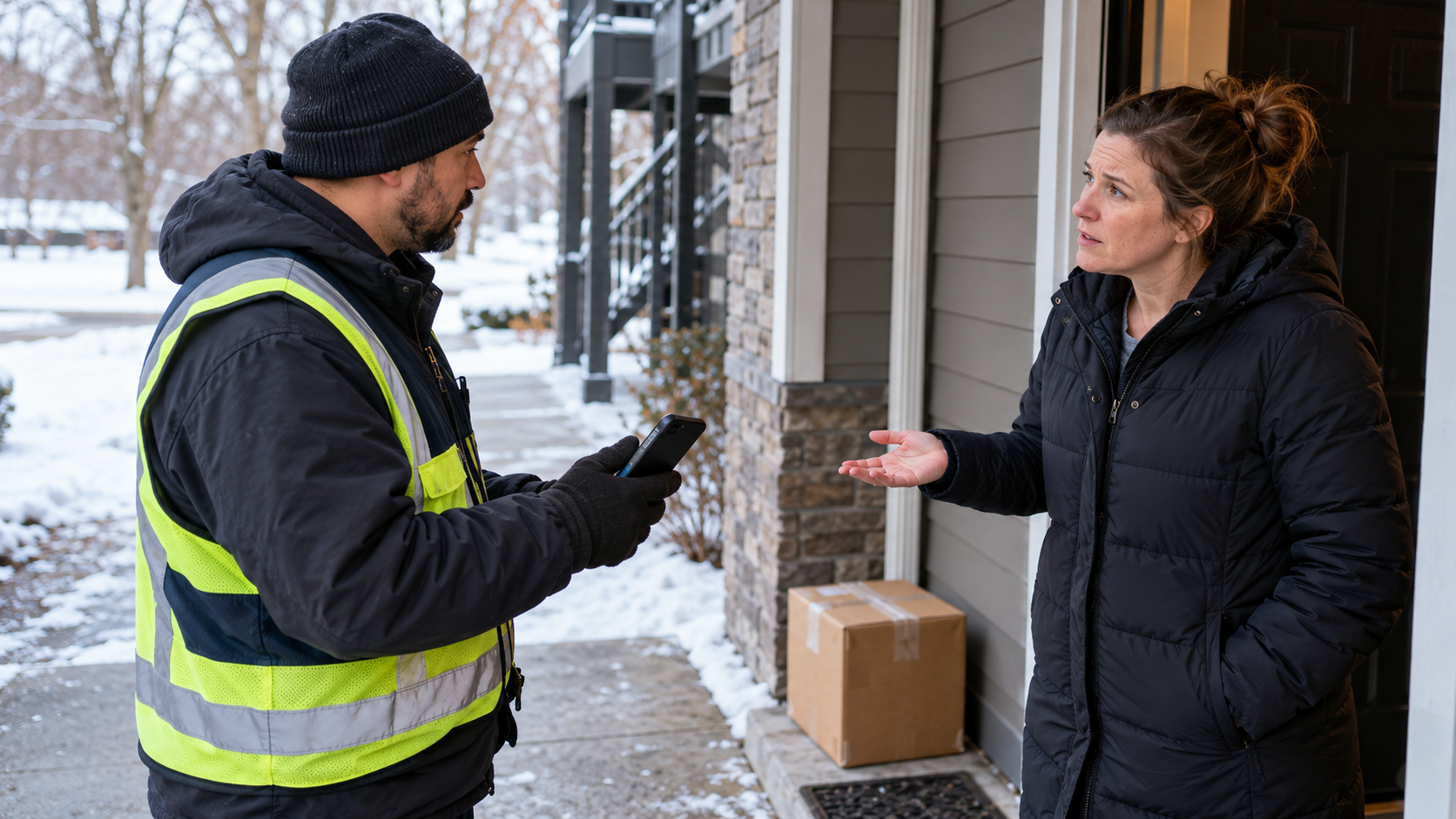
A route app shows a parcel delivered at 14:06. Twenty minutes later, a person at the address tells the driver, “That scan is wrong. Nothing came here.” The driver remembers leaving a box near a side entrance, but several units share the building. A Minnesota delivery driver disputed delivered scan needs an item-level reconstruction: which barcode posted, what proof was saved, where the driver physically placed or handed off that box, and what the person says is missing. The posted scan and the person's report can coexist while support checks the mismatch.
Carrier help pages treat a delivered-but-not-found report as an issue to investigate. UPS support suggests checking likely placement areas and people who may have taken the parcel before opening a missing-package investigation. FedEx support points to picture proof when available. USPS tracking help distinguishes delivered from attempted statuses and discusses items marked delivered that cannot be found. These steps do not establish what happened to this parcel. The employer's route data, proof, and correction process control the driver's next action.
The public or internal record already says “delivered,” and someone disputes that outcome. Preserve the posted event while investigating. An immediate second scan or silent deletion can hide the evidence needed to resolve the case. If the scan never uploaded, or the person declined the parcel before accepting it, document that different event under the employer's process.
Open the completed delivery scan dispute by parcel ID
A completed delivery scan dispute starts with the tracking or parcel ID, not the customer's name alone. Confirm the exact item the person expects and the exact item marked delivered. One order may arrive in two boxes; only one may have been on this route. A multi-unit stop can include several parcels with similar names. Ask support to match the complained-of item to the route event before treating a general “my package” report as a known scan error.
Check the posted event's time, location label, recipient name or signature, and photo reference if one exists. Note whether the app shows a direct handoff, doorstep release, locker transaction, front-desk receipt, or other delivery type. Each type points to a different physical check. A “delivered” headline alone does not say where the parcel went.
The person may show a shopping-app notification rather than the carrier's tracking number. It can help identify the order, but it may summarize several shipments or update at a different time. Use the barcode, merchant tracking reference, or support lookup to establish item identity. Avoid requesting access to the person's account or copying private order details into a personal device.
If the scan is still locally queued and the central system does not show delivery, preserve that distinct state. A customer may have received a preliminary notification from another source. The driver should not claim a completed carrier delivery from an unsynced device event. This article's main case is a scan that actually posted; uncertain writes need reconciliation before any correction or new event.
Make a delivery proof mismatch report from saved evidence
A delivery proof mismatch report compares the original saved proof with the customer's account. View the photo, signature, locker receipt, or receiving-staff record through the employer's approved tool. Do not recreate proof after the fact. A new photo of an empty step cannot show where the box was at 14:06; it can only show the step when photographed later.
Look for specific mismatches. The photo may show a red door while the addressed unit has a blue door. The signature may belong to a named front-desk worker whom the customer has not asked. The route record may say “front porch” while the driver remembers the side entrance. Record each observation with its source. Avoid jumping from one mismatch to “stolen,” “misdelivered,” or “customer lying.”
A photo can be real but insufficient. It may show a box without a readable barcode or without enough building context to distinguish two identical hallways. A GPS point may be near the correct property while the parcel rests at a neighboring door. Conversely, a customer may not have checked an approved parcel room. The proof should be assessed as evidence of a particular handoff, not as a magic answer to every location question.
If proof is missing or failed to upload, say so. The driver may remember taking a picture, but a photo in a private camera roll is not necessarily the accepted delivery proof. Preserve the failed upload reference and follow the employer's evidence process. Do not attach a different image to the completed event merely to make it look whole.
Treat a signature as evidence of a handoff to the signer, not automatic proof that the named addressee personally received the box. Check whether the service allowed an agent, front desk, or another household member to sign. Record the name shown and the location where the driver met that person. If the signature field contains only a typed role such as “reception,” support may need the building's receiving log to identify who actually accepted it. Do not fill that gap by guessing a staff member's name from a later conversation.
Separate the person's statement from a confirmed scan error
Record the person's words and the time of the report. “Resident at 4B says no parcel was at their door at 14:20” is a useful statement. It is not yet proof that the scan posted for the wrong address, and it does not diminish the person's concern. Ask which entrance, mailbox, locker, or receiving desk they have checked if the employer's procedure calls for it. Do not make the customer conduct an unsafe search or enter another resident's unit.
If a person says a neighbor has the parcel, ask for the source of that information. They may have seen a photo, received a message, or be guessing. Record the distinction. A driver should not knock on every door or retrieve a package from private property without employer direction. Support can identify an approved recovery process if the evidence points to a specific wrong location.
If the person says they refused the parcel, check the actual handoff history. A refusal before acceptance would not ordinarily be a completed delivery, while a parcel accepted and later returned creates a different sequence. The driver's memory and scan may conflict. Preserve both and ask the supervisor to reconcile rather than choosing whichever account sounds easier to close.
The person may accuse the driver of theft or mistake. Respond with the investigation path and avoid debating motive. “I will report the exact tracking number and proof discrepancy to support” is more useful than a defensive argument. The driver can describe their own actions precisely without assigning blame to the person, a coworker, or an unknown passerby.
Check physical custody before any recovery step
If the driver is still near the stop, check the vehicle's parcel list and assigned compartments under the employer's process. A box could have been scanned delivered but left in the vehicle. If the exact barcode is physically present, report that immediately. Keep it secure and obtain an authorized correction or delivery instruction. Do not quietly bring it back and scan a second delivery as if the first never happened.
If the driver handed the parcel to a receiving worker, the proof may include that person's name or desk receipt. Ask the designated receiving point to check its log through the authorized channel. Do not call a station or front desk and ask them to change their records to match the route app. The goal is to locate the item and understand the handoff, not to force consistency between screens.
If the parcel was left unattended and is no longer visible, the driver cannot infer who removed it. Record the exact placement, time, photo, and any later observation. A later empty doorstep does not show whether the recipient, a household member, building staff, weather, or another person moved it. The carrier's investigation process can combine those facts with other evidence.
If a wrong-location photo seems likely, tell support the suspected location but do not conduct a personal retrieval without authority. Another resident may now have custody, and a property-access rule may apply. A recovery needs an item ID, safe approach, authorization, and truthful transfer record. Replacing a parcel on the correct porch without recording its interim custody would create a second gap.
For a locker delivery, compare the locker transaction or compartment reference with the parcel ID. A public “delivered” status might reflect that the locker accepted the item, while the recipient has not opened the compartment. If the transaction failed or the door reopened with the parcel still inside, a different investigation is needed. The driver should not claim to have checked a locked compartment they cannot access; send the transaction reference to the locker or carrier support owner.
Do not overwrite the posted delivery history
The original event is evidence even if it is wrong. Keep its event ID, time, location label, proof attachments, and any customer notification generated from it. If support confirms an error, make a traceable correction through the employer's process. The corrected public status should be independently checked by the destination team before anyone tells the customer the record is fixed.
Submitting a new “delivered” scan can make the parcel look delivered twice. Submitting an “attempted” scan after a completed delivery can make the timeline contradictory. A driver should not choose a second status simply to clear the route card. Ask support which original event needs correction and how the actual custody should be represented.
If the mistake is a wrong barcode, identify both parcels. One may have been physically delivered while its own record stayed open; another may have been marked delivered in error. A correction must preserve both identities and actual outcomes. Changing only the complained-of parcel could leave a different customer with a misleading tracking page.
If the delivery event is technically valid but the person still cannot find the item, keep that distinction. Support may open a missing-package investigation without changing the original delivery status immediately. The driver can provide observations, but should not promise a particular claim outcome or declare the customer's report closed merely because the photo exists.
Work through two units with similar entrances
Imagine a driver has Parcel A for Unit 4B and Parcel B for Unit 4D. Both doors open onto the same corridor. The driver records A as delivered at 14:06 and B as delivered at 14:09, with separate photos. At 14:25, the resident of 4B says A is missing. The driver checks A's barcode and saved proof. The photo for A shows a mat with a distinctive striped pattern; the 4B doorway has a plain mat, while 4D has the striped one. That is a concrete mismatch to send to support, not proof by itself that the parcel remains there now.
The driver checks the vehicle and confirms neither A nor B is still aboard. They do not change A's posted scan from the hallway. Support can compare both photos, route events, and any receiving account, then direct a permitted recovery or correction. The resident of 4B should receive the tracking and case reference, not an unsupported assurance that 4D has their box.
Change one fact: the photos match the correct doors, but 4B still reports A missing. The driver records the report and actual placement. They should not accuse the resident or assume theft. The recipient may have missed an approved alternate location, or the item may have moved after delivery. The carrier's missing-package path is the right next step.
Change another fact: A is found in the vehicle after the scan. Now the physical error is known. The driver preserves the false completion event, tells support the exact barcode and location, and follows a correction-bound delivery or station handoff instruction. A new scan without that reconciliation could hide why a customer received a “delivered” notice before the item left the van.
The two-unit example shows why a photo should be tied to a specific parcel and door. A route-level stop summary cannot explain which parcel went to which threshold. The investigation should work from the exact barcode, proof, and physical custody rather than a general impression that both boxes were handled together.
Give the customer a useful next step
If the driver is authorized to help the person check likely delivery spots, name only appropriate areas: the listed door, approved parcel room, receiving desk, or household member. UPS support and FedEx support offer similar customer-facing checks and investigation paths. The driver should not direct a resident to search a neighbor's property or enter a locked area.
Provide the approved carrier or employer support route and the case reference if one is created. Explain what is being checked: the delivery photo, recipient record, route event, or station history. Avoid promising a recovery time, refund, or replacement. Those decisions may depend on the sender, carrier, and evidence outside the driver's view.
If a public tracking page still says delivered while an internal correction is pending, be candid. Say the discrepancy has been reported and the record is under review. Do not tell the person it is already fixed because a supervisor acknowledged the case. A posted public result and an accepted internal ticket are different states.
If the person later finds the parcel, add that update to the case with its time and source. The original complaint was still real at the time it was made. Do not delete it. A finding that the box was behind a planter, at a desk, or with a household member can close the location question while preserving a useful explanation of the delay.
Close with an item-level reconciliation
Before ending the shift, compare the disputed item's original scan, saved proof, physical custody, customer report, and support case. Identify any gap that remains: wrong door, uncertain recipient, missing photo, parcel still in vehicle, or delivered proof with no known current location. Give the gap to a named supervisor or support owner under the employer's process. “Customer says missing” alone is too thin for the next person to investigate.
If the correction leads to a new handoff, record who accepted the parcel and when. If the original delivery stands and a claim or search continues, preserve that state without manufacturing a new receipt. Any public status change should correspond to an actual approved correction. The driver should not backdate a delivery to make the route appear on time.
Drivers exploring customer-facing delivery work can use the Saint Paul delivery driver Careers hub as the current entry point. The published delivery job-offer review guide can help a candidate ask about proof-of-delivery tools and dispute support. On the route, the driver needs the saved event and the employer's case process for the exact parcel.
A completed scan is a claim in the record about a physical event. When a person disputes it, the driver should preserve the claim, assemble the item-level evidence, and report any mismatch through the authorized path. The customer gets a case that can be investigated; the route history remains honest even before anyone knows where the parcel is now.