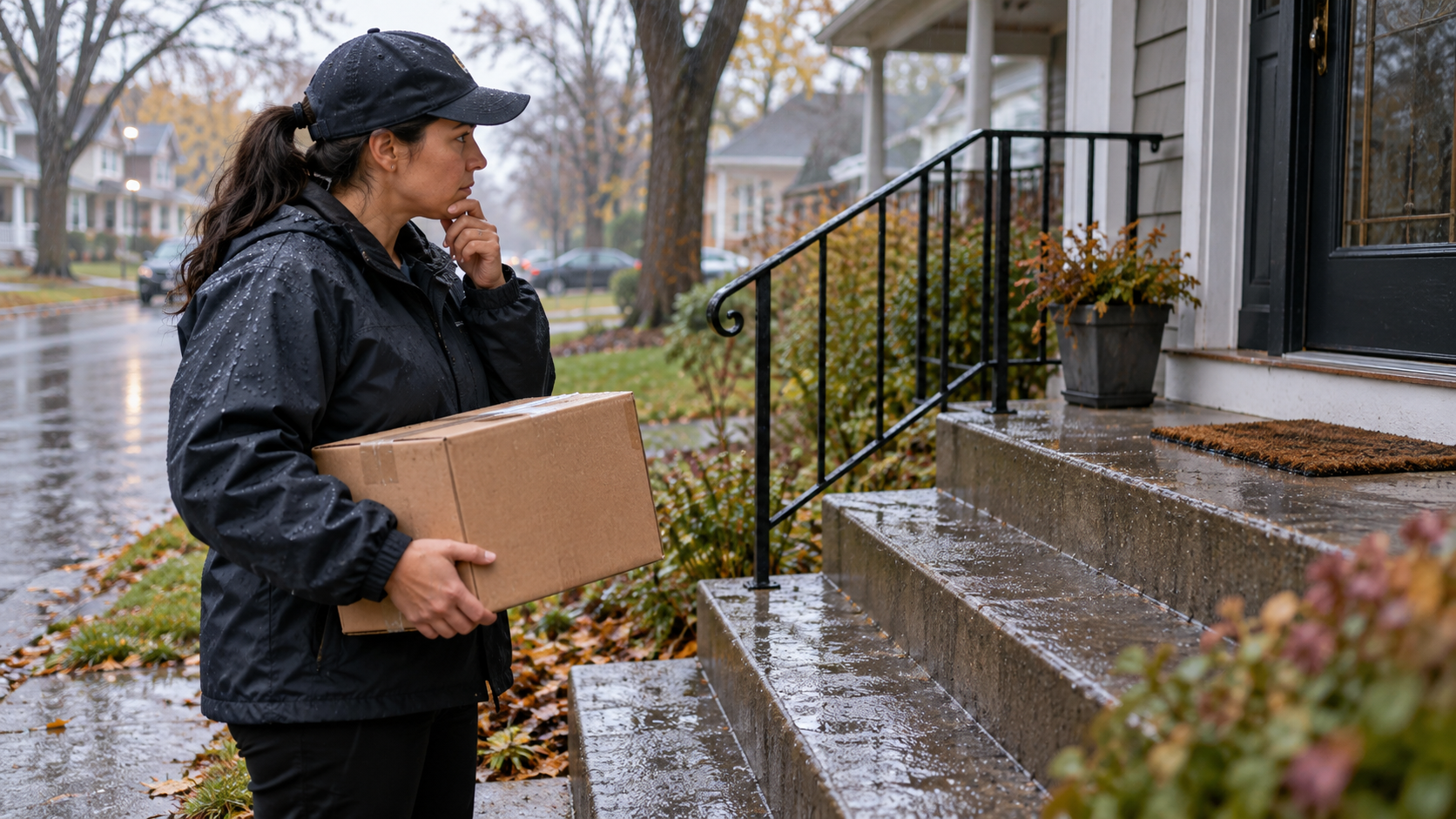
A customer's note says, “Leave the parcel on the front step even if nobody answers.” The step has no cover, rain is beginning, and the box will be visible from the sidewalk. The driver can reach the step safely, but the requested resting place may expose the parcel before the customer retrieves it. A Minnesota delivery driver exposed package drop request requires two checks: whether the shipment permits unattended release at that location, and whether the condition observed at the stop fits the employer's delivery procedure. The note does not prove that either condition is met.
UPS's tracking-status guidance says its drivers try to find a safe place out of plain sight or harmful weather when a shipment does not require a signature. UPS's delivery-change page describes customer-requested changes through official options and notes that restrictions may apply. Its signature guidance gives additional limits for certain parcels. These are examples of distinct service rules; a driver must use the current employer and shipment instructions for the box in hand.
The approach to the step may be safe while the step itself is exposed. If the path is icy, blocked, or otherwise unsafe to walk, the driver also needs an access exception. The record should show both conditions when both exist. A package can have an authorized release option and still lack a suitable place to rest at this stop.
Make an exposed delivery location check at the stop
An exposed delivery location check begins with what the driver can see. Is the requested spot uncovered, in direct rain or snow, within public view, beside a busy walkway, or vulnerable to vehicle traffic? A location can be exposed in more than one way. Describe the actual condition and time. “Front step uncovered and wet at 14:10” gives support more to work with than “unsafe place.”
Look for the exact place named in the note. “Front porch” might mean a covered recess near the door, while “front step” might be beyond the roofline. A photo of the doorway can help if the employer permits it, but do not photograph neighbors, entry codes, or unrelated property unnecessarily. The driver should not enter a private area to prove a location is exposed; assess it from the authorized delivery approach.
Consider the package's packaging without claiming to know its contents. A cardboard box may be visibly wet; a plastic mailer may resist rain better, but the driver generally cannot determine how long either can remain outside or what is inside. Report the observable exposure. Do not promise the customer that a parcel will be undamaged because the label says “waterproof” or that a rain-soaked outer box proves internal damage.
Public visibility is another separate observation. A doorstep facing a sidewalk may be easily seen by passersby. A recessed doorway may be less visible. The driver cannot guarantee a package will not be taken from either place. The useful record identifies where the parcel would rest and whether the location matches the release instruction and employer policy.
Perform a package release instruction review
A package release instruction review starts with the parcel ID and live shipment requirements. Check whether an unattended release is permitted, whether a signature or direct handoff is required, and whether the shipper or recipient has a current approved instruction. A multi-parcel stop can contain one releasable box and one that cannot be left unattended. Keep their decisions and proof separate.
Read the source and time of the request. A customer may have entered the front-step note months ago for an unrelated parcel. A handwritten sign may be intended for another carrier. A current approved delivery-change instruction may have a different status from a free-text preference. The driver should use the employer's rules to determine which instruction applies to this shipment now.
If a shipper restriction requires a signature, the customer's request to leave the box cannot be treated as a completed signature. Ask the customer to receive it through an authorized handoff or follow the prescribed attempt process. Do not select “customer requested” in a release menu merely to bypass a blocked signature field. The correct status should reflect that no unattended delivery occurred.
Some services allow a customer to assume or accept certain release conditions for an eligible parcel. The driver still needs the accepted request in the authorized system. An exposed spot is not automatically forbidden everywhere; the actual carrier and employer rules decide whether it can be used. At the doorstep, the driver should not improvise a legal conclusion about liability or assume that a written note transfers all risk.
Separate permission from the condition on arrival
An approved instruction may have been reasonable when entered but poor under current conditions. The customer could have selected an uncovered step during dry weather; heavy rain may now reach the box. Report the condition and use the employer's decision path for an unsuitable drop location. An accepted instruction does not require the driver to ignore what they see at the stop.
The reverse can happen too. The customer may ask for an exposed spot, but a covered recess beside the same door is available. Do not silently substitute that recess unless the service permits driver placement discretion or the customer authorizes a change through an accepted channel. A different location can affect where the recipient looks and whether the proof-of-delivery photo is accurate. Check the service's allowed alternatives.
If the requested place is exposed mainly to theft risk, avoid treating the driver as a security assessor. Describe its visibility and the available authorized options. The customer may knowingly prefer the front step because it is easier to reach, while the employer may still require a safer drop or an attempted delivery. The driver follows the applicable rule and records the chosen outcome; they do not guarantee security after release.
If the box itself is already damaged or leaking, report that separately under the employer's package-condition procedure. Exposure at the drop location and preexisting package condition are different facts. A wet box before delivery might have been exposed earlier, and a dry box could become wet if left uncovered. The driver should not assign a cause from appearance alone.
Contact the customer through the approved channel
When the service permits contact, tell the customer what has changed: “The front step is uncovered and rain is reaching it. Is there an approved covered handoff point or someone available to receive the parcel?” Use the employer's call or message tool so the instruction and time can be retained. Do not contact the customer through a personal account or send a public photo of the package.
A customer may answer, “Leave it anyway.” That reply should be checked against the service's release rule. If the parcel is eligible and the employer accepts an in-route instruction, record the reply and the actual drop. If release remains prohibited, explain that a handoff or later attempt is required. The driver should not turn a phone conversation into an unauthorized release merely because the customer sounds certain.
If the customer suggests a neighbor, parcel locker, front desk, or alternate address, each has its own authorization and proof requirements. A neighbor's willingness to take a parcel is not the same as a recipient-entered neighbor change. A locker must actually accept the parcel. A new address may require an official redirect. Use the appropriate process rather than treating every alternative as a variation of “front step.”
When the customer does not answer, record the real contact attempt. An unanswered call, a message sent, and a confirmed conversation are not interchangeable. The employer's default rule then determines whether to use another approved location, make an attempted delivery, hold the parcel, or return it to the station. The driver should not write “customer approved” because a prior note remains on the route screen.
Compare covered alternatives without changing the address
A covered porch, recessed side door, or attached parcel box may protect the shipment better than an uncovered step. Check that the alternative is on the correct property, permitted by the shipment, safe to access, and specific enough for the recipient to find. A driver should not hide a parcel in landscaping, behind an unlocked shed, or inside a different building without authorization.
If the parcel requires a signature, a covered place alone does not satisfy the handoff. Ask whether an eligible person can accept it at a safe entrance. If nobody is available, follow the service's attempt or hold process. The location's weather protection solves only the exposure concern; it does not remove recipient requirements.
For an eligible release, document the actual place. “Covered porch beside front door” is more precise than “front door” when the customer originally asked for the uncovered step. The photo, if required and permitted, should show where the box actually rests without exposing sensitive information. Avoid photographing a different spot after moving the parcel to improve the appearance of the proof.
An alternate delivery day or pickup location may be available through the carrier's official options. UPS's delivery-change page provides examples such as holding or redirecting eligible shipments. Availability depends on the service and shipment; the driver should ask dispatch or direct the customer to the approved channel. Do not promise a hold or new date before it is accepted.
Work through two parcels on an uncovered step
Imagine a driver has two parcels for one customer. Parcel A is eligible for unattended release under the current service and has a customer note asking for the front step. Parcel B requires a signature. Rain has started, and the step is beyond the porch roof. The driver checks both parcel IDs. For A, the driver contacts the customer through the route app about the exposed step and asks whether a covered porch recess is acceptable under the carrier's process. For B, the driver requests a direct handoff and does not leave it unattended.
Suppose the customer approves the porch recess for A through an accepted channel, and an eligible person signs for B at the door. The driver places A in the recess, records that actual spot, and records the real signature handoff for B. Neither parcel is marked as left on the uncovered front step. One customer conversation produced two different delivery outcomes because the shipments had different release rules.
Change one fact: the customer answers and insists that A be left on the wet step, while the employer's procedure requires the driver to avoid a location exposed to harmful weather. The driver follows the employer's exception or alternate-location process and documents the customer request. They should not place A there and then write “covered porch” to make the proof look compliant.
Change another fact: no one answers, and Parcel A's service permits the driver to choose a covered safe place on the same property. The driver can use that place if it satisfies the employer's rules, documenting the real location. Parcel B remains undelivered without its required signature. The route's stop card may show both parcels together, but the item-level outcomes must stay separate.
The example is hypothetical. An employer might prohibit unattended release for both parcels, or allow a different alternative. Its purpose is to test the two questions separately: is release authorized, and is the selected resting place suitable under the current conditions?
Record the actual placement or no-delivery outcome
If the driver leaves an eligible parcel, the proof should identify the true location and time. A delivery photo should show the actual parcel at the actual resting place, subject to the employer's photo rules. Do not label an exposed doorstep as a covered porch or mark a direct handoff when the box was left alone. The recipient and support team need an honest location if the parcel is missing later.
If the driver does not leave it, use the applicable attempted-delivery, unsafe-location, weather, or other approved code. Choose the code that matches the event rather than the easiest one to clear. “Customer not home” may be incomplete when the key issue was the instructed drop place in heavy rain; “recipient refused” would be false if no person was contacted. Add the observed condition and any support instruction.
Record where the parcel goes next. It may remain with the driver until route closeout, be accepted by a station worker, or move under an approved hold process. An exception scan does not itself prove station custody. Match the parcel ID to the intake receipt when a handoff occurs. If the device is offline, preserve the queued attempt and reconcile it before submitting another status event.
If the driver discovers after scanning that the photo or location label is wrong, report the exact mismatch promptly. A correction should preserve the original event and identify what actually happened. Do not upload a second photo from a different location or rewrite the delivery time to make the case cleaner. A truthful correction is more useful than a record that appears internally consistent but describes the wrong place.
Keep access and exposure as separate findings
An uncovered step can be easy to reach. A covered porch can require crossing a hazardous walkway. Evaluate the path and the resting place independently. If the route to a sheltered location is unsafe, do not go there merely because it protects the box. If the path to an exposed spot is safe, the exposure and release rules still need attention.
The customer may frame the issue as a choice between speed and care: “I need it today, so leave it anywhere.” The driver can explain the available authorized options without promising that one will be accepted. A direct handoff, an approved covered location, a later attempt, or a hold may be possible depending on the shipment. The driver should not invent a compromise location outside the address or beyond the authorized area.
Weather can change during the route. A place observed dry at noon may be wet at 16:00. Record conditions at the actual attempt, not a forecast or another driver's earlier note. If the parcel is already under a cover and the wind is blowing rain into the recess, describe that observation and whether the box is actually getting wet. “Covered” is a physical feature; it does not always mean the box is protected at that moment.
For drivers assessing residential delivery work, the Saint Paul delivery driver Careers hub is the current entry point. The published delivery job-offer review guide can help a candidate ask about release rules, customer instructions, and exception support. On the route, the controlling facts are the current shipment restriction and the place the driver actually sees.
Before closing the stop, compare the parcel's physical outcome with its status. If it was left, the proof should name the true spot. If it remains with the driver, the exception should explain the exposure or restriction and identify the next custodian. A customer's preference can inform an eligible delivery, but the record must show the authorized choice made under the conditions at the doorstep.