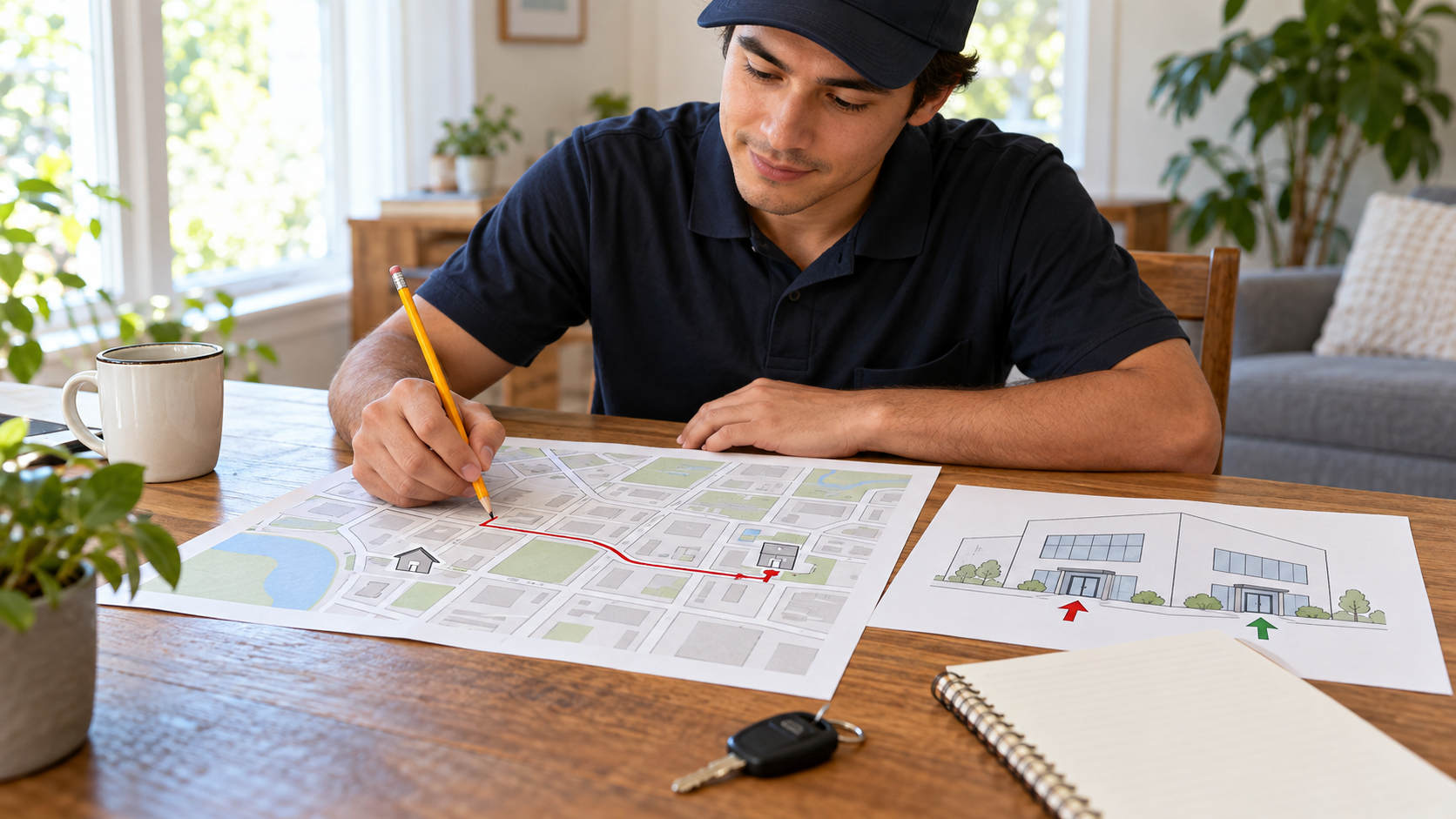
Your first shift starts before sunrise at a facility you have never visited. The map leads to a large building with a truck gate, a visitor lobby, two parking areas, and a door marked “employees.” The street address is correct, yet it does not tell you where a new driver should report. A first-day travel plan needs the employer's entrance and check-in point, then a route that reaches that point at the assigned time. Planning only to the map pin can still leave you late or outside a restricted area.
A Minnesota delivery driver first day entrance travel plan starts with a confirmed destination. Ask for the exact reporting address, entrance or gate, parking or drop-off point, and person or desk that checks in new hires. Then plan the trip for the actual report time and travel mode. Check current road or transit conditions close to departure. Keep an approved contact for a changed instruction, but do not use a locked-door fallback as a substitute for knowing the correct entrance in advance.
The public Minnesota 511 service can help you check current road conditions before a drive. It cannot identify the private door your employer wants. A public job posting may name a service area rather than the station where drivers report. Ask the employer for the current site instruction and compare it with your calendar before traveling.
Confirm the reporting site, not just the service area
A role advertised for Saint Paul may start from a station elsewhere in the metro area. The customer delivery zone and employee reporting point are different locations. Read the offer, onboarding calendar, and first-shift message for the actual address. If they differ, ask which applies to the first date. Do not choose the address that seems closest to the advertised city or that appears first in a search result.
Ask whether the first day is orientation at an office, a station tour, or a route report. These events may use different sites. Put the event name beside the address: “Tuesday orientation—training center” and “Friday first route—north station.” This prevents an old orientation pin from becoming your default route destination. If the employer changes the first-route date, reconfirm the site rather than assuming the same venue still applies.
The station versus service-area guide helps distinguish the work area from the place a driver reports. It cannot supply your private first-day entrance. Use the actual employer message for the site and ask for clarification if it gives only a broad region or brand name.
Map the station entrance arrival route
A station entrance arrival route ends at the door or check-in area, not at the center of the property. Ask which road or driveway leads to the assigned entrance and whether a different gate is reserved for trucks. If the employer sends a map pin, compare it with a written entrance description. A pin near the loading side of a large property may not be where new hires are allowed to enter.
Preview the final few turns of the journey. Where do you leave the public road? Is there a sign for employee parking? Is the pedestrian route from parking to check-in marked? If the employer has a site diagram, use it; do not invent a path from satellite imagery. Ask whether a security booth requires your name on a visitor list. Planning the final 200 yards can matter more than choosing between two highways.
If a route app directs you through a delivery or fleet gate, do not follow it blindly. Ask the employer whether that gate is for drivers in company vehicles or for employees arriving in personal cars. A location can have separate rules for vehicle traffic and pedestrian entry. Use the authorized arrival path even if it is a slightly longer walk.
Check parking and drop-off before leaving
If you drive to work, ask where a new hire may park and whether a permit, temporary pass, or registration is needed. A lot can be near the building but reserved for fleet vehicles. Do not leave your car in a loading lane because you intend to move it after check-in. The employer should identify the permitted lot or tell you whom to ask when you arrive.
If someone drops you off, ask for a safe passenger drop-off point. It may differ from employee parking or the truck entrance. Plan where the driver can stop without blocking traffic, and know the pedestrian route from there to the check-in door. Do not ask a driver to enter a restricted yard because the public side appears farther from the entrance.
If parking instructions arrive only after onboarding, ask whether the first day uses a visitor area. Do not assume permanent employees' parking rules already apply to you. Keep the permit or temporary pass instructions with the address so you do not reach the gate and discover that the lot requires a credential you have not received.
Build a first shift travel buffer from the real trip
A first shift travel buffer is time you choose to account for uncertainty, not an invented employer reporting requirement. Estimate the journey from your starting point to the actual entrance, including parking, walking, and check-in. Consider the time of day, road conditions, transit frequency, and your unfamiliarity with the property. Add a realistic margin for those uncertainties. The exact margin depends on the trip; a blanket “arrive 30 minutes early” rule may be too much for one route and too little for another.
Separate travel time from paid work time. If the employer asks you to report at 5:45 a.m., clarify whether that means arrive at the gate, check in at dispatch, or begin a required task. Do not silently move the employer's start time earlier in your notes because you personally choose to arrive early. Likewise, if the employer requires pre-shift activities, ask how those are scheduled and recorded rather than assuming they are part of a voluntary travel buffer.
Use a simple backward plan. If you must be at the check-in desk at 5:45, estimate the walk from parking and any security line, then identify the latest reasonable parking arrival. From there, calculate departure based on the current trip, with your chosen uncertainty margin. This makes the plan tied to the actual entrance instead of an optimistic map estimate to the property edge.
Take one practice look at the route when you are not under time pressure. You need not drive there twice, but you can review where the approach road branches and whether the employee lot is before or after the main building. If you do a practice drive, use public roads and permitted visitor areas; do not enter a secured yard to inspect the gate. Note where you can safely turn around if navigation sends you to the wrong side. A practice look is especially useful when the street address covers several buildings or the facility has one-way traffic.
Check current conditions close to departure
Road construction, weather, and incidents can change the drive. Minnesota 511 is one public source for current road information, but you still need to judge your particular route. Check conditions when the trip is close enough for the information to matter, then adjust departure if needed. Do not assume yesterday's travel time applies to a dawn shift during a weather event.
For transit, use the transit provider's current schedule and alerts for the exact early trip. A weekday route may not run at the hour you need, and a transfer that works at midday may not work before sunrise. Ask the employer for the station entrance from the stop; the nearest stop to the building may be on the wrong side of a fenced property. Plan a lawful pedestrian path, not a shortcut through a vehicle gate.
If you bicycle or walk, check whether the route reaches a pedestrian entrance and where you may secure a bicycle. Some industrial sites have roads without comfortable pedestrian access. Ask the employer about the last approach rather than relying only on a generic directions app. Your travel mode may change which entrance is usable.
Check the return trip too if your first day may end outside normal transit hours. Ask the employer for the expected end time or a range, while recognizing that a route may run differently from orientation. A trip that reaches the station at dawn may have a poor return connection in the afternoon or evening. Planning that ride home does not determine the exact shift length; it identifies whether you need a backup. If the employer cannot provide an end time, ask how drivers learn when a route is complete and what options exist if your normal ride is unavailable.
Prepare for low light and unfamiliar signage
An early shift can begin when signs are hard to read. Review the employer's entrance description before leaving, not while driving around the property. Use legal, safe stopping points to check directions. Do not stop in a truck lane to study your phone. If the employer gives a landmark, verify that it is still visible and ask for a street address or gate name as a backup.
Keep your phone charged and the relevant instructions available if mobile data is weak. A screenshot of the employer's address and entrance description can help, but treat it as a copy of the current instruction, not an authority if a later update arrives. If you use navigation, enter the approved employee entrance or parking address if the employer provides one, rather than only the company's mailing address.
If you miss a turn, take a safe legal route back. Do not cross a median, reverse through a gate, or enter a private drive just to save time. If the error will make you late, contact the employer's designated shift contact with an accurate revised arrival estimate. The same contact can tell you whether the check-in point has moved.
Keep orientation and route entrances separate
Your orientation may be at a visitor lobby during office hours. The first route may start at an employee door before that lobby opens. Ask whether the entrance changes between events. A successful first visit does not prove you know the route-shift entrance. Put both instructions in the calendar with the corresponding date and event.
For example, Tuesday orientation could use the south lobby at 10:00 a.m., while Friday dispatch uses the north employee gate at 5:30 a.m. Your Tuesday commute may teach you the property layout, but it may not show you how to reach the north gate from the road or where to park before dawn. Ask the trainer for Friday's route entrance before leaving Tuesday, then confirm it if the assignment changes.
If orientation ends with a station tour, do not assume the tour exits at the same door employees use to enter later. A trainer can walk the group through internal doors that are locked to newcomers from outside. Ask which exterior entrance your badge or first-day visitor instruction covers. This is a practical navigation question, not a request to bypass security.
Verify a last-minute location change
If a new message gives a different site, check whether it is from the employer's authorized scheduling channel. Compare the role, date, and report time. A one-day training change may not move every future shift. Ask whether the new address replaces the original for this event only. Update your travel plan after the employer confirms the instruction.
Recalculate travel time from your actual starting point. A site 10 miles away can take longer if it requires a different transit transfer or crosses a congested area. Check parking and entrance details for the new location rather than carrying over the old site's rules. If the change arrives too late for you to reach the new report time, tell the schedule owner immediately and ask for the next instruction.
Do not use a coworker's map link as the sole basis for a location change. The coworker may report to a different entrance or station. A verified message from the route or onboarding owner protects both your arrival and the employer's expectation about where you will be.
Know what to do if the entrance is still unclear
Before the day, ask one focused question: “For my Monday 5:45 a.m. route report, which entrance and parking area should I use, and where do new hires check in?” If the answer includes a gate code, badge, or visitor list, follow the employer's handling instructions. Do not circulate the access detail in a group chat. Save the named contact for a missing or changed instruction.
If you reach the confirmed entrance and cannot enter, use the employer's on-duty contact and approved waiting point. That locked-door fallback is a separate task from planning the trip, but it belongs in your first-day note. Do not explore every gate or follow another driver into a restricted area. Tell the contact where you are and what you see, then follow the authorized next step.
If the assigned entrance remains ambiguous the night before, ask before leaving rather than choosing from multiple map pins. A clear destination can prevent both lateness and a security problem. If no reply comes, preserve the last confirmed instruction and your attempts to clarify, then use the employer's designated escalation contact. Do not represent an unconfirmed entrance as settled.
Make a compact arrival card
Your final note can fit on one phone screen: event and date, report time, site address, entrance, parking or transit stop, check-in point, contact, and fallback. Add the current employer message that supplied the information. You do not need to save every possible road route. The card's purpose is to prevent a wrong-door arrival when you are tired or the site is dark.
For example, a useful card might read: “Friday, first route; 5:45 a.m. check-in; north station at the confirmed street address; employee entrance on the west side; park in the marked new-hire row; dispatch desk inside; call the on-duty number if the door is locked.” Every detail in that card should come from the employer's current instructions. If you do not know the parking row or door side, leave a question mark and ask rather than filling it from a map guess. An honest incomplete card is better than a confident wrong one.
The Saint Paul delivery driver careers hub helps you explore openings, but it does not give a private employee entrance. The public station-versus-service-area guide helps you understand why the advertised area can differ from the report site; the employer's current instruction supplies the actual door. Minnesota 511 can inform the drive but cannot replace that instruction.
On the evening before the first day, check that the address, door, and time still agree across your card and the latest employer message. On the morning itself, check current travel conditions and leave with your chosen buffer. If the route changes or you cannot enter, contact the named owner with precise facts. The useful outcome is not merely reaching the building; it is arriving at the correct check-in point, at the assigned time, through the approved approach.