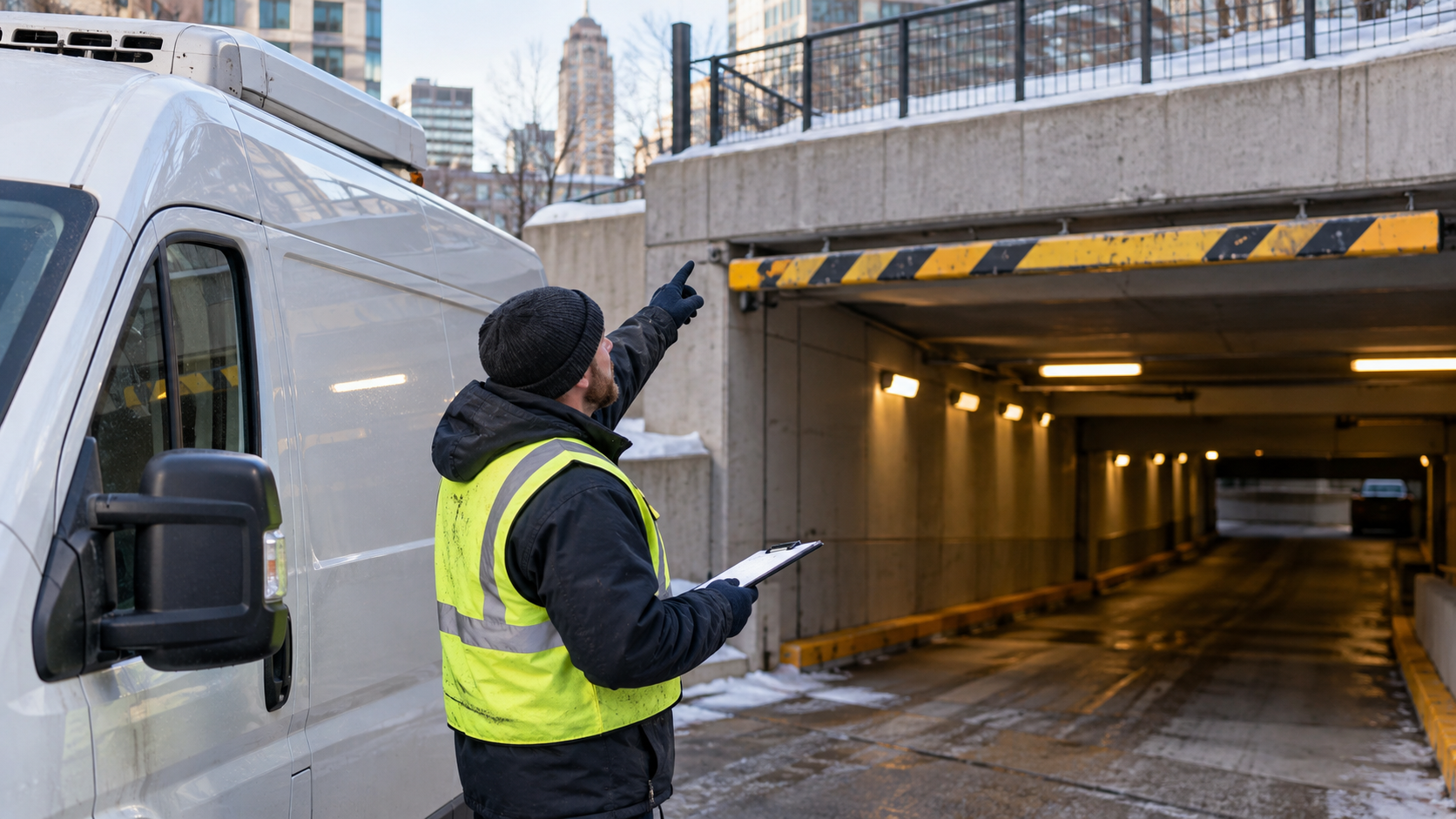
A delivery note says “use the parking garage.” The driver turns toward the ramp and sees a clearance bar, but the number is hard to read from the road. The vehicle is taller than a passenger car, and a roof-mounted unit may add height. Once the van enters a narrow ramp, reversing or turning around may be difficult. The useful decision happens before crossing the entrance line: know the vehicle's true height, read the posted limit, and confirm the route through the structure.
A Minnesota delivery driver garage clearance check compares the assigned vehicle as it is today with the actual garage access point. Do not use a generic van model height if this unit has a roof rack, beacon, refrigeration equipment, or another addition. Do not treat the legal maximum height for roads as proof that a private garage is tall enough. If the figures or route are uncertain, stop in a lawful safe place and ask the employer or site for another access plan.
This guide is for a driver delivering to a building with garage access. It does not approve a particular ramp, calculate a universal safety margin, or override a posted restriction. The employer's vehicle record and the garage operator's current signs and instructions are the sources for the immediate decision. A delivery address inside a building does not require the driver to bring the vehicle into its garage if that cannot be done safely.
Identify the exact vehicle and its highest point
Before relying on a height number, confirm which vehicle you are driving. A fleet may use similar-looking vans with different rooflines, suspension, or mounted equipment. Check the employer's vehicle specification or marked height information for that unit. If it is missing or unclear, ask a fleet lead how to verify it. Do not measure casually from a photograph or copy a number from another vehicle.
Include equipment that is attached today: racks, antennas, warning lights, refrigeration units, or a raised feature the manufacturer dimension may not include. Ask whether any load or vehicle configuration changes the height. A driver should not assume a flexible-looking antenna can safely strike a clearance bar. The highest relevant fixed point controls the comparison, and the employer should provide a reliable measurement method.
Keep units consistent. A garage may post feet and inches, while a fleet sheet uses inches or metric units. Convert carefully and ask for help if the sign or vehicle sheet is ambiguous. Do not round a height down to make the vehicle appear to fit. A small difference on paper is not a reason to test the ceiling with the roof.
Minnesota Statutes § 169.81 includes vehicle height limits for highway use under the provision's terms. That legal limit is separate from the clearance of a private garage. A vehicle may be lawful to drive on the road and still be too tall for a particular parking structure. Use the vehicle's actual height for the garage decision.
Perform delivery vehicle height verification before approach
delivery vehicle height verification should happen before the driver commits to a constrained entrance. Read the employer's height label or fleet record, confirm it applies to this unit, and note any mounted equipment not covered. If a substitute vehicle was assigned after the route was planned, redo the check. A delivery note written for a smaller vehicle may not apply to the one now carrying the packages.
If the employer's height record conflicts with a visible roof feature, stop and ask. Do not choose the smaller number because it makes the route easier. A maintenance change or aftermarket accessory may not be reflected in an old document. The driver should identify the conflict, not repair a fleet specification from memory. The supervisor or fleet team can supply the current number or a different access plan.
Check whether the vehicle will enter loaded or unloaded. Height usually depends primarily on the vehicle and its equipment, but configuration and suspension can vary. Do not count on load weight compressing the vehicle enough to clear a low entrance. An uncertain measurement needs a safe alternative, not a trial drive under the bar.
Record the verified height in the employer's approved vehicle record if that is part of the workflow. A private note can help for the shift, but it should not become an unofficial fleet specification reused by other drivers without verification. The next driver may use a different unit or equipment setup. Tie the number to the vehicle ID and the source that provided it.
Read the garage entrance clearance sign in context
A garage entrance clearance sign may state a maximum height at the entrance, a lower restriction on an internal level, or a limit for a particular lane. Read the complete sign before turning in. Look for arrows, vehicle-type restrictions, posted hours, and instructions for delivery vehicles. If the sign is obscured by another vehicle or cannot be read in time, continue to a lawful safe place and approach again. Do not stop abruptly in traffic to decipher it.
The first bar or sign may not be the lowest point in the structure. A ramp can slope, overhead piping can hang lower, a gate can open to a limited height, and internal levels can have different clearances. Ask the garage operator or receiving contact which route delivery vehicles use. A posted number at one entry does not guarantee every aisle, turn, or unloading space shares that height.
If the posted limit is below the verified vehicle height, do not enter. If the numbers appear equal or uncomfortably close, do not treat equality as an invitation to test the structure. Ask the employer or garage operator for a confirmed suitable route or an alternative surface-level access. This guide does not invent a universal numerical clearance buffer; the vehicle and structure need a real, reliable fit under the site's rules.
If the sign uses unfamiliar notation, take time to clarify it from a lawful stop. A misread foot-and-inch mark can matter. Do not ask a customer to guess the clearance because their passenger car fits. The receiving staff or garage operator may have a vehicle route map or know which entrance larger delivery vehicles use.
Check the approach, ramp, and exit path
Clearance is a route, not a single doorway. Look at the turn into the ramp, slope transition, overhead bar, gate, internal bends, unloading location, and exit. A vehicle may clear a straight entrance but scrape a steep transition or be unable to turn within the garage. The driver should use employer vehicle guidance and site instructions to evaluate the path. Do not invent a maneuver by crossing into another lane of the ramp.
Ask where the driver can stop after entering. A loading bay may be reserved, time-limited, or too short for the assigned vehicle. If the only available spot blocks the ramp or emergency access, entry is not a workable delivery plan. Confirm the receiving entrance and the pedestrian path from that bay to the customer. A garage may have vehicle clearance but no authorized place to unload.
Check the exit route before entry where information is available. Some garages have separate entry and exit heights or one-way circulation. A driver can enter through a taller opening and face a lower exit elsewhere. Ask the garage operator if the signs do not make the route clear. Do not assume you can reverse back up a narrow ramp after discovering the problem.
If a gate or ticket system requires stopping on an incline, consider whether the vehicle can safely wait and restart under employer training. Do not use an unapproved passenger-car lane simply because its gate is open. If the site has a delivery entrance, use that route after verifying its dimensions and access rules.
Use a worked comparison before entering
Suppose a hypothetical van's fleet record gives a height of 9 feet 2 inches including a roof unit. The first garage entrance is marked 8 feet 10 inches. The answer is to avoid that entrance and ask for another delivery access. The driver's route app may still draw a line into the garage; it does not change the posted height. These figures are examples, not specifications for a real van or building.
Now suppose a second entry is marked 9 feet 6 inches. That sign alone does not finish the check. The driver should confirm the second entry is open to deliveries, the internal route has no lower restriction, and there is a legal unloading place. If a lower sign appears farther inside, stop before it in a place the garage rules allow and contact the operator. Do not continue deeper because the first sign looked sufficient.
Change one fact again: the assigned van has a recently installed roof beacon not included in the fleet sheet. The driver no longer has a reliable 9-foot-2-inch height. Ask the fleet lead for an updated measurement or use a confirmed surface-level option. The decision changes because the vehicle fact changed, not because the driver became less willing to deliver.
The example shows why a precise number and a complete path matter. A vague “van should fit” statement cannot resolve a lower posted sign or an unmeasured accessory. Record which fact prevented entry so dispatch can choose a suitable vehicle or access point.
Stop before the clearance point when information is uncertain
If you cannot verify height or read a sign before entering, do not use the clearance bar as a measuring tool. Find a lawful safe place outside the ramp where the vehicle does not block traffic or the garage entrance. Then contact dispatch, fleet, or the garage operator. Tell them the vehicle ID, the visible sign, the roof equipment, and the delivery address. Ask for a specific alternative.
If the vehicle is already near the entrance and traffic is behind it, do not reverse blindly. Follow the site's traffic direction and request help from authorized staff if needed. A spotter may help with an approved maneuver, but a bystander's wave is not a clearance measurement. Avoid escalating a height uncertainty into a collision or traffic hazard.
If a sign is missing or damaged, ask the garage operator for its current posted limit and delivery vehicle route. Do not infer clearance from the height of another vehicle that entered. Different vehicles can have different roof equipment, and a driver may not know whether the other vehicle used the same internal path. Keep the decision tied to reliable information for your own unit.
NIOSH's motor vehicle safety guidance provides broad context for work-related driving risk. For a low-clearance approach, the practical application is to resolve uncertainty before a constrained maneuver. The source does not certify a garage or replace the employer's fleet record.
Choose an alternative delivery access when needed
If the garage is too low, ask whether there is a surface loading zone, dock, side entrance, or receiving area suitable for the vehicle. Verify signs, hours, and package handling needs. A legal surface stop may be workable for a small parcel and not for a heavy item requiring a cart or lift. Tell dispatch the package size and path constraint, not only the garage height.
Do not leave a package at a clearance bar or ticket machine because you cannot enter. The recipient may have a delivery instruction, but it does not authorize an unattended drop in a traffic area. Follow the employer's customer-contact and exception process. If the site can send authorized staff to a safe surface pickup point, confirm the handoff method and recipient identity under company rules.
If no alternative is available, record the access issue accurately. “Garage posted 8 feet 10 inches; assigned vehicle height 9 feet 2 inches including roof unit; surface entrance unavailable” gives dispatch a decision basis. Avoid marking the stop “customer absent” when the driver could not reach an authorized unloading point. The employer can decide whether to reassign a smaller vehicle or reschedule.
If the garage operator later confirms a different entrance, treat it as a new route instruction and verify it before returning. The driver should not erase the first failed approach from the record. It explains the route time and helps the next driver avoid the same low entrance.
Recheck clearance when the vehicle or site changes
A clearance note from last week may belong to a different vehicle. If dispatch assigns a substitute van, a truck, or a unit with new roof equipment, repeat the height check even if the delivery address is familiar. Record the vehicle ID with the observation. A driver who knows that one fleet van cleared a garage cannot assume the next one will. The same applies when a route is transferred to another driver partway through a shift.
The garage can change too. Construction scaffolding, hanging signs, a temporary gate, repair equipment, or snow buildup near an entry can reduce usable space or alter the route. A posted height may remain visible while an additional obstruction appears. Do not try to decide from the street whether a hanging object will flex out of the way. Ask the garage operator or use an alternate access that is confirmed suitable for the vehicle.
If a dispatcher says “we delivered there yesterday,” ask which entrance and vehicle were used. The answer may reveal a surface dock or a lower van. If the same vehicle and entrance were used, that history is useful, but still read the current sign and inspect for changed conditions. A past success does not authorize driving under a new or obscured obstacle.
When a site supplies a written vehicle route, match each instruction to the real path. “Enter from the alley” may still require a particular gate or floor. If the map and sign disagree, stop before the uncertain segment and clarify. The driver should not assume the garage's general parking entrance is the delivery entrance merely because both reach the same building.
If the employer's vehicle record lacks a confirmed height, ask for fleet verification before the next garage stop rather than creating a personal guess that circulates as fact. The route team can also flag the site for a vehicle type known to fit under current instructions. Those are future planning improvements; the present driver still needs a safe decision at the entrance today.
Keep vehicle and garage details current for future routes
After the delivery, report a confirmed low-clearance conflict to the employer's route team. Include the entrance street, sign wording, vehicle ID and verified height, roof equipment, and any usable alternate access. Label an observation with its date. Garage signs, equipment, and delivery procedures can change, so the note should help the next driver verify, not invite blind reliance.
Drivers comparing roles can ask what vehicles they will drive and how height information is provided. The published delivery job offer review guide can help turn “garage deliveries included” into questions about equipment and route support. The Saint Paul delivery driver Careers hub provides broader job context. Neither page supplies a clearance measurement for a specific vehicle.
If the vehicle record and garage signs do not establish clearance, send dispatch the vehicle ID, verified height, sign, and entrance location. Use a confirmed surface access or keep the stop pending under the employer's process while another method is arranged.