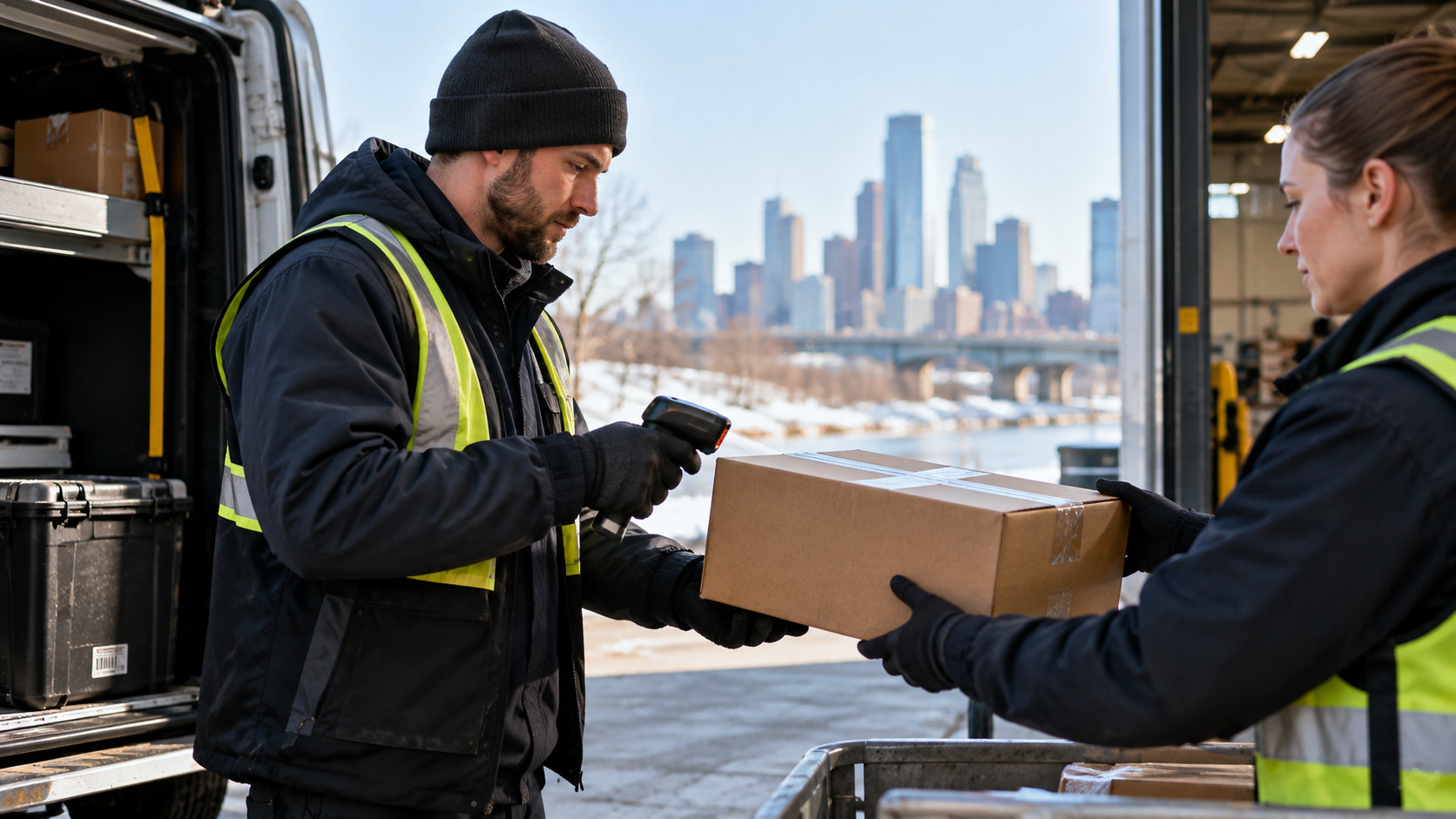
A customer hands a driver a sealed return that the route system marks for special handling. The driver scans it, places it in the vehicle's assigned secure area, and later gives it to station intake. At closeout, the app shows “returned,” but the intake list has no item-level receipt. A Minnesota delivery driver high-value return chain of custody check follows the specific item across each physical transfer. The driver needs to know who accepted it, when, under which request, and what record supports the next handoff. A broad route status cannot fill a missing custody interval.
USPS Registered Mail guidance describes secured processing, acceptance by designated personnel, and a signature at delivery for that service; it also says routine facility-by-facility public scans are not provided. UPS's high-value transport guidance discusses tighter visibility and custody controls. Both examples show why the driver needs actual handoff evidence alongside a customer-facing tracking page. Another employer's return route follows its own handling rules.
The designation “high-value” should come from the current employer task or approved handling instruction. A driver cannot determine a shipment's declared value from its size, logo, or a customer's comment. The goal here is to trace an item already flagged for special handling. The driver records only the events they perform or witness and routes any gap to the team authorized to investigate it.
Start the high-value return handoff record with identity
The high-value return handoff record begins with the exact return authorization, barcode, or item identifier. Match it to the task before taking the item. Check the required piece count, service designation, label, and any seal or container ID the process calls for. A customer may have two boxes from one order; one might carry the special-handling flag and the other might not. Keep their records separate even if they are collected at the same door.
Read the live task rather than relying on a morning printout. A pickup can be canceled, reassigned, or changed after the route is built. If the customer's box has a different barcode from the assigned item, ask dispatch or the designated support team to resolve the identity. Do not attach the box to a similar-looking return because it is clearly expensive or because the customer says it belongs to the same order.
Record the physical condition required by the employer's procedure at acceptance. That may include whether a seal is intact, whether packaging appears open, or whether a serial or container number is visible without opening the carton. Do not inspect contents unless explicitly authorized. A condition note should state what the driver saw at that handoff; it is not a valuation or a claim decision. If the seal is broken or an ID is missing, report it before moving the item farther through the route.
The pickup event should show the time and location of actual acceptance. If a device is offline, preserve the local event reference and follow the approved fallback method. A queued scan can be useful evidence, but it may not yet exist in the central record. The driver needs to know whether the system accepted the event before treating it as a completed digital handoff.
Map each custodian without guessing between scans
A custody chain is a sequence of physical holders. After the customer, the driver may be the next custodian. A helper, route partner, transfer driver, locker operator, or station worker may later receive the item. For every actual transfer, record the item ID, outgoing custodian, incoming custodian, time, location, and approved receipt or event ID. The fields vary by employer, but the question is constant: who had the item after that moment?
A scan may report a status without identifying the person who touched the package. Ask what the scan means in the employer's system. “Loaded,” “arrived,” “returned,” and “received” can mark different stages. A driver arriving at the station with a sealed carton is still its custodian until another authorized person accepts it. Parking the vehicle at the loading bay does not itself transfer responsibility for the return.
Do not fill a gap with assumptions. If a helper took the box while the driver unloaded another stop, ask for the helper's account and any scan or handoff reference. Note that the transfer was not recorded at the time if that is true. Backdating a made-up signature would make the chain look complete while leaving the actual uncertainty unresolved. A supervisor can investigate a missing interval more effectively when the gap is described honestly.
Public tracking may offer only milestones. USPS says Registered Mail does not provide routine scans through every facility despite its secure handling. Other systems may show more. A sparse public page therefore cannot prove that custody was careless, and a dense page cannot prove every physical transfer was valid. Use the employer's item-level records and receipts, with the public view as a separate observation if the case requires it.
Run a secure return custody check during the route
A secure return custody check compares the route's assigned secure items with the items physically present in the vehicle or approved container. Do this at the points the employer specifies, especially after a route handoff, vehicle change, or stop where several packages were moved. Count by item ID, not by a rough number of boxes. One missing high-value return cannot be reconciled by finding another carton of similar size.
Store the item in the designated place and follow any required seal, cage, or lock process. The driver should not invent a more “secure” location that the next worker cannot access or that lacks an intake path. If a container seal number is part of the procedure, record the number actually applied and verify it at transfer. A seal number typed from memory after the shift is weak evidence if a mismatch later appears.
When the route vehicle changes, the driver should identify whether the item moves with them, stays in a sealed vehicle, or goes to another custodian. “Changed vans” is not a custody event for the package unless the package's location is known. Record the old and new vehicle or container references through the authorized system, along with the receiving person when custody changes. If the item remains locked in the original vehicle, tell dispatch who controls that vehicle and where it is.
If a package is temporarily inaccessible because a secured container cannot be opened, do not claim a physical count that did not happen. Record the container ID and intact-seal observation if those are the allowed checks, then mark item-level verification as pending until the authorized opening. This distinction lets the next team see what was actually verified at the time.
Use a receipt at every real transfer
At a driver-to-driver transfer, scan both sides if the employer's tool supports it. The sender should confirm the exact item leaving their custody; the receiver should confirm the exact item arriving. A route-level “transfer complete” may cover several packages and conceal a missing one. Reconcile the item list before either worker departs. If one barcode will not read, use the approved exception path and preserve the unreadable label evidence.
At station intake, ask for the item-level receipt or equivalent reference. Confirm the receiving worker or desk, handoff time, location, and item ID. A tote-level count can help, but it may not prove this return is inside the tote. If a sealed container is accepted without opening, record both the container reference and who is responsible for later item-level verification. Do not represent a container scan as an individual parcel inspection unless the process actually makes that link.
If an intake worker refuses the item because the task is missing, the seal is broken, or the barcode conflicts, the driver still holds it. Ask the station lead for a secure temporary disposition and document the refusal. Do not leave the item on a counter while the app says “returned.” The physical handoff and digital status must eventually agree, but an incorrect scan cannot substitute for acceptance.
When a station worker accepts the item and the driver device shows “upload pending,” preserve the receipt and original queued event ID. Ask support to reconcile that event. Sending another return scan immediately may create duplicate histories or conflicting timestamps. The driver can prove a physical handoff with the station receipt while accurately describing the digital state as uncertain.
Spot gaps that need supervisor investigation
Some discrepancies are simple to identify but require a named owner to resolve. A customer handoff appears in the route app, yet no station receipt exists. A station receipt lists the right tote but not the return ID. A container seal at intake differs from the one recorded at loading. A transfer scan shows a receiver who says they never handled the item. Each case needs its own evidence and a specific next check.
Start with the last verified custodian and item location. If the driver still has the box, the immediate task is secure storage and a corrected handoff. If the station has physically accepted it, obtain the receiving worker's evidence and ask support to repair the record. If no one can locate it, follow the employer's missing-item or security incident path promptly. Do not create a clean intake scan from memory to make the route screen look complete.
Preserve failed or uncertain attempts. A scan error code, offline queue ID, photo upload failure, or rejected receiving signature explains why a record is absent. Save the exact timestamp and item ID in the approved case. A later repair should link back to the original attempt. Repeating the same action without resolving its cause can make it harder to distinguish one physical transfer from multiple digital writes.
A driver should not independently accuse a coworker or customer based on a gap. The gap says the record cannot currently account for the item, or the item cannot currently be located. The designated supervisor can compare vehicle logs, station intake, device history, and direct accounts under the employer's process. The driver contributes precise observations and keeps the current physical item secure if it remains with them.
Test the chain with a three-person return
Imagine a customer gives a driver one sealed, flagged return at 10:00. The driver matches return ID R318 to the active pickup, records the seal as intact under the approved task, and places the box in the assigned secured container. At 12:00, a route partner takes over. Both workers check R318 and record the transfer. At 16:00, the partner brings the container to station intake, where an authorized worker signs for R318. The chain has four documented custodians: customer, first driver, route partner, and station intake. Each change has its own time and item reference.
Change one fact: at noon the partner signs for the sealed container, but the item-level list does not show R318. The first driver should not call R318 transferred merely because the container moved. Record the container seal and the missing item-level confirmation, then ask the route owner how to verify the contents under the approved process. The partner may have the physical box, but that needs an authorized check rather than a guessed scan.
Change another fact: station intake signs for the container at 16:00 but finds R318 absent when it opens it. The partner's prior seal observation and the station's receiving seal record now matter. Preserve both, identify the last verified item-level check, and open an incident. Do not rewrite the noon transfer or station receipt to claim the box was definitely present at 16:00. Those records should show exactly what each person checked.
If the station instead confirms R318 physically present but the device shows it assigned to the first driver, the problem is a digital custody mismatch. Keep the station's item-level receipt and the original transfer events. Support can reconcile the route state against those receipts. A new pickup scan would falsely imply the customer handed over the same box again.
The hypothetical value designation does not reveal the contents or a dollar amount. The check works because it tracks a flagged item with verifiable handoffs. It remains useful for any service that asks for tighter custody control, provided the driver follows that service's actual rules.
Keep security details inside approved channels
High-value handling records can contain customer names, addresses, item descriptions, seal numbers, and location information. Use the employer's approved case or scan system. Do not send photos, access codes, or container locations through personal accounts or public messages. A customer asking for a live location may need to use official tracking or support, especially when the internal record exposes secure storage details.
The driver should share enough information with the next authorized custodian to complete the handoff: exact item ID, required handling flag, condition exception, and case reference. Avoid broad statements such as “expensive package in the van” when the actual task is to identify one secured return. Precise, limited disclosure helps the receiving worker locate and verify the item without spreading sensitive details.
An unusual route delay does not excuse leaving the item unattended outside the approved secure process. Ask dispatch where the flagged return should go if the planned station is closed or the transfer worker is unavailable. Record the changed destination and accepting person when a new handoff occurs. Until then, the driver remains the last known custodian if the item is still in their vehicle.
If an incident arises, preserve the original records. A corrected event may be necessary, but it should be linked to the mistake it corrects. Deleting a failed scan, changing a handoff time, or replacing a condition photo can make the sequence impossible to reconstruct. The supervisor needs the actual timeline, including uncertainty, to determine the next authorized action.
Close at the last independently supported handoff
Before ending the route, compare the flagged-return list against the vehicle, transfer receipts, and station item-level intake. Each return should have a current custodian supported by a real event. If one remains in the vehicle, arrange the approved secure handoff rather than marking it complete. If it reached intake, the receiving record should identify the same item and the person or unit that accepted it.
The driver's final note should stop at the last event they can support. A station receipt can establish station custody, while later inspection, insurance, repair, or forwarding belongs to other teams. “Received by station intake at 16:00 under R318” is clear. “Safely delivered to the merchant” reaches beyond the driver's knowledge unless that later event was separately verified.
For drivers considering roles that involve special-handling returns, the Saint Paul delivery driver Careers hub is the current entry point. The published delivery job-offer review guide can help a candidate ask what training, equipment, and support the employer supplies. On an actual route, the controlling answers come from the assigned service instructions and item-level handoff records.
If a receipt or transfer is missing, name the exact gap and its last verified custodian. That gives the supervisor a place to investigate and keeps the route from declaring a high-value return complete on the strength of a general status label. Every person in the chain should be able to say what they accepted, what they passed on, and which record supports that change.