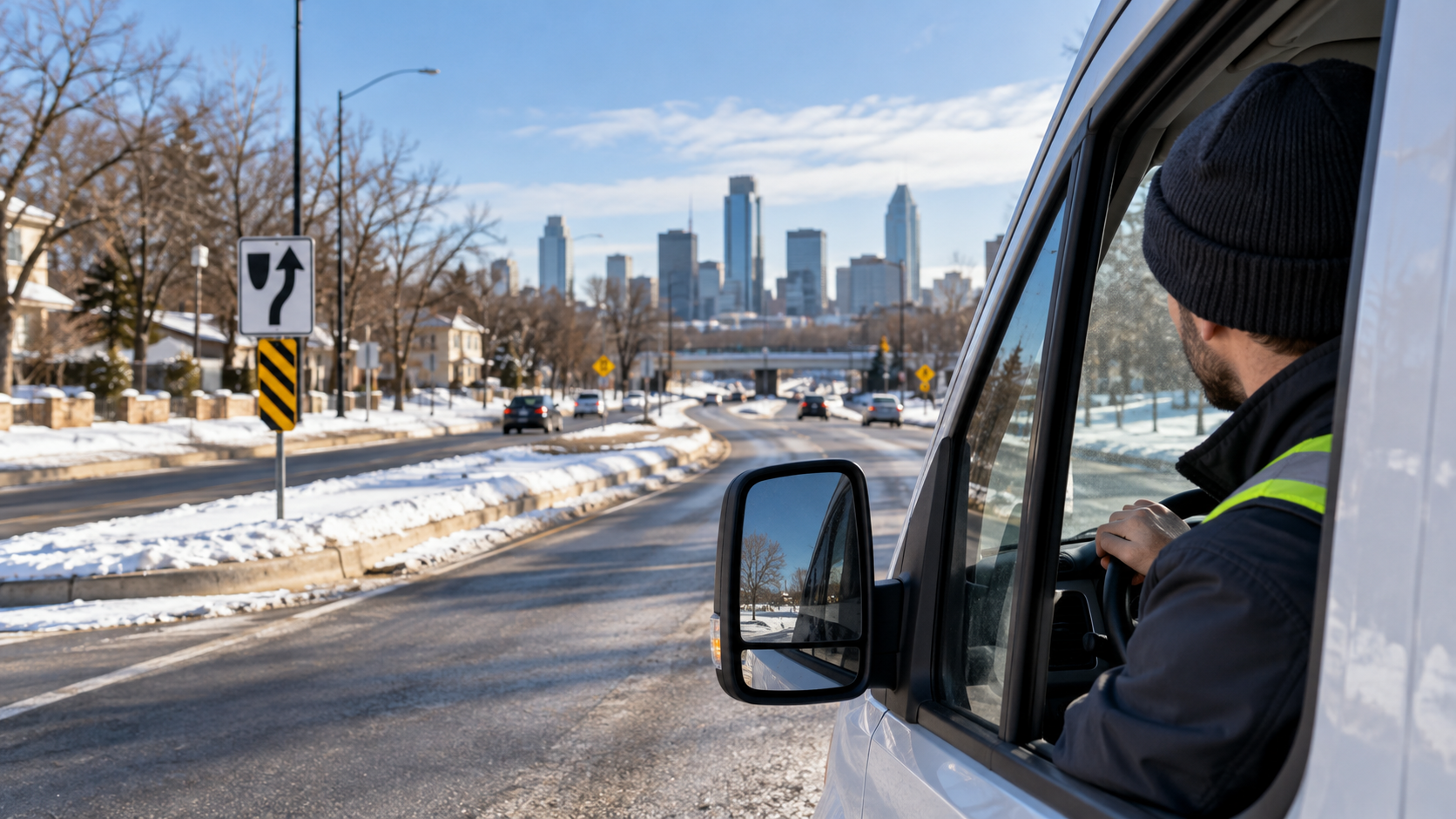
The next delivery is now behind the van. Perhaps the app announced the stop late, the address was on the opposite side of a divided road, or the driver passed a driveway before recognizing it. The impulse is to get back immediately. A quick U-turn or reverse move can look efficient on a map while being prohibited or unsafe in the actual lane. The better first move is to continue lawfully and plan a return route that fits the vehicle.
A Minnesota delivery driver legal turnaround plan starts with the road ahead, not with the missed pin. Stay in the lane's permitted movement, find a lawful place to pause if you need to inspect the map, and compare options such as a permitted U-turn, a block loop, or a later approach from another street. Check signs, sight distance, traffic, and the assigned vehicle's dimensions. If a short return is unavailable, tell dispatch what route and delivery window changed.
This guide covers a missed or reordered stop that is behind the driver. It does not decide how to enter a private driveway, handle a newly closed road, or interpret every possible turn restriction. Minnesota's turning and traffic-control rules apply to the real maneuver, and employer vehicle-routing policy may be stricter. A route app can suggest a path; it cannot approve the turn.
Keep moving lawfully after the missed stop
Do not brake hard in a through lane or reverse toward the address. Continue under the current signs and signals until you can choose an appropriate turn or safe stopping place. A driver who misses a side street can usually solve the route with a later legal movement. The missed stop is a service issue; a sudden maneuver introduces a separate road risk.
Notice which side of the street the destination is on and whether the road has a median, one-way section, turn lane, or limited access. Those features may explain why the app's immediate return path is impossible. If you cannot read the map without looking away from traffic, wait until lawfully stopped. A quick attempt to drag the pin while moving can consume the attention needed to read the next intersection.
Minnesota Statutes § 169.06 addresses obedience to applicable traffic-control devices. Follow posted turn restrictions, lane arrows, signals, and authorized direction. Do not treat the app's “make a U-turn” prompt as an exception. If a sign forbids the movement, keep going and evaluate the next lawful option.
Keep the package secure while rerouting. Do not unload it on an unsuitable curb because you are near the address, and do not mark a delivery attempt when you merely passed the building. The route record should reflect the actual stop attempt and any later return, not an estimated event created to keep the app sequence tidy.
Map a missed delivery stop return route
A missed delivery stop return route should be a complete path back to the correct entrance, not merely an arrow pointing opposite your present direction. Look for public streets that permit the vehicle to turn around a block or approach from a safer side. Check one-way streets, restricted turns, traffic signals, and whether the next intersection supports the vehicle's size. A legal loop can be longer than a U-turn and still be the better route.
If the road is divided, identify a permitted crossover or interchange rather than trying to cross a median or use a gap intended for another movement. If the destination is behind a one-way block, approach through the legal street network. A navigation app may propose an alley or private drive as a shortcut; verify public access and employer policy before using it. Do not turn onto a narrow road without a known exit just to reverse direction.
At a safe stop, compare the return route with upcoming deliveries. If the missed stop has a time window and the next stop is nearby, dispatch may prefer an altered sequence. Ask when the choice affects commitments. Do not silently skip a stop and later claim it was impossible to reach. Record why the order changed and the new plan.
The return route should end at a workable delivery access. A legal turn can bring you to the correct block but leave the entrance on a busy curb with no lawful stopping space. Check that separately. If the address is on a side street or has a receiving entrance, use the employer's current instructions. The goal is an actual deliverable approach, not simply reaching the map pin again.
Evaluate a safe U-turn alternative
A safe U-turn alternative may be a block loop, a permitted signalized turn, or another public route that brings the vehicle back without reversing direction in a constrained place. The term does not mean every U-turn is prohibited. Minnesota Statutes § 169.19 sets conditions on turning to proceed in the opposite direction, including safety and interference with traffic, and limits U-turns near certain curves and grades. Read the current provision and the posted controls for the actual site.
If a U-turn is allowed by signs and the road layout, still ask whether it can be completed safely in the assigned vehicle. A box truck may need a larger turning path than a compact van. Do not start a multi-point turn in live traffic because the app says it is the shortest route. If the vehicle cannot complete the turn without crossing into unsafe space or obstructing traffic, continue to another route.
A block loop may have its own restrictions. Check each turn, not only the first. A driver who turns right three times may end up at the same restricted approach or in a one-way street moving away from the customer. Preview the full sequence from a safe stop. If the app keeps routing to the same prohibited movement, ask dispatch for a vehicle-appropriate approach.
Do not use a private driveway as a default turnaround. The property may be narrow, occupied, or closed to commercial vehicles, and reversing from it into a busy street can be hazardous. If the employer or property owner has an approved delivery access plan, follow that plan; otherwise use public roads where a lawful turn can be made. A driveway that looks empty from the street is not proof of permission or room to turn.
Compare complete options before choosing the shortest line
At a safe stop, list two or three plausible return paths. For each, check the first movement, every later turn, vehicle suitability, and where you will approach the customer. A path that looks short on the map can fail at a one-way street, a no-turn sign, a low clearance, or an intersection too tight for the van. A complete path includes a legal way to leave the delivery site afterward, not only a way to arrive.
Option A might be a permitted U-turn at a signalized intersection with adequate space and visibility. Option B might be a loop on public streets. Option C might be continuing to the next stop, then returning later when the route naturally comes back. The driver should not rank them by distance alone. Consider signs, traffic, time window, package size, and how the vehicle will stop at the address. Dispatch may decide that C better protects the rest of the route if stop order is flexible.
If the app offers only one route and it includes an uncertain maneuver, ask for another map view or dispatch guidance after stopping. Do not keep selecting “reroute” while moving until the app displays an answer you like. If a road has a temporary restriction, label it in the inquiry so dispatch knows the app's suggestion may be stale. A human route decision still needs current road evidence.
The plan should be short enough to execute without studying a screen at every turn. Note the next lawful intersection, a cross street, and the approach side. Then put the device in its approved position and drive. If an unexpected sign changes the plan, continue lawfully and pause again. A driver does not need to force the original option once new evidence appears.
Coordinate the return with other stops
The missed stop may be one of several in the same neighborhood. Check whether returning now will require passing other scheduled stops twice. If those stops have no urgent window, dispatch may approve a loop that serves them in a new order. If one has a timed pickup or a business closing time, the better plan may be to complete it first and return to the missed address later. Record the authorized order rather than silently reshuffling customer commitments.
Keep physical package access in mind. A route bag sorted for the original sequence may place the missed stop's parcel behind several later items. Do not rearrange cargo while driving or unload multiple parcels at a traffic curb to retrieve one. At a safe stop, find the right package and restore the load under the employer's method before reentering traffic. The return route has to work with the actual van, not only the map.
If dispatch transfers the stop to another driver, confirm who receives the package and when. An app reassignment may precede a physical handoff. Keep the item secure and do not mark it transferred until the employer's custody step occurs. If the customer is notified of a new ETA, let the operation give that promise. Your route note can state the observed missed approach and final disposition without speculating about the other driver's arrival.
Use a short example to compare options
Suppose a driver passes a storefront on a divided road. The app says “U-turn in 200 feet,” but a sign prohibits the turn at the next intersection. A public cross street two blocks farther leads to a loop that returns on the storefront side. The driver should continue to the legal loop, checking each sign and the vehicle's fit. The extra distance is part of the route correction. These are hypothetical streets; no real intersection is approved by the example.
Change the vehicle from a van to a longer box truck. The same cross street may be too narrow for the required turn or have a truck restriction. The driver should not assume that a path that worked in the van remains suitable. Ask the employer for a truck-appropriate route or continue to a larger permitted intersection. The delivery pin stays the same while the maneuver decision changes.
Change the service window: the missed stop closes receiving in ten minutes. That urgency affects dispatch's stop-order decision, not the legality of a turnaround. Tell dispatch the location and possible lawful return time. The employer may ask another driver to handle it or approve a later attempt. Do not promise to reach the dock by making an unverified turn.
If the loop returns to the address but there is no legal place to stop, the driver has a new access question. Record what you observed and ask for a loading area or alternate entrance. Avoid repeating the loop until a curb opens if that would create traffic conflicts or consume the rest of the route without a plan.
Pause to review the route only where stopping is lawful
When you need a map, choose a lawful place outside traffic. A red light or congestion queue is still part of driving, not a route-planning station. If no suitable curb is nearby, continue to one. Use the employer's device policy and do not type a dispatch message while moving. The return plan can wait a few blocks.
At the stop, verify the exact address and delivery entrance. A nearby building number may have pulled the pin to the wrong side of a block. Check the package ID and customer note in the approved system. If the stop was moved by dispatch while you were driving, confirm whether it is still assigned to you before planning a return. A route change can make the apparent “missed stop” no longer yours.
NIOSH's work-driving information provides general context for reducing road risk. In this situation, a safe pause allows the driver to inspect a complete route rather than react to a short prompt. The source does not decide which intersection is legal for your turn; signs, traffic, and vehicle fit do.
If dispatch gives a route verbally, repeat the streets and any vehicle restriction back. A dispatcher may not see the sign you observed. Tell them if a proposed turn is posted against your movement or unsuitable for the assigned vehicle. The driver should retain enough of the instruction to follow it without repeatedly looking down at the device.
Keep the stop status and timing truthful
Record when the stop was missed or reordered if the employer's system asks. Do not create a “delivery attempted” scan merely because you drove past the address. An attempt normally relates to actual arrival and the employer's proof process. If you later return and deliver, use the real completion time. A detour note can explain why the route order and ETA changed.
If a customer-facing ETA is affected, tell dispatch the likely delay and the reason in plain terms. “Passed entrance; legal return requires a block loop” is better than an unexplained late status. If another driver will take the stop, document the transfer under the employer's procedure and confirm the package physically changes hands when required. A reassigned screen alone may not move the parcel.
Do not modify the original route history to hide the missed turn. A route plan and actual route can differ for ordinary reasons. Keep the corrected path, actual times, and any dispatch instruction visible. That information can help route planners adjust a pin or approach note for future drivers without blaming someone for taking a legal detour.
If the stop remains behind at the end of a shift, follow the employer's return or exception process. Do not leave the package in the vehicle unrecorded. The final state should say whether it was delivered, transferred, or returned, and the physical item should match that status.
Learn from repeated missed approaches
If several drivers pass the same entrance, report the address, approach direction, turn restriction, side of road, and better lawful access. A map pin at the rear of a building can make the next stop appear later than it is. A note such as “receiving entrance on Oak Street; approach from south to use permitted turn” may be useful if verified and approved by the route team. Label any time-limited restriction with its hours.
Keep the advice specific to the vehicle and current road conditions. A turn suitable for a van may not suit a larger truck. A construction detour can change the approach for a week. Do not write a permanent “always turn here” instruction based on one shift. The next driver should still follow current signs.
Drivers comparing delivery roles can ask how routes are corrected when navigation is wrong or stop order changes. The published delivery job offer review guide can help identify which support is promised. The Saint Paul delivery driver Careers hub provides broader job context. Neither page gives a turn permission at a real intersection.
Before returning, verify the selected route's full turn sequence and the delivery entrance. If dispatch moves the stop to another driver, reconcile the physical package handoff before closing your assignment.