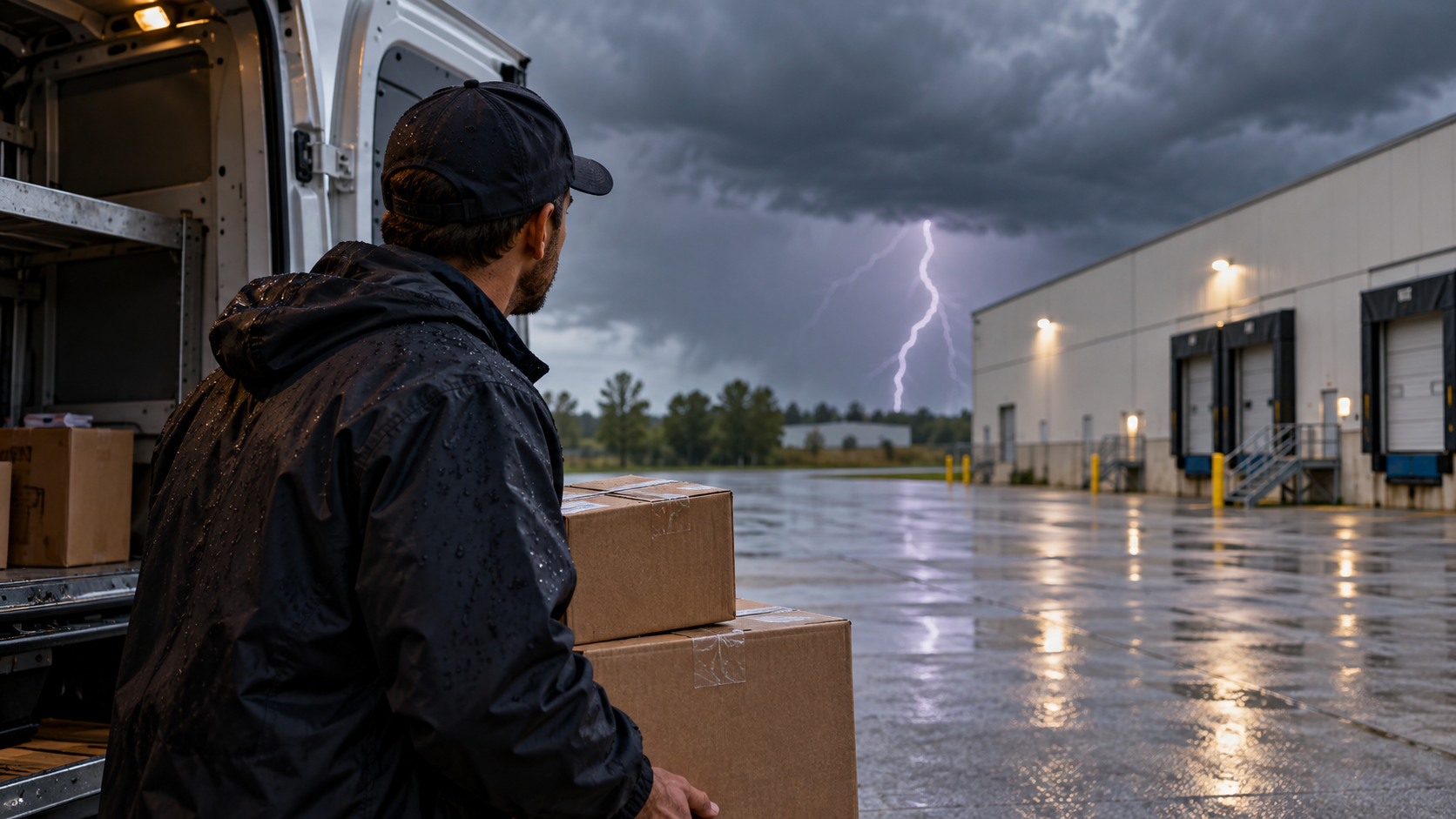
The driver has parked at a warehouse and is about to carry two parcels across an open yard. Thunder sounds beyond the building. The receiving door is visible, but the walk and signature could take several minutes. The parcels are still in the van. Starting the handoff now would put a person outside for a task that can wait.
A Minnesota delivery driver lightning stop response puts shelter before the scan, signature, or customer deadline. The National Weather Service says that if thunder can be heard, lightning is close enough to strike and people should move immediately to a substantial building or enclosed metal-topped vehicle with windows up. There is no safe outdoor place during a nearby thunderstorm. A covered dock, porch, open garage, or doorway that leaves the driver outside should not be treated as equivalent to shelter.
The route still needs a plan. The driver should tell dispatch where the vehicle is, where the parcels remain, and that the outdoor handoff has stopped. When conditions change, the team can decide whether the driver resumes, another worker takes the stop, or the parcel is returned under the employer's procedure. The lightning decision is about the people at this stop first; a late-delivery code comes later.
Stop an outdoor task when thunder is heard
The NWS workplace guidance advises workers not to start a task they cannot quickly stop when storms threaten. On a delivery route, that means avoiding a long carry, a multi-parcel unload, or a wait in an open yard once thunder is audible. Close and secure the cargo door under the vehicle's normal procedure if it can be done without delay, then get to safe shelter. If the parcel is already in the driver's hands, follow the employer's emergency plan and prioritize reaching shelter rather than completing a scan.
Do not judge safety from rain alone. Lightning can be close enough to matter when a stop looks merely cloudy, and a heavy rain shower without thunder is a different problem. The driver can use current forecasts and alerts to plan, but the audible thunder at the stop is a direct trigger for shelter under the NWS guidance. A weather app that has not updated is not permission to finish one more outdoor delivery.
If another person is about to walk out to meet the driver, tell them the handoff is pausing and direct the coordination through the employer's approved channel. Do not ask the recipient to stand in the open with a phone or signature device. The package can remain secured until people can meet under the shipment's rules after the hazard window.
Plan shelter before the first outdoor unload
Thunder may not have started when the driver reaches the stop, yet dark clouds, distant lightning, or rising wind can show that a storm is approaching. The NWS job guidance tells outdoor workers not to begin a task they cannot stop quickly when thunderstorms threaten. Before opening the cargo area, identify where the driver and any helper would go if thunder begins. A long walk across an open lot should not start with no shelter plan at the far end.
Check the current forecast or alert through the employer's approved source, then compare it with the visible conditions at the site. An app may show a storm cell nearby without a thunder sound at the stop; it can help the team decide to postpone an exposed delivery early. If the driver hears thunder, the NWS shelter instruction applies immediately. Do not wait for the app to display a red warning or calculate the storm's distance from a flash.
The route plan can be changed while the driver is sheltered or still inside the vehicle. Dispatch may move a long outdoor stop later and serve an indoor-access stop after the storm, if travel itself is appropriate and the employer approves the sequence. The driver should not assume that an indoor recipient can be reached without crossing an exposed yard. Check the actual path and delivery rules before calling any stop a safe substitute.
If a helper is assigned, agree in advance who will close the vehicle, who will account for parcels, and where both people will shelter. No one should stay outside to guard a package while the other person goes indoors. The parcel's security can be handled through the employer's custody process after people are safe.
Choose a lightning shelter route hold
A lightning shelter route hold needs a real safe location. A substantial building with electricity or plumbing is one NWS example. An enclosed, metal-topped vehicle with windows up is another. The driver should know which option is reachable from the current position without lingering in the open. A thin canopy, exposed loading dock, picnic shelter, or tree does not offer the same protection. Do not move from a safe vehicle to an open porch because the recipient says the parcel can be left there.
If the delivery van is a suitable enclosed metal-topped vehicle, stay inside with windows up and doors closed while waiting. The vehicle's roof, not rubber tires, is the relevant protective feature in the NWS shelter guidance. If the van is open, soft-topped, or otherwise unsuitable, use a substantial building identified in the employer's plan. Do not improvise a shelter by standing against the vehicle or under its open cargo hatch.
Tell dispatch the shelter location and whether the vehicle can remain legally parked there. If it blocks a lane or dock, follow the employer's safe vehicle-movement instructions; do not make a long exposed walk to solve a parking inconvenience. The supervisor may need to contact the site or move the route plan while the driver remains sheltered.
Report thunder near a delivery stop without guessing distance
A thunder near a delivery stop report should name the location, time thunder was heard, current shelter, open parcel count, and immediate route impact. “At warehouse 4, thunder heard at 2:16, driver inside closed van in legal visitor space, two parcels still aboard, outdoor handoff paused” is a hypothetical example. It gives dispatch usable facts without estimating how many miles away the strike occurred.
Describe observations separately from forecasts. A weather alert may cover the region, while the driver heard thunder at this property. A flash may be seen but no sound heard yet. Tell the route owner what happened and use the employer's weather procedure. Do not claim a storm has passed because rain stopped for a minute or because the sky looks brighter on one side of the yard.
Keep the parcel state precise. If the driver did not unload, say so. If a package was left at a dock before thunder, record whether an authorized recipient actually accepted it or whether it remains unattended under a rule that permits that placement. A photo taken before the hazard does not prove a signature happened afterward. Dispatch can update the customer while the driver is sheltered.
Work through a warehouse handoff interrupted by thunder
Imagine a driver with two parcels for a warehouse. One requires a signature from an authorized receiver. The van is in a legal visitor space, and thunder sounds before the driver opens the cargo door. The driver remains in the enclosed van, closes the windows, reports the stop hold, and tells dispatch both parcels remain aboard. The receiving clerk is informed through the site's approved contact channel that the handoff will wait.
The driver notes the last audible thunder for the company's lightning procedure. At 2:45, suppose another thunderclap is heard. The safe-wait period starts from that later sound, not from the first report. NWS Lightning Tips says to stay in safe shelter at least 30 minutes after the last thunder. When the interval has passed, the driver checks current conditions and the employer's route instruction before stepping out. The warehouse may still have an outdoor access problem, so the handoff is not automatically complete at the end of the clock.
If the yard is safe to use under the employer's process, the driver takes the correct parcels to the receiving point, obtains the required signature, and records the actual handoff. If dispatch reassigned the stop during the hold, the driver first reconciles who owns the task and where the parcels are. A schedule change does not make two parcels leave the van.
Change one fact: the driver had already carried one parcel into a substantial building before thunder sounded. The driver remains sheltered there under the site and employer plan, tells dispatch where the parcel and driver are, and does not run back across the yard to the van. Custody and any accepted handoff need a factual record. Change another fact: the driver is at an open residential porch, not in a substantial building. Return to the safe vehicle or other real shelter promptly; the porch roof is not enough.
Use the last thunder, not the first lull, to plan a return
NWS guidance calls for at least 30 minutes in safe shelter after the last sound of thunder. A quiet spell followed by new thunder resets the practical wait. Record the most recent sound so dispatch knows why the route remains held. The driver should not promise a recipient an exact release time while thunder is still recurring. The customer can be given a pending update through the employer's channel.
The 30-minute rule is a minimum safety interval from the last thunder, not a delivery guarantee. Weather may remain severe for another reason, the van may need to be moved to a legal position, or the site may close its receiving door. After the interval, reassess the actual route and entrance. A driver should not treat a clock notification as proof that every outdoor condition has cleared.
If the next stops are outdoors too, discuss the broader route with dispatch while sheltered. Moving the vehicle to a different address may not solve an active thunderstorm. A route change can be planned, but it should not require the driver to step outside prematurely. Keep open parcels matched to the van and driver until a real transfer occurs.
Keep indoor shelter and delivery authority separate
A warehouse lobby may be a substantial building where the driver can shelter. That does not automatically make its reception desk an authorized recipient for every parcel. Follow the shipment's identity, signature, or location rules when the handoff resumes. A person offering refuge should not be pressured to accept an item they are not permitted to receive.
Likewise, the driver can remain in a safe vehicle without claiming the delivery was attempted at the door. A route app's geofence may record arrival near the address, but the driver has not reached the receiving point. Use the employer's hold or exception status that reflects a weather interruption. If no code fits, ask dispatch rather than choosing recipient-unavailable or delivered.
If the site contact proposes an indoor path from a sheltered garage to the recipient, verify that it is both safe during the storm and authorized for the vehicle and shipment. Do not walk through an open dock or outdoor breezeway because the final room is indoors. The route owner can coordinate with the property while the driver stays sheltered.
Account for a driver already outside
A driver may hear thunder halfway between the van and the receiving door. The immediate decision is which substantial building or suitable enclosed vehicle can be reached most directly without continuing the delivery task. Do not stop in the yard to finish a device entry or take a placement photo. The NWS lightning guidance says to move to safe shelter immediately. A package in the driver's hands can be carried into shelter if that is the safest movement; its delivery status can be sorted out after the person is inside.
If the receiving building is already open and substantial, go inside under the site and employer procedures. If the driver has to return to the metal-topped van, close its doors and windows once inside. An open cargo bay, open-sided dock, or awning on the way is not a substitute shelter. Avoid standing under an isolated tree or beside tall equipment while deciding. The NWS guidance identifies those as hazards during lightning.
From shelter, report the driver's location and the parcel's location separately. The driver may be inside the building holding a parcel, while the remaining load stays in the van. A receiving clerk may accept the item only if the shipment's handoff rules are satisfied. Do not mark all parcels delivered because one reached a building. If the driver left a parcel in an authorized location before thunder, record that completed event with its real time; later parcels remain open.
If no safe shelter was reachable at the moment thunder began, follow the employer's emergency guidance and seek the best available safe location promptly. Do not turn the last-resort outdoor risk-reduction advice into a planned delivery method. The route can be held and customers updated once the driver is in shelter.
Know when an emergency response replaces route work
If someone is struck or collapses during a storm, call emergency services and follow trained first-aid and employer emergency procedures. The NWS workplace page says lightning victims do not carry an electrical charge and need urgent medical attention. A driver should not delay an emergency call to complete a scan or report a weather code. Dispatch can handle the parcels and customer updates while the people receive help.
If lightning damages the vehicle, power lines, or the property, keep away from hazards and follow emergency direction. Do not touch a downed line or drive into a hazard to reach the next stop. This is no longer a routine delayed handoff. Report the exact observation, location, and people involved to the responsible emergency and fleet channels. Avoid naming a cause for damage that has not been confirmed.
The route record can be finished later by a supervisor or replacement driver. It should show which parcels remain aboard, which were physically transferred, and which were accepted by recipients before the emergency. A stopped task is not an automatic delivery failure or return-to-station event.
Resume with a new stop and parcel check
After the safe wait and employer release, confirm the receiving point is still open and the parcel still belongs to this route. Check the vehicle's position, doors, and load before unloading. The storm may have left debris or standing water on the path, creating another access issue that needs its own decision. A lightning hold ending does not certify the walkway.
Perform the handoff under the original shipment rules. If another driver accepted the parcels during the hold, the first driver should not resume them from an old task list. If the parcels remained in the van, record the later actual delivery time rather than backdating it to the first arrival. Keep the last-thunder and release notes in the route record so the delay has an understandable sequence.
Drivers comparing roles can use the Saint Paul delivery driver Careers hub and the published delivery job-offer review guide to ask who can pause outdoor work for lightning and how dispatch handles those stops. On a live route, the driver can stop the outside task at thunder, use real shelter, keep parcels accurately assigned, and resume only after the safe interval and a fresh site check.