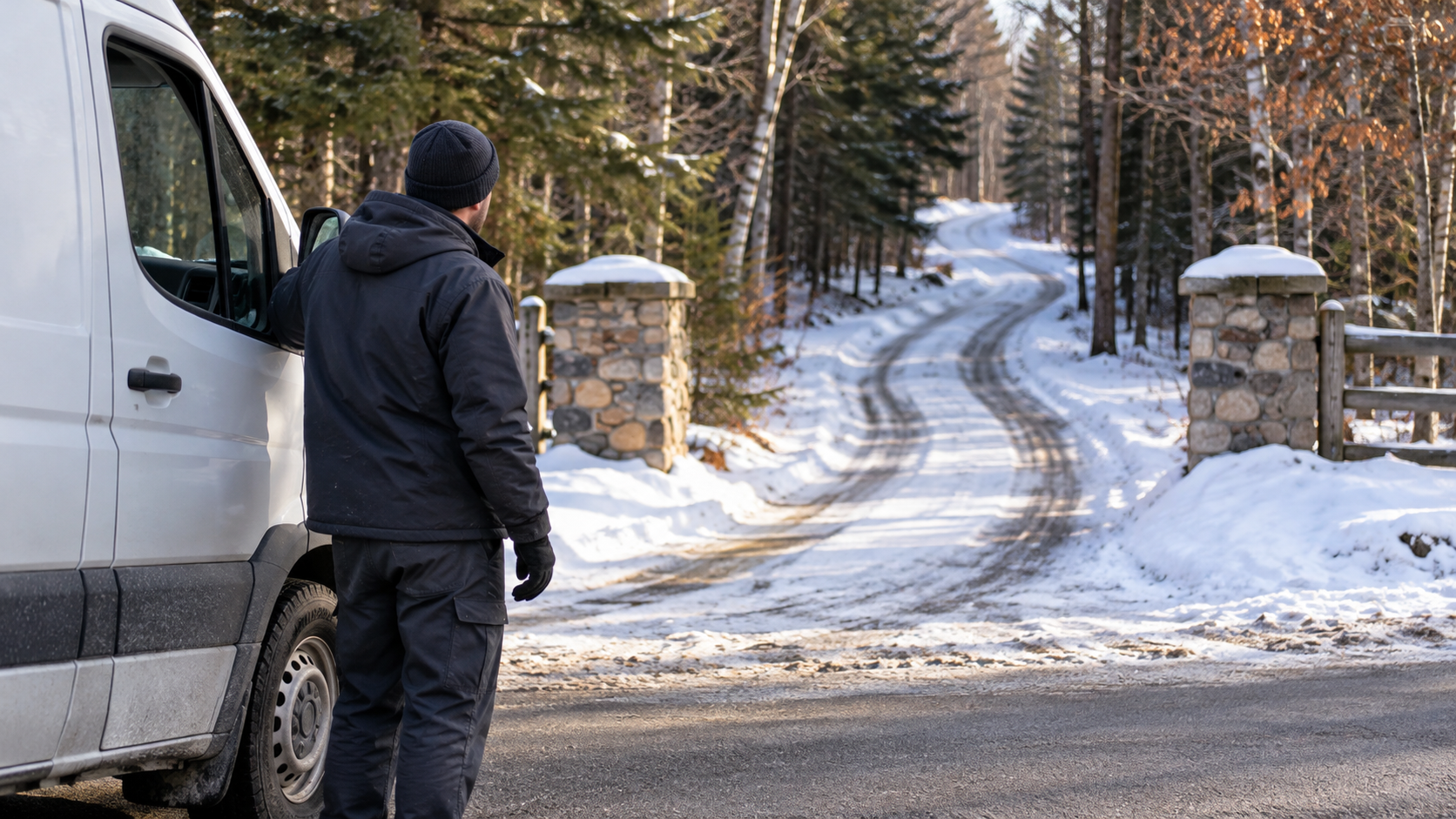
The delivery address sits at the end of a long driveway. From the public road, the driver can see a narrow entrance and perhaps the first bend, but not the house or a place to turn the van. The route app draws a line to the building as if entry were simple. Once inside, the driver may have no room to reverse direction and may face a long backing movement toward traffic. The useful time to ask about that exit is before entering the driveway.
A Minnesota delivery driver long driveway turnaround decision compares the vehicle, private approach, package, and available alternative. Can the assigned vehicle enter, pass any narrow or low points, reach an authorized unloading place, and leave without an improvised backing maneuver? If those facts are unknown, stop lawfully outside the traffic flow and ask the customer or dispatch about the property's delivery access. Do not use the driveway as a test track.
This guide focuses on a long private driveway with no obvious turning space. It does not replace the rules for a public-road U-turn, a garage clearance check, or general vehicle routing. A customer's delivery instruction may help locate an entrance, but it does not establish that the van can turn at the far end. The employer's vehicle policy and the actual property determine whether entry is appropriate.
Check the driveway before the front wheels enter
From a lawful stopping point, observe the driveway width, slope, surface, overhead branches or wires, gate, curves, and visibility toward the end. A driveway that looks wide at the road can narrow behind a hedge or bend. A paved entrance can turn to gravel or mud. A low limb may matter for a roof-mounted unit. If you cannot see enough to know the van can proceed and leave, do not infer the missing section from the map's smooth line.
Check whether the property actually invites delivery vehicles to use the driveway. A sign may say private road, no trucks, or deliveries at a separate entrance. The customer may have listed “front door” as the drop point while the building has another vehicle access. Ask through the employer's approved contact method. Do not assume a gate that opens for a passenger car has room for a long van or permits commercial access.
Know the assigned vehicle's size. A substitute van may be longer or taller than the one that served the address last week. Confirm relevant dimensions from the employer's vehicle record, including mounted equipment. Do not use a coworker's “it fits” memory without knowing which unit they drove and which approach they used. A place that works for a small van may trap a larger one.
Minnesota Statutes § 169.19 addresses turning and starting movements in the situations it covers. That is road context for planning a lawful entrance and exit from a public roadway. It does not certify a private property's geometry. The driver still needs a physical way to turn and leave the site under the employer's trained method.
Make a driveway exit visibility check
A driveway exit visibility check asks what the driver can see when leaving the property. Even if there is space to turn at the house, a hedge, hill, curve, or busy road can limit sight lines at the driveway mouth. If the plan requires backing out, the visibility problem may be worse. Do not commit to a long reverse toward a road you cannot watch adequately. Ask for a different delivery approach or trained assistance under employer policy.
Look for a clear path from the unloading point to the exit. Parked cars, trailers, landscaping, and snowbanks can take away a turnaround that appears on an aerial image. The image may be months old. A customer may say “turn around by the barn,” but the driver should verify that space is open and suitable for the assigned vehicle today. If the end cannot be inspected before entry, ask how the site normally receives delivery vans.
Consider traffic on the public road. A narrow driveway opening onto a high-speed road can make a slow reverse hazardous. The driver cannot solve that by asking another person to stand in traffic without an approved safety plan. A customer waving from the porch cannot see every approaching vehicle or the van's blind spots. Use the employer's backing and spotter training, and seek an alternative if the maneuver cannot be done under it.
NIOSH's motor vehicle safety information provides broad work-driving context. It does not endorse a particular driveway maneuver. The practical application here is to plan the exit before entering a constrained private approach, especially when sight distance and backing would become part of the route.
Ask about no turnaround delivery access
no turnaround delivery access means the driver has not identified a usable turning point; it does not mean the customer cannot receive the package. Ask whether there is a legal surface stopping place on the public road, a second entrance, a circular drive, a designated receiving area, or a place where an authorized recipient can meet the driver. Each option needs its own checks for permission, traffic, vehicle fit, and package handling.
A small parcel may be carried from a lawful parking space if the walking path is safe and the employer permits it. A heavy carton or item requiring a cart may make that option impractical. Do not leave a parcel at the driveway mouth just because the van cannot enter. Ask dispatch whether another vehicle, assisted delivery, or later appointment is needed. The package and site both shape the decision.
If the customer says a second entrance exists, ask for the exact street and gate, then verify that the vehicle can use it. The map pin may still point to the original driveway. A verbal “come around back” can hide a low garage, restricted private lane, or locked gate. Confirm the access before moving and let dispatch know if it changes the route materially.
If the employer has a prior delivery note, read its date and vehicle context. A note that says “turn around at top” may have been written before a new fence or parked trailer appeared. Use it as a lead, not a guarantee. Update the note with observed facts after the visit so the next driver can make a better decision.
Ask site questions that reveal the exit plan
If customer contact is permitted, ask about the vehicle route rather than only the drop location. “Is there room for a delivery van to turn at the house?” is a start, but follow with the features that matter: Is the turning area open today? Are there parked vehicles, a gate, low branches, or a narrow bridge? Is there a second exit? Where do delivery vehicles normally unload? A customer may answer one question and overlook another, so compare the response with what you can observe and with employer training.
Do not turn the customer into a safety certifier. They may say a moving truck used the driveway once, but that truck may have had a different length, driver, weather condition, or backing plan. Use their description as site information. The assigned driver and employer remain responsible for deciding whether the vehicle can use the approach under the current procedure.
If the customer asks you to drive in and “we will figure it out,” explain that you need a known place to leave the vehicle before entering. Ask whether they can meet at an authorized point or whether dispatch should arrange another delivery method. Avoid promising a drop at the doorstep when vehicle access and package handling remain unresolved. Keep the conversation short and specific; the customer does not need a long account of fleet policy.
Check the gate or access-control process. A code may open an entry gate but leave the driver waiting at a second gate with no turn. If a gate closes behind vehicles, know how the van can exit. Ask whether an authorized site contact is available if the access system fails. Do not enter a long enclosed drive solely because the first gate opens and the app shows the customer beyond it.
If the property has multiple addresses or units, confirm which one the package serves. A driveway may lead to a separate building from the mapped pin. Wrong-property entry can create an unnecessary turnaround problem. Verify the address and package ID from the approved route record before committing to the private lane.
Keep an accurate note of the answer: “Customer says circular drive is clear at 2 PM; not yet verified from road.” When you arrive, confirm or revise that observation. If the drive is clear and the employer permits entry, record the actual successful route. If not, tell dispatch what changed. Separating reported conditions from observed conditions keeps future route notes trustworthy.
Compare entry and outside-stop options in a worked example
Suppose a hypothetical rural driveway is 400 feet long. From the road, a driver sees a narrow gravel lane and a bend that hides the house. The app says to drive to the front door. A customer note says “delivery trucks turn by the shed,” but the driver is in a longer van than usual and cannot see the shed. The appropriate question is whether the current vehicle has a clear, authorized route to that turning space and back. The number and property details are illustrative.
Option A is to enter after the customer or dispatch confirms the turning area and the driver can verify the approach under company policy. Option B is to use a lawful roadside space and walk the parcel if the package and pedestrian route permit it. Option C is to defer or reassign the delivery if neither option works. The driver should not choose A merely because it is closest to the door, or B because it avoids a phone call. The observed conditions decide.
Now add a snowbank that narrows the driveway entrance. A van that fit in summer may not fit today. Or add a parked truck at the shed: the turning space is no longer available. A prior successful delivery does not remove the need for a current check. Tell dispatch what changed and ask for an adjusted plan. Do not drive to the far end and hope the truck moves before you need to leave.
If the customer offers to move a vehicle, wait at a lawful safe location and confirm the turning area is clear before entering. Do not block the public road while they rearrange the property. Keep the package on board until the vehicle and unloading plan are workable.
Respond if you discover the problem after entry
Sometimes the driveway looked usable until the last bend. If you reach a point where forward travel is unsafe or the exit plan is uncertain, stop in a stable place without blocking a required access route. Contact dispatch and describe your exact location, vehicle, obstacle, and available space. Do not continue deeper just to see whether there is a hidden turn, and do not reverse a long distance by guesswork.
If the employer has a trained backing or spotter procedure, follow it with authorized help. A customer may know the property but may not be trained to guide a commercial vehicle. Clarify who can assist and what each person can see. If a tow or another vehicle is needed, let the employer coordinate it. The time cost of a proper exit is preferable to damaging property or backing into traffic.
Keep the package secured while the vehicle problem is handled. Do not unload it beside the driveway simply to reduce pressure to complete the stop. If the customer can lawfully and safely meet the driver at the current position under employer procedure, confirm identity and proof requirements before a handoff. Otherwise keep it in custody until dispatch decides.
Record the point where the route became unworkable. “At the second bend, parked trailer leaves no forward turning space; van stopped before the house” is more useful than “driveway bad.” The next driver needs to know whether a smaller vehicle, different entrance, or appointment would solve the access problem.
Keep public-road stopping separate from driveway permission
If you decide not to enter, find a lawful place to stop on or near the public road. Minnesota Statutes § 169.32 addresses stopping and parking on highways in the situations it covers. The precise road, shoulder, signs, and local restrictions matter. Do not stop in a travel lane or block the driveway while planning the next step.
A lawful parking space may still leave a long or unsafe walk. Check traffic, shoulder width, crossing, surface, and package weight. A private driveway might be safer for walking than for the van, but the driver still needs permission and an employer-approved delivery method. Do not assume the customer will accept a roadside handoff or that an unattended package at the gate meets proof requirements.
If the road has no lawful stopping option, continue to a safe place and contact dispatch. A delivery attempt does not require the driver to create a traffic hazard. The employer can decide whether to send a different vehicle, arrange a meeting point, or return at another time. Keep the stop status accurate: “access unresolved” is different from “customer unavailable.”
If a customer suggests parking in a neighbor's driveway, verify permission rather than treating the suggestion as authorization. The neighbor may not agree, and the van may have the same turning problem there. A public-road alternate or employer-managed solution is clearer than an improvised private-property maneuver.
Leave a precise access note for the next route
After the stop, record the approach direction, vehicle used, visible constraints, confirmed turning space or lack of one, and any alternate delivery method that actually worked. Distinguish what you saw from what the customer said. “Customer reports turn by shed; not verified because parked trailer blocked view” is honest and useful. Avoid a permanent “no vans” label from one visit unless the employer has verified that restriction.
If a smaller vehicle or a different entrance completes the delivery later, update the route note with the confirmed result. The next driver should know which option was tested, not merely that the first driver was unable to enter. Label temporary conditions such as snowbanks, parked equipment, or construction with the date observed.
Drivers comparing delivery roles can ask how private-driveway access and backing are handled. The published delivery job offer review guide can help distinguish actual vehicle and support commitments from open questions. The Saint Paul delivery driver Careers hub provides broader job context. Neither page can tell a driver whether a particular property has room for today's van.
Before entering a long driveway, verify the vehicle can reach an authorized unloading place and leave it under an approved method. If the far end or exit cannot be established, use a lawful safe pause to ask for site details or another delivery access. Record the actual outcome so the next route does not depend on a guess.