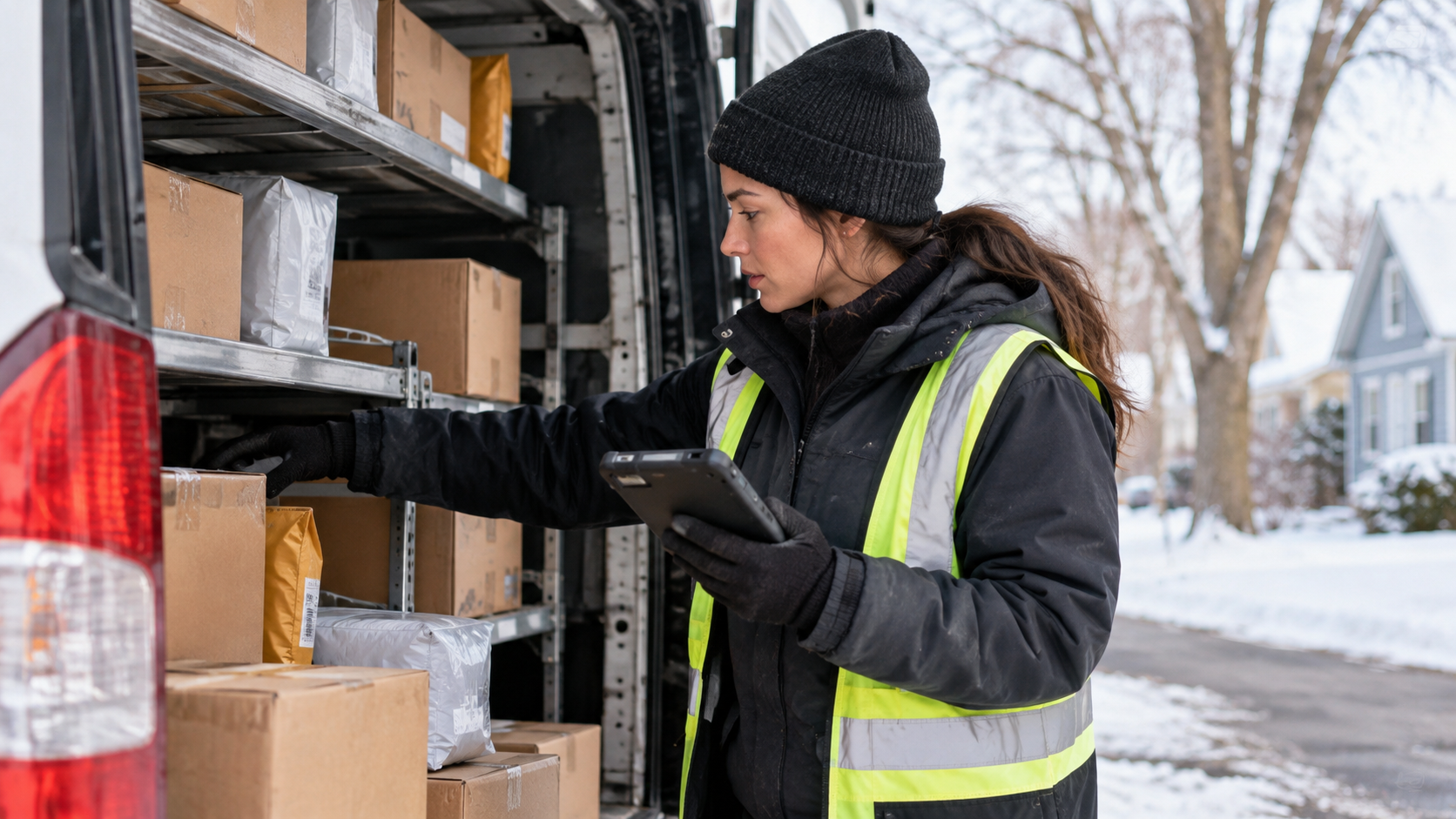
The route app lists a parcel for the next stop, but the driver cannot find it in the vehicle. The tempting shortcut is to mark the address “attempted” and keep moving. No delivery attempt happened if the parcel was never there. A Minnesota delivery driver missing route package report starts with the difference between a digital assignment and physical custody: which item is listed, what was actually loaded, where it was last seen, and who needs to search or correct the record.
Route systems can carry useful information without proving a specific parcel is in a specific van. Public carrier examples show the distinction at a broader level. The USPS tracking-status guide explains that some “USPS Awaiting Item” statuses mean the item is still with a shipping partner, and UPS tracking help distinguishes label creation from actual possession. A driver's route listing is a different system, but the practical inference is the same: a record should trigger a custody check, not substitute for one.
This guide covers a package expected on the route but not found in the driver's load. It does not cover a parcel physically present with an unreadable label, a wrong address at the stop, or an access barrier after arrival. Those situations have different facts and exception codes. Here the task is to establish a bounded search, preserve the assignment evidence, alert the right team, and avoid a false delivery or failed-attempt event while the missing item is traced.
Identify the exact package absent from vehicle
An app may show a stop with several packages. Open the item details and capture the complete barcode or shipment ID, destination, stop number, and any route or bag reference the employer uses. Check whether the count represents individual parcels or a bundle. A “three packages” card might include two cartons and an envelope; finding two items does not tell you which ID is missing until you match each label to the list.
The phrase package absent from vehicle should describe a physical observation, not a conclusion about where the parcel went. Record when you checked, what areas of the vehicle you inspected, and whether the package was ever seen at loading. “Listed on Route 12, barcode ending 4821; not found in cargo area after checked shelves and totes at 10:14” is more useful than “lost package.” The item might still be at the station, with another driver, in a wrong tote, or under a misread label. None of those explanations is confirmed by absence alone.
Check whether the app has a recently updated route assignment. A dispatcher might move an item between routes while the driver is on the road, and a stale screen may still show the old assignment. Use the employer's approved refresh or dispatch view, preserving the prior screen if the mismatch needs review. Do not assume a disappearing route card proves the parcel was transferred. Ask for the actual reassignment or custody record when it affects who should search.
If the item is shown as a pickup rather than an outbound delivery, the physical expectation may be different. A scheduled pickup is not normally in the van before the pickup occurs. Read the event type and route note before reporting a shortage. Similarly, an item listed for a station return may already be at a handoff point. The barcode and event type together define what the driver should physically possess at this stage.
Search the load once using a bounded method
Stop in a safe, lawful place before searching. Check the cab, cargo shelves, totes, bins, and floor areas that the employer's load plan assigns to that stop. Move items carefully so labels remain attached and parcels are not crushed. A quick look from the driver's seat can miss a small envelope behind a larger carton. A long, unstructured search at the curb can waste time and still miss the same place twice.
Match identifiers as you go. A box of the same size or same retailer is not necessarily the missing parcel. Scan or read the label through the approved workflow; do not mark an item present based on shape or address alone. A multi-piece shipment may have related barcodes with different final digits. Record which pieces are physically in the vehicle and which exact ID is absent. This prevents a report from sending station staff to search for the wrong carton.
If the load has sealed totes, follow the employer's procedure for opening and re-closing them. Do not break a seal or enter another driver's vehicle without authority. Ask dispatch when the search requires access outside your assigned load. A bounded check means the driver can state what was examined and what was not. It is honest to say “I checked my assigned van and two listed totes; station cage not checked” if the cage is under someone else's control.
If you find a package with damaged or unreadable label that might be the missing item, do not guess its identity from destination context. Use the employer's exception or station identification process. A parcel with no reliable barcode can create two problems at once: the expected item remains unaccounted for, and an unidentified physical item needs custody handling. Keep those records distinct until support matches them.
Compare the route manifest discrepancy with the loading record
A route manifest discrepancy becomes clearer when you compare what the route says with what the loading scan or handoff record says. Was the barcode scanned onto this vehicle, into a tote, or merely assigned to the route? Did a station worker hand over the tote? Was the item shown as “loaded,” “staged,” or “expected”? These terms may have precise meanings in the employer's system; use the actual definitions rather than assuming they all mean the parcel was in the van.
Write down the last verified custody point. If the driver personally scanned the package at load and saw it in the vehicle, the search may focus on sorting, a prior stop, or an accidental transfer. If no physical load scan exists, the station's staging area may be the first place to investigate. If the item was transferred to another driver mid-route, look for the transfer identity and time. A route listing alone cannot resolve which of those paths happened.
The load count is a clue, not a substitute for item identity. A van can have the expected number of packages while one wrong item replaces the missing one. Conversely, a bulk tote count may differ from the number of individual parcels. Confirm the barcode-level gap. If an extra parcel is present, report that separately with its own ID. Do not use the extra item as a reason to close the missing item's stop.
Preserve the before-state when a dispatcher edits the route. Save the route assignment or event reference through an approved tool, note the time, and ask what changed. A later reassignment may be the correct fix, but it should not erase the explanation for why the driver reported an absent item. Do not take broad screenshots containing unrelated customer addresses into a personal account to preserve evidence.
Report the shortage before a false attempt is recorded
Use the employer's designated shortage or missing-load channel as soon as the bounded check shows the item is absent. Give the barcode, route and stop, expected destination, last known load evidence, areas searched, and whether any parcel with a similar label was found. State the physical fact plainly: “Parcel ending 4821 is on my route but is not in my assigned vehicle after the load check.” Ask who owns the station or transfer trace and whether the route assignment should stay open.
Do not classify the stop as “customer unavailable,” “no access,” or “delivery attempted” if you never brought the package to the address. Those codes describe a different event. Do not scan “delivered” to clear the card. A false event can mislead the recipient, distort the custody trail, and complicate a later search. If the app forces a status before continuing, contact support for the approved missing-item code or workaround; do not invent one.
The report should also say what the driver can still do. If there are two other parcels for the same address, they may be deliverable under their own barcodes. If the missing item is the only package for that stop, the route may need to skip or remove that stop through the approved process. Ask dispatch whether to continue other work while station staff search. A missing parcel need not freeze every unrelated delivery, but the unresolved item must remain visible to a named owner.
If the package is time-sensitive or has special handling, tell the supervisor. The driver should report the actual service marking or route instruction without guessing the contents. An earlier investigation may be needed when a delivery window is near, but urgency does not authorize a fabricated attempt or unsupported customer promise.
Separate station search from driver custody
Once dispatch receives the report, a station worker may check staging shelves, sort areas, misloaded totes, or a transfer log. The driver cannot claim those areas were searched unless someone confirms it. Record who is checking them and what result they report. “Station checking cage B” is a pending action; “cage B checked, parcel found under Route 14” is a result. Keep the distinction in the route note or support case.
If the station finds the parcel, confirm its barcode and condition before planning delivery. It may be placed on another van, held for a later route, or brought to a rendezvous point. Any transfer to the original driver needs its own custody record and time. Do not mark the stop delivered simply because the station located the parcel. The delivery still must happen under the approved route and proof process.
If another driver has the item, ask dispatch to reconcile the route assignments before either driver records final delivery. Two drivers should not carry an open stop for one barcode without a clear owner. If a driver already delivered it, support can verify that event and remove the stale assignment through the approved process. The original driver should not create a compensating scan or tell the customer they delivered a parcel they never handled.
If the parcel remains unlocated, preserve the shortage report and next trace action. A driver may be released to continue or end the shift while the station owns the search. That is an operational handoff, not a conclusion that the item is lost forever. Ask how the unresolved item will appear in the system and who will update the customer if the delivery promise changes.
Handle a parcel found after the report
The missing package may turn up behind a tote after dispatch opens an investigation. Report the find immediately with the same case ID. Say where it was, when it was found, and whether the parcel is still in the driver's custody. This closes one factual gap but does not automatically close the route incident. The station may already have changed the assignment or notified the recipient. Check the current route state before attempting delivery.
Do not erase the original shortage report to make the route history look clean. The report was accurate at the time of the bounded search. Add the newly found fact and the next approved action. A transparent sequence helps explain why the stop was delayed and prevents another worker from continuing a search for an item now in the van.
If the parcel turns up at a prior stop, do not assume it was delivered there. It may have fallen out during unloading, been handed to the wrong person, or been left in a receiving area. Preserve the exact observation and contact support for recovery. A photograph of the item at an address is not proof of an authorized delivery to its intended recipient. The physical error needs its own controlled correction.
When a found item is damaged or its label is detached, use the employer's exception and relabeling rules. The original route ID should be reconciled with the physical package only through verified identifiers. Do not “solve” a missing-route report by assigning an unidentified box the missing item's identity because its size seems plausible.
Use a three-parcel example to keep the outcomes separate
Imagine a driver has three barcodes for one apartment building. Two boxes are in the van. The third appears in the route app but cannot be found after the driver checks the assigned shelf and tote. The driver reads all three labels, confirms exactly which barcode is absent, and reports that ID before arriving at the address. The two present boxes can be delivered under their own instructions if dispatch permits; they do not make the third parcel delivered or attempted.
Suppose the loading screen shows the third barcode was assigned to the route but has no vehicle-load scan. Station staff search the staging shelf and find it still in a cage. They confirm its barcode and arrange a later delivery route. The driver records that station result and continues with the two parcels actually carried. The route card for the third item should be reconciled by the system owner; the driver does not tap an attempted-delivery code for an item never taken out.
Change the evidence: the third parcel did receive a vehicle-load scan, and another driver has a transfer record from a mid-route exchange. Dispatch needs to identify the current custodian and correct the assignment. The original driver reports what their own van search found. They should not claim the station had the parcel because this version points to a transfer. A different last custody event changes the investigation path.
In a final version, the third box is discovered under the front seat. The driver updates the same shortage case, verifies the barcode, and asks whether the stop remains assigned to them. The earlier report remains part of the history. If the route is still active and the package is sound, the driver may deliver it under the employer's direction with its own proof. A find is a new fact, not a reason to delete a truthful report.
Close the route discrepancy with a named result
An unresolved shortage should not disappear at shift end. Check the support case or dispatch handoff for the final known custody state: found at station, transferred to another driver, found in the van, delivered by an authorized owner, or still under investigation. Record who owns the next action and which route or station record will be corrected. “Missing” is a starting observation; a later outcome needs evidence.
If a route audit shows the package was never physically loaded, ask how the assignment will be fixed so a future driver does not inherit a false attempt. If a load scan proves it entered the van but no handoff or return record exists, the trace may need more work. Do not close either situation merely because the route card was removed. The system should reflect the physical custody trail as far as it is known.
For drivers comparing jobs, the published delivery job-offer review guide can prompt questions about dispatch and route support. The Saint Paul delivery driver Careers hub offers local role context. During onboarding, ask the employer where to report a missing-load item, which code avoids a false attempt, and how station and driver records are reconciled.
The driver's most useful contribution is a precise, early account of the gap: this barcode is assigned here, this vehicle was checked, this was the last verified custody event, and this team owns the trace. That account helps find the parcel while keeping the recipient's status truthful.