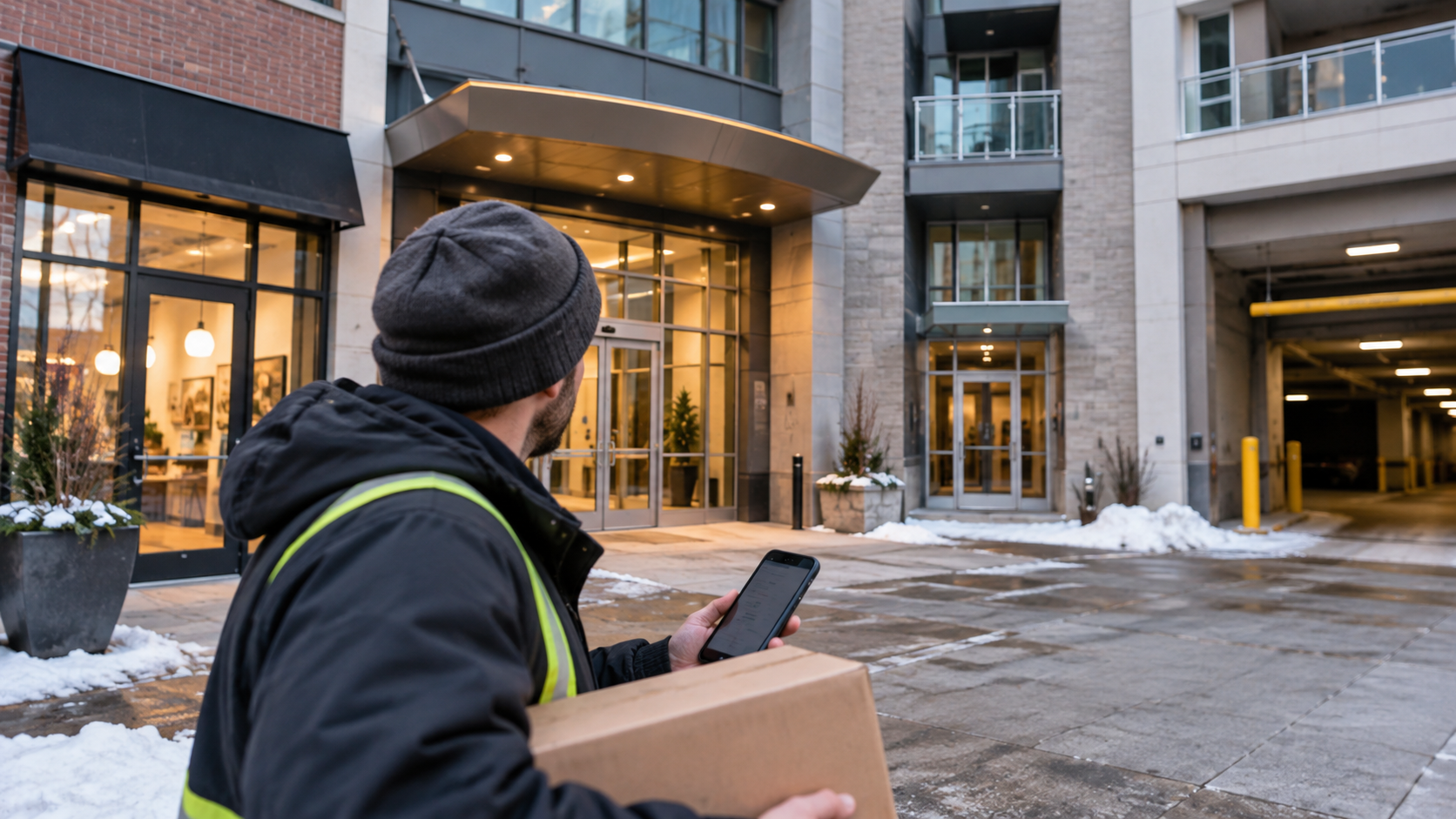
A map pin lands in the middle of a large block. One address appears over several doors: a retail storefront, an office lobby, a residential tower, and a garage. The parcel names a business in Suite 420. The nearest door may be open, but it may lead to the wrong tenant or an area where deliveries are not accepted. A Minnesota delivery driver multi-tenant building entrance choice needs more than the street number. Match the recipient and unit to a public path that the building and your delivery instructions permit.
Start with the address as written, including building, suite, floor, or room. Then compare it with signs and directories at the property. Ask a building or recipient contact when the signs do not identify the route. Find a lawful place for the vehicle before spending time on that search. Do not follow someone through a secure door or leave a parcel at an unrelated front desk to make the stop look complete.
This guide focuses on locating the correct public entrance at a multi-tenant building. A separate article covers what to do when an assigned entrance is closed during delivery hours. Another covers a site with a distinct receiving dock. Here the primary uncertainty is which public doorway leads to the named tenant or authorized handoff point in the first place.
Read the address beyond its street number
The street address gets you to the property, but a multi-tenant building needs another identifier. Check the recipient name, suite, unit, building letter, floor, and any delivery note. Do not silently drop a suffix because the map search omits it. “Suite 420” and “Building 4, Unit 20” can point to different places even if both appear near the same pin. If two parts of the address disagree, preserve that uncertainty and ask for clarification before handing the parcel to anyone.
USPS Publication 28 § 213 describes secondary address designators such as apartment, building, floor, suite, unit, room, and department. Those terms help you recognize that the line after the street address identifies a location within a property. The postal standard does not tell a driver which door to use at a particular site. The building directory, current site signs, recipient instruction, and employer procedure answer that later question.
Look at the label on the parcel and the route app separately. A label may say “Ste 420” while the app shows only the main street address. The missing suite may be a display limitation, not proof that any lobby can accept the item. Conversely, a route note may list a tenant that moved. If a current directory no longer shows that tenant, do not substitute a similarly named company. Contact the recipient or dispatch with the exact mismatch.
When a suite number is present, do not infer a floor from its first digit unless the building directory confirms that convention. Some buildings number spaces by wing or historical tenant layout. “420” may be on a fourth floor at one property and in a ground-level business park at another. The current directory is a better source than a habit from another route.
Use the tenant suite directory as a map, not permission
A tenant suite directory can connect the name on the parcel to a floor, wing, or public lobby. Read the whole listing rather than the first matching word. A health clinic, management office, and pharmacy may share a brand in one complex. The suite or department on the parcel distinguishes them. If the directory lists a different name at the expected suite, ask whether it is a renamed tenant or an address error. Do not assume either explanation.
Directories also vary in age. A paper board near a door may be less current than a staffed desk; a digital directory may still omit temporary tenants. Note the date if one is posted, and compare the directory with the actual door label. A sign saying “All visitors use east lobby” may direct you to the correct public path even when the map pin points at a west service entrance. Follow current site instructions that apply to visitors and deliveries, provided they do not conflict with your employer's restrictions for the parcel.
The directory is not a release authorization. It can tell you that Suite 420 is on the fourth floor. It cannot decide whether the receptionist in the ground-floor lobby is allowed to take a parcel for that suite. Confirm the handoff method through the recipient, building desk, or approved delivery instructions. If the person at the desk says packages are not accepted, do not leave one there because the tenant appears on the board.
If the directory is behind a locked entrance, use the intercom or public contact channel. Avoid tailgating into a controlled area. A door opening for another visitor does not give you permission to enter or leave a package. A driver can state the tenant and suite over an intercom without sharing unnecessary package details with bystanders.
Identify the correct public entrance from the street
The correct public entrance is the doorway that the site directs visitors or deliveries to use for the intended tenant, subject to the shipment's instructions. Check building names and numbers on exterior signs. A campus can use one street address for several connected structures. A retail storefront might have its own door, while the offices above it use a lobby around the corner. The garage may share the address but lead only to resident parking.
Walk only along public or otherwise authorized paths while checking signs. Read arrows, posted hours, and “deliveries” notices from a safe pedestrian position. If a sign points to a service entrance, determine whether it applies to your vehicle and parcel. Some signs direct large freight to a dock while small parcels go through a public lobby. Do not treat the word “delivery” as enough to override a locked gate, a permit requirement, or a shipment instruction naming a different desk.
Check the actual door label before going inside. It may name a tower, a suite range, or a department. If the parcel is for Suite 420 and the door says “Suites 100–199,” keep looking. A door number that resembles the suite number might be a fire exit or staff entrance. Do not pull on unmarked or emergency doors to test them. If a public route is unclear, ask an authorized contact rather than exploring restricted corridors.
A building can have more than one entrance that reaches the same tenant. Choose the one the building and delivery instructions support, then confirm the receiving point. The closest walking distance is not always the correct path. It may create a longer internal search or place the parcel at an unstaffed lobby. A few minutes spent confirming the entrance can prevent a false proof of delivery and an unnecessary return trip.
Keep the vehicle legally placed while you verify
Finding a door can take longer than the route estimate. Park or stop only where the current signs and applicable rules allow. Minnesota Statutes § 169.34 covers prohibited stopping and parking locations, including driveways and certain crosswalk areas. A delivery task does not create general permission to block those places. A map pin near the address does not identify a legal curb space.
If you need to make a call or study a directory, first find a lawful place where the vehicle can remain for that time. Read loading-zone limits and check whether the whole vehicle fits. Do not leave the van at a garage mouth while you search for the office lobby. If no practical legal space exists near the correct entrance, report both problems to dispatch: the entrance route and the parking constraint. The solution may require a different stop order, smaller vehicle, or delivery appointment.
NIOSH's Motor Vehicle Safety at Work describes the general importance of preventing work-related road crashes. It does not identify any particular building entrance or parking place. The useful application here is to avoid making an abrupt turn or stopping in traffic because a map pin appeared on the wrong side of a block. Pull over lawfully, then examine the address and site signs.
If the lawful space is far from the entrance, consider package size and the walking path. A hand-carried envelope may be feasible from a nearby side street; a heavy multi-piece order may need a loading dock or cart route. Do not force a parcel through a public lobby when the building requires freight at another entrance. Ask the recipient or dispatch for a workable authorized path.
Ask a question that resolves the doorway
When you contact a building or recipient, give the information needed to identify the stop: street address, tenant name, suite, and the entrance you are near. Ask: “Which public entrance serves Suite 420 for this parcel, and where may it be handed to an authorized person?” That question is narrower than “Is this the right building?” It invites an answer about both route and handoff. If the answer is “east lobby,” ask how that entrance is marked and whether the lobby desk accepts deliveries for the tenant.
If a guard says to use another door, note the guard's role and instruction. If a tenant representative provides a different address, verify whether it is a corrected destination or simply a preferred entry point at the same property. A change of street address can affect the delivery authorization and route record. Do not rewrite the destination yourself based on a casual suggestion. Use the employer's process for address changes.
If nobody answers, keep the facts separate. You identified the correct street address and a possible tenant listing, but the authorized public handoff path remains unconfirmed. That is different from saying the customer refused the parcel or that the building was closed. Ask dispatch how to record the unresolved access and retain the parcel under policy. The next driver needs the precise open question, not a generic “couldn't find it” note.
If a receptionist volunteers to take the package, confirm that they accept deliveries for the named tenant. Ask for the recipient or desk identity required by your employer's proof-of-delivery process. Do not hand over a restricted or signature-required item to a person who merely happens to work in the building. A public entrance can be correctly identified while the proposed handoff still fails the shipment's conditions.
The answer may depend on the parcel rather than the tenant alone. A lobby desk might accept ordinary small packages but direct oversized boxes to receiving. A medical office might require a named employee to sign for one shipment even though the same office allows routine supplies at reception. Describe the package type only to the extent needed under your employer's privacy rules, and ask whether the proposed point can accept this delivery. If the desk's answer conflicts with the route note, tell dispatch exactly what changed. Do not quietly choose the more convenient instruction.
If a contact gives directions by landmarks, repeat them back before moving: “East lobby beside the pharmacy, not the garage door on the avenue?” Buildings often have several doors that could fit a vague phrase such as “main entrance.” Confirm the public path, not just the compass direction. A precise description helps when the vehicle must be moved around the block and the driver cannot see the contact while walking. Once at the indicated door, check the posted name or suite range again; a phone instruction can be misunderstood, and signs may have changed since the contact last visited.
Walk through a multi-tenant example
Imagine a parcel addressed to Northstar Design, Suite 420, at 600 Example Avenue. A map pin lands by a garage marked “600.” A sign near the garage says “Residents only.” Around the corner is a storefront labeled Northstar Retail, while an east lobby directory lists Northstar Design at Suite 420. The driver has learned that the east lobby is the likely public route to the intended tenant. The storefront's similar name and the garage's street number are not enough to justify a handoff at either one.
The driver finds a lawful side-street space, enters the east lobby during posted public hours, and asks the desk whether it receives parcels for Suite 420. If it does, and the shipment and employer instructions permit that handoff, the driver can complete the delivery with the required proof. If the desk only directs visitors upstairs, the driver must follow the public route or contact the tenant. The directory alone has not completed the delivery.
Now change the directory: it lists Northstar Design in Building B, but the entrance to Building B is accessible only through a controlled courtyard. The driver should not follow another tenant through a locked gate. Contact the building or recipient for authorized access. If nobody confirms a public path, report the exact barrier and ask dispatch for the next step. The parcel remains in custody; a plausible guess about Building B is not a delivery.
These names and addresses are hypothetical. The useful method is to rank evidence by what it can prove. The parcel supplies the destination identifier. Exterior signs and the directory help locate the tenant. A site or recipient contact can clarify permitted access. Employer instructions determine the allowed handoff and record. None of those pieces can be replaced by the map pin alone.
Save a route note that helps the next driver
After the stop, record the entrance that was actually verified, the tenant or suite it serves, and the date of the observation. If the lobby desk accepted the parcel, note that specific handoff under the employer's process. If the desk declined, record the refusal without claiming a permanent building rule from one conversation. A useful route note might say: “East lobby directory listed Suite 420 on October 21; desk directed small parcels upstairs; garage entrance is residents only.” It gives the next driver a starting point without pretending to grant future access.
If the tenant moved or a new sign appeared, ask the route owner to update the address and access directions. Preserve the older note as history if the system allows it. A public entrance can change hours or security rules, so the next driver still needs to read current signs. Do not write a door code into a broadly visible note unless the employer and building authorize that handling of access information.
Drivers considering similar work can ask how route instructions handle complex sites and who resolves access questions during a shift. The published delivery job-offer review guide helps frame that employer-support question. The Saint Paul delivery driver Careers hub provides broader role context. Neither page identifies a door at the current stop; the verified site information does that.
The final record should make the outcome clear. If the parcel was handed over, identify the authorized point. If access was not established, say which doors and contacts were checked and where the parcel went next. That account helps the next attempt begin with the right tenant and a realistic public route, without converting an uncertain doorway into a completed delivery.