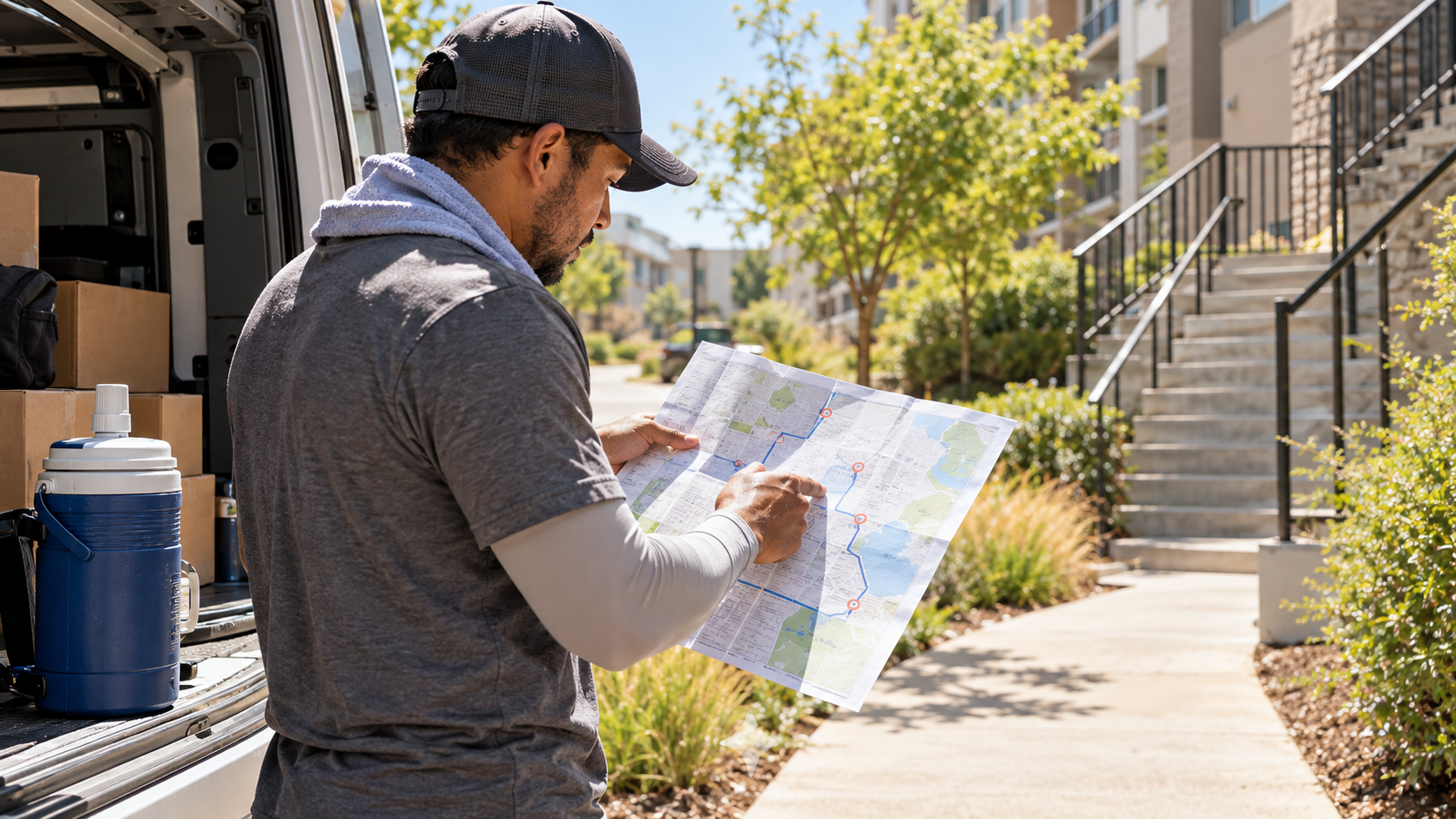
A delivery route can look manageable from an air-conditioned cab. At the fifth stop, the driver carries a parcel across an open lot, waits for a gate, then climbs exterior stairs to the recipient. The next three stops have similar walks. The van may be cool between addresses, but the work outside it repeats. Planning only for driving time misses the part of the route where heat exposure builds.
A Minnesota delivery driver outdoor heat work plan names the outdoor tasks, the places where a worker can cool down and drink, and the person who can change the route if the plan is not working. It should use current weather information and the employer's heat procedure. It should not rely on a single temperature on a dashboard or promise that a short stop is harmless. Sun, humidity, exertion, duration, clothing, and the driver's recent heat exposure all affect the situation.
The driver and dispatch need to see the accumulated pattern: repeated loading, walking, waiting, and handoffs in heat, even though the route is labeled a driving job. Keeping food and water accessible in the van helps, but it does not identify a safe cool-down place after a long exposed walk. A route plan should account for those outside tasks before the driver is already at the far end of a hot property.
Make a delivery route heat exposure check
A delivery route heat exposure check starts with the route's outside tasks. Which stops require a long walk from legal parking? Which have an exposed loading yard, a stairwell without cooling, or a wait for a gatekeeper? Which parcels need a cart or two-person handling that may take longer outside? The route app may show address order and delivery windows but rarely shows how long a driver must stand in direct sun at each property.
Check the current local forecast and alerts through the employer's approved source. The National Weather Service heat tools explain that heat index combines air temperature and humidity, while measures such as wet-bulb globe temperature consider more environmental factors including sun and wind. A shaded thermometer and an asphalt lot can feel different. Do not convert one forecast number into a medical prediction for every worker or location. Use it to trigger the employer's heat plan and a closer look at the actual work.
Identify any route stretch without a reliable cool-down place. A driver may spend time in a cooled cab, but parking, engine rules, vehicle condition, or customer waits can make that option unavailable at a particular stop. Ask dispatch where the approved rest location is and how a driver reports needing it. A vague suggestion to “take a break somewhere” is less useful than a named place and a route change the team can actually make.
Build water and cooling into the route before departure
OSHA's heat guidance emphasizes frequent access to water and more rest as heat stress rises. The driver should know where water is available under the employer's procedure, whether it will remain accessible throughout the route, and how to reach a shaded or cooled location. A bottle buried under parcels does not help during an exposed stop. Keep water in a place that does not interfere with driving or cargo security.
Discuss the route's break plan with the supervisor when unusually hot conditions are expected. A delivery window can be adjusted; a driver should not have to silently skip a cool-down period to keep the app on time. The exact frequency and length of rest depend on the employer's heat program, the work, and current conditions. Agree on the schedule before the driver is already overheated at a remote property.
Cooling can be a shaded area, a safe air-conditioned place, or another approved location. A parked van may help if it can be used under company and vehicle rules, but it is not the only possible place. If the vehicle's cooling system is unavailable or cannot be used while parked, tell dispatch before the route begins. A route plan that assumes a cooled cab needs a real alternative when the cab is hot.
Plan an outdoor parcel handoff heat break
An outdoor parcel handoff heat break should be planned around a real stop or safe pause, not squeezed into an unsafe parking maneuver. Identify a place to cool down after a cluster of exposed handoffs. If a building lobby is an authorized delivery point, a driver may complete the handoff there under the shipment rules, but that does not make the lobby an automatic rest facility. Ask where employees are actually allowed to rest and drink.
Sequence heavy or lengthy outside work with dispatch when the employer permits route changes. An exposed warehouse yard may be better scheduled at a cooler time, while a stop with indoor access may be more flexible. Do not invent a new delivery time without telling the route owner or customer through the approved channel. The plan must preserve signature, appointment, and custody requirements for each parcel.
If a stop takes longer than expected because a gate is locked or a recipient is delayed, the driver should update the heat plan. Waiting in direct sun for a person who has not arrived is an outdoor task, not free time. Ask dispatch whether to return later, wait in a safe cooled place, or transfer the stop. The parcel stays with its actual custodian while the team decides.
Give new and returning workers a different start plan
CDC/NIOSH describes acclimatization as a gradual adjustment to work in heat and recommends a plan for new and returning workers. A driver who has handled summer routes for months may not have the same recent exposure as someone returning from time away. A new worker's route should not assume they are ready for the longest sun-exposed sequence on the first hot day simply because they can drive the vehicle.
The supervisor can adjust workload, pace, and monitoring under the employer's heat program. The driver should know whom to tell about discomfort and how to request a cool-down without losing track of parcels. Do not make a worker prove tolerance by finishing a difficult stop before reporting symptoms. NIOSH advises training supervisors and workers about heat stress and allowing rest and water breaks when discomfort occurs.
The plan should account for changed duties as well. A driver newly assigned to oversized deliveries may spend more time lifting and walking outdoors than on a previous route. A shorter mileage total can still mean more heat exposure if the stops require long carries. Describe the actual work to the supervisor rather than relying on the route's drive-time estimate.
Work through a hypothetical afternoon route
Imagine a driver scheduled for twelve afternoon deliveries during a local heat alert. The first four stops are small residential handoffs near legal parking. Stops five through eight serve business properties with open yards and long walks. The driver and dispatcher review those outside tasks before departure, confirm water and a cooled rest location, and identify the person who can approve route changes. The parcels are loaded so the driver does not have to sort them in direct sun at each stop.
At stop five, a gate remains closed. The driver waits in a safe shaded place allowed by the site while dispatch contacts the recipient. When the wait extends, dispatch moves the stop later and the driver takes the planned cool-down period before continuing. The package stays in the van; no handoff has occurred. This is a route adjustment, not a failed delivery invented to clear the queue.
At stop seven, suppose the driver feels unusually weak and dizzy. The driver stops work in a safe place and contacts the supervisor under the heat-illness plan. The supervisor arranges help and route coverage rather than telling the driver to finish one more yard. The example does not diagnose the cause. It shows why the plan needs a way to stop and get help before a schedule argument begins.
Change one fact: the vehicle's air conditioning stops working at the start of the route. A plan built around cooling in the cab no longer works. Report the equipment condition to fleet and dispatch; the team may need another vehicle, a different rest place, or a changed route. Do not keep using the original plan as though the cooling assumption were still true.
Recognize when the plan has failed
Heat planning cannot prevent every problem. OSHA's heat-illness page lists warning signs and first-aid responses. If a worker is confused, faints, or has other signs of serious heat illness, get emergency medical help under the employer's emergency plan. Move to a safer, cooler place if that can be done without creating another danger, and follow trained first-aid directions while help is coming. Do not treat a delivery deadline as a reason to delay the call.
For less clear symptoms or heat discomfort, stop the outdoor task and report what is happening. The driver should not self-diagnose and then continue solely because the next stop is close. The supervisor may need to assess the worker, arrange cooling and rest, and change the route. A device can record that a task is open; it cannot decide whether a person is fit to keep carrying parcels.
Record the vehicle location and parcel status when work stops. If the driver is receiving help, another employee can take custody under the employer's process. Dispatch can notify customers about delays without making the ill worker finish scans. A planned transfer is not a completed physical handoff, even during an emergency.
Keep communication short enough to use in the heat
A field update should provide the immediate facts: location, outdoor task being done, symptom or condition observed, safe waiting place, and help requested. “At warehouse gate B; exposed wait extended; moving to the approved cool-down area; parcel still in van; need dispatch to move the stop” is actionable. A driver experiencing confusion or collapse may be unable to write a complete message, so the team needs an emergency call path that does not depend on a polished report.
Dispatch should confirm who owns the open stops. If the driver can continue after a permitted rest and supervisor decision, update the route with the actual time. If another driver takes over, identify the receiving employee and physical parcel transfer. Do not mark unfinished stops delivered, or describe a planned break as work completed. The schedule can be repaired after the worker is safe.
Heat conditions may vary across the route. A shaded stop can be manageable while an open loading yard is not. Give the supervisor those local details. A simple weather-app temperature may not capture sun, humidity, exertion, or the time spent waiting. The route plan should respond to actual outside work and the worker's condition.
Arrange check-ins for a driver working alone
Delivery drivers often spend outside work periods without a coworker standing nearby. NIOSH's workplace recommendations include a buddy system in which workers watch each other for signs of heat illness. A solo route needs an employer-approved way to get similar attention: scheduled contact, a supervisor check after exposed stops, or another process appropriate to the operation. A device ping that merely shows the van moved does not tell anyone how the driver feels after a long carry.
Before departure, confirm the contact method and what happens if the driver misses a check-in. The supervisor should know the route area and last planned stop so help can be directed to a real location. If a driver reports feeling unwell, the team should be able to pause assignments and arrange help without waiting for a delivery exception to appear. This is especially important for a new worker or someone returning to hot outdoor work after time away.
The driver can make short, concrete reports: “Finished the exposed warehouse stop; cooling at the approved site; next outdoor stop is in twenty minutes.” The exact interval belongs to the employer's plan, not this article. Avoid creating a burden of constant messages that keeps the driver on a phone instead of resting. The check-in should let a person notice a problem and act on it.
If the route changes, update the person monitoring it. A driver sent to a different industrial park should not leave the supervisor looking for them at the original yard. Keep customer and parcel details within the proper work systems; a heat check-in needs location and worker status, not a broadcast of recipient information.
Adjust the physical work, not only the clock
Moving a delivery earlier can help, but it may not be enough if the task still requires a long carry in direct sun. NIOSH recommends limiting time in heat, increasing recovery time in cool areas, reducing physical demands, using tools that minimize strain, and adding workers to a task when appropriate. The employer can apply those options to a specific route: use an approved cart on a suitable path, arrange a two-person delivery for a heavy item, or split a cluster of exposed stops.
Check the equipment against the property. A cart may reduce carrying effort on a smooth, accessible path but be unusable on stairs or broken pavement. Do not substitute an improvised tool that cannot control the load. A second worker must actually be assigned and available; listing “team lift” in a note does not put another person at the stop. Tell dispatch when the proposed control does not match the site.
Clothing and protective equipment can change heat burden. NIOSH advises training workers on the added heat load from exertion, clothing, and personal protective equipment. Follow the employer's required gear rules and ask how the work-rest plan accounts for them. Do not remove required safety equipment just to feel cooler during a delivery. The route owner may need to shorten exposed tasks or add recovery time instead.
The practical test is whether the revised work can be performed with water, cool-down access, and a way to stop if symptoms appear. A schedule that looks shorter in the app may still put a driver through the same hot yard twice. Compare the actual outside tasks before accepting the new order.
Protect the next shift from an incomplete plan
At shift handoff, note which stops were changed because of heat, where the remaining parcels are, and whether the route still has exposed outdoor work. If a cooled rest area was unavailable or a customer's gate caused repeated waits, tell the next planner. That is operational information, not a claim that a parcel was delivered late because a driver wanted a break.
If the vehicle's cooling system or water access failed, leave those issues with named fleet or supervisor owners. A new driver should not inherit the same route plan without knowing an assumption was broken. If a worker required medical help, follow the employer's privacy and incident procedures; dispatch needs to reassign work, not circulate personal details to customers.
Drivers comparing roles can use the Saint Paul delivery driver Careers hub and the published delivery job-offer review guide to ask how an employer plans water, rest, shade, and route changes in heat. On a current route, the useful plan identifies outside tasks, a reachable cool-down option, a way to report symptoms, and a named person who can adjust the work.