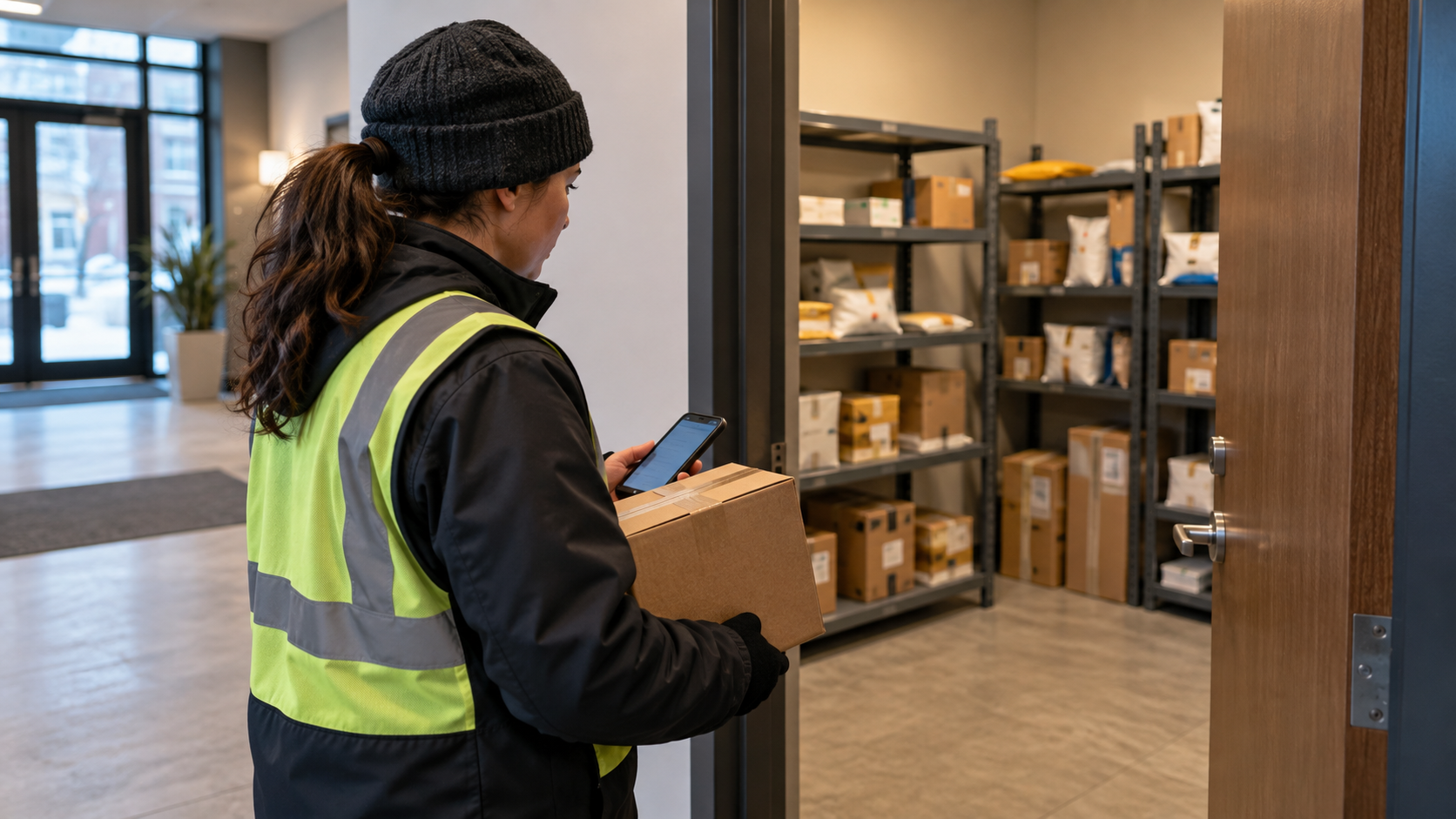
A building has a room labeled “Packages.” The door is open, and parcels from several carriers sit on shelves. Your delivery app names a tenant in the building but does not say to leave the item in that room. A Minnesota delivery driver parcel room authorization decision asks whether this specific shipment may be released there. An open door and other packages are clues about how the property works; they are not permission from the recipient, the building, and your employer for this parcel.
Check the delivery instructions, the building's current room rules, any recipient direction, and the shipment's handoff requirements. If a signature or named receiver is required, an unattended shelf may not meet it. If an approved room uses a locker or scan process, complete that process before recording delivery. Keep the parcel with you when authorization is unclear, and ask the responsible contact for a decision.
This article focuses on whether a parcel room is an allowed drop location. It does not solve how to find the right entrance in a multi-tenant building, how to enter a locked site, or how to document a broader access barrier. Those can be separate problems on the same stop. The parcel-room question begins once the driver knows the room exists and must decide whether a handoff there is valid.
Identify the room and the shipment rules
Start with the exact room. Some properties have a resident parcel room, a tenant mailroom, a staffed package desk, and a carrier-only locker area. They may all be called “package room” in conversation, yet each has different users and custody arrangements. Read the sign at the door and any posted receiving instructions. A room for residential tenants may not accept deliveries for a business suite upstairs. A shelf beside the lobby may be a temporary sorting area, not an approved final drop.
Match the parcel to the named recipient, unit, and any delivery restriction. A label addressed to Unit 312 does not automatically authorize a drop in a shared room for the whole complex. Check the employer's app for the allowed location and proof requirements. If the item is signature-required, restricted, temperature-sensitive, oversized, or otherwise subject to special handling, follow those instructions. Do not assume that a building's routine room practice changes the shipment's conditions.
An authorized parcel room drop has a traceable basis: an instruction from a permitted source and a location that can actually accept this parcel. The basis might be a recipient's authorized delivery preference, a building policy recognized by the employer, or an employer route instruction for this shipment type. If the sources conflict, ask dispatch or the designated support contact. Do not choose the instruction that is easiest to execute and leave the conflict out of the record.
USPS's Receive Mail & Packages page describes a carrier-specific service in which an eligible customer can provide delivery instructions authorizing a package to be left at a specified location. That example shows why a location request is tied to the package and service. It does not make a USPS option available to another delivery company or prove that this building's parcel room is approved for your shipment.
Confirm an authorized parcel room drop before handoff
The recipient may prefer the room, the building may operate it, and the employer may set the shipment's release rules. Those interests can overlap without being identical. If a recipient sends a message saying “leave it in the package room,” check whether the shipment permits unattended delivery and which room the recipient means. If the employer requires a signature, ask how that requirement can be satisfied. If the building prohibits outside couriers from entering the room, a recipient's preference alone may not give you access.
When a front-desk worker directs you to a room, ask whether the worker is describing a building policy or simply pointing out its location. “Packages go through the locked room beside the elevators; register each one at this desk” gives a process to verify. “There's a shelf over there” leaves more questions. A guard who controls the door may know entry rules but may not be authorized to sign for the parcel. Confirm who takes custody.
If instructions are delivered by phone, repeat the room name or location. Large buildings can have several parcel spaces. Ask whether the room serves the recipient's unit and whether the building wants the parcel on a shelf, in a locker, or with a staffed desk. Keep any access code in the employer's approved secure channel. Do not add a private code to a broad route note or a public delivery photo.
If nobody can confirm the room's authority, keep custody and report the unresolved question. Do not infer permission from the presence of packages with other carrier labels. Those packages may have different recipients, services, or exceptions. A delivery left there without authorization may be impossible for the intended recipient to retrieve and hard for the employer to investigate.
Inspect whether the room can receive this parcel
Even an approved location may be unusable for one stop. A locker may be full, the scanner may be offline, or the shelf may not fit the parcel. A room may be open to residents but locked to drivers without a credential. Record the actual condition and ask for an authorized alternative. Do not leave an oversized carton on the floor outside a full room and describe it as a parcel-room delivery.
Check for a label, unit slot, or check-in requirement. A room with many shelves may require a specific shelf by floor or tenant. If the building requires a package log, complete it accurately. If the process asks for an order number you do not have, contact the appropriate support person rather than inventing one. A room's ability to hold parcels does not itself show that the building can identify yours later.
Some locations are staffed during only part of the day. A parcel room may be accessible at 4 p.m. while its attendant leaves at 3 p.m. If staff acceptance is required, the room being physically open may not be enough. Read the posted hours and ask whether an unattended drop is permitted for this package. Do not turn a staffed handoff into an unattended one without an authorized instruction.
Look at the path from the lawful parking place to the room. A cart route, elevator, or security desk may be required for a large item. Minnesota Statutes § 169.34 restricts stopping and parking in several locations, including in front of driveways. A parcel room inside a building does not excuse blocking a prohibited curb space while locating it. If no safe legal vehicle position and access path are available, report that separate obstacle.
Match the parcel to the room's actual custody process
Rooms differ in what happens after the driver places a package. A staffed desk may sort it by unit and notify the resident. A locker may require a successful scan and door close before it assigns a compartment. An open shelf may have no registration at all. Ask what the site process is and whether it meets the shipment's release conditions. Do not treat all three as equivalent because they share a room name.
At a locker, follow the device prompts using the exact recipient or unit information. If the screen selects a different resident with a similar name, stop and correct it before closing the door. If the door does not latch or the system does not issue a confirmation, the parcel may not be under the locker operator's custody. Contact the attendant or employer support while you can still account for the item. A photo of a closed locker bank alone cannot establish which compartment holds the parcel.
At a staffed room, identify the person accepting the shipment and whether that person can receive it for the named tenant. A clerk may sign for packages for one building but not another building that shares the address. If the parcel has several pieces, count them with the receiver before you complete the record. A single receipt for three cartons should clearly correspond to all three. If one item is refused because it is too large or damaged, record the partial handoff and keep custody of that item under policy.
At an unstaffed shelf, ask what instruction specifically permits unattended release there. A sign that says “Package Room” may identify a location without naming which carrier, tenant, or shipment classes may be left. A past successful drop is helpful background but does not override the current parcel's requirements. If you cannot establish who will take responsibility after you leave, ask dispatch whether the employer's rules permit that form of release. If the answer is no or unknown, retain the package.
Be careful with room access obtained from another person. A resident holding a door open may be courteous, but that action does not authorize your delivery or confirm the resident can accept the parcel. A guard may admit you only to reach a staffed desk. Stay within the access granted and do not wander through other rooms to find shelf space. If the assigned room is inaccessible, record the access problem and ask for the next step. Permission to enter a building and permission to leave a parcel are separate decisions.
Record parcel room proof of delivery accurately
Parcel room proof of delivery should identify what actually happened and meet the employer's requirements. If a worker accepted the parcel, record the permitted person's identity or role as required. If an authorized locker took it, use the locker confirmation or scan. If the employer permits a shelf drop, record the exact room and shelf through the approved method. Do not sign on behalf of a recipient or claim a staffed handoff for an unattended item.
The USPS Tracking Basics FAQ explains that tracking may include delivery or attempted-delivery information and a delivery location such as a reception desk. That is an example of why location matters in a record. It does not define proof requirements for another employer. Use your company's actual fields and describe the specific authorized room, not simply “delivered to building.”
If a photo is required and permitted, frame it to show the parcel at the approved drop point without revealing private resident information. A photo of a package near a closed door does not prove it reached the parcel room. If the room prohibits photography, ask the employer how to document the handoff by another means. Do not break site rules or expose other tenants' parcels to produce a prettier proof image.
Keep custody and scan status aligned. A parcel still in the vehicle is not delivered because a room has been located. A parcel placed in a locker but not accepted by its system may still need retrieval or staff help. If you must remove it, follow the employer's correction process so the delivery record does not remain falsely complete. If staff move the parcel after taking it, record the point where custody transferred, not a later destination you did not see.
Use a worked example to test authorization
Suppose a driver brings a small parcel for Unit 312 to an apartment complex. The app says “leave at authorized location if recipient unavailable.” A building sign says parcels for residents go to a locked room, and a staffed desk admits approved carriers after logging each package. The desk confirms that Unit 312 uses that room, accepts this parcel, and gives the driver a receipt. The driver can use the employer's permitted handoff and record the desk or room details required by the app. The authorization rests on the shipment rule and the actual site process, not on the room's name alone.
Change one fact: the parcel requires the recipient's signature. The desk says it can log packages but cannot provide the required signature or is not an authorized receiver. The driver should not mark it delivered to the room. Contact the recipient or dispatch for a compliant handoff. An open room and a clerk's general willingness to store items do not cancel the shipment condition.
Change another fact: the desk is closed and the room door is propped open. The driver has no current instruction permitting an unattended shelf drop. Keeping the parcel and reporting the room's condition is the truthful outcome. Do not use another tenant's entry or a passerby's offer to make the drop possible. Ask for a return time or alternate authorized point under the employer's process.
These examples are hypothetical. The important test is specific to the parcel: the allowed release method, the building's actual acceptance process, and the proof the employer requires. A general note that “building has a package room” identifies an option to check. It does not complete the authorization check for every later shipment.
Handle a disputed or unclear room instruction
If the recipient directs a room drop but the building staff refuses it, report the conflict without assigning blame. Tell dispatch the recipient's instruction, the staff member's role, and the rule the staff cited. Ask for an authorized alternative. Do not argue that the recipient's message gives you permission to enter a building-controlled room against the site's current access rule.
If the building accepts the parcel but the employer's app has no matching location or release option, ask how to record it before handing over the package. A generic “front door” code may be inaccurate for a secure room. If a supervisor authorizes an exception, preserve the instruction and use the method provided. Do not choose a false location and plan to explain it later only if someone asks.
If a room is full, distinguish “authorized but unavailable” from “not authorized.” The first may be solved by another time or an approved overflow point; the second requires a different handoff method. A follow-up driver needs to know which condition occurred. Record the date and observed capacity because a full room today may have space tomorrow.
If the parcel has already been left in the wrong room, act promptly through the employer's correction path. Tell support where it was placed, whether it can be safely retrieved, and what status was entered. Do not silently move it to another location without updating the record. The recipient may already have received an incorrect delivery notice. Accurate correction should follow the parcel's actual custody.
Leave a useful instruction for later routes
After a verified handoff, a route note can identify the room, entrance, check-in process, and date observed. It should also state the limit: “Desk logs small resident parcels during staffed hours; confirm shipment release rules.” That is more useful than “all packages go to parcel room.” Building staff, hours, and employer policy can change, and individual parcels may require different proof.
Drivers comparing delivery jobs can ask how an employer handles package rooms, locker failures, and signature exceptions. The published delivery job-offer review guide helps frame those questions. The Saint Paul delivery driver Careers hub supplies broader role context. Neither page authorizes a drop at a particular building.
The decision ends with an actual custody result. Either the parcel reaches an authorized person or location and the proof matches that event, or the driver retains it and records why the room could not be used. A room that looks convenient is only a candidate until the shipment and site instructions support that handoff.