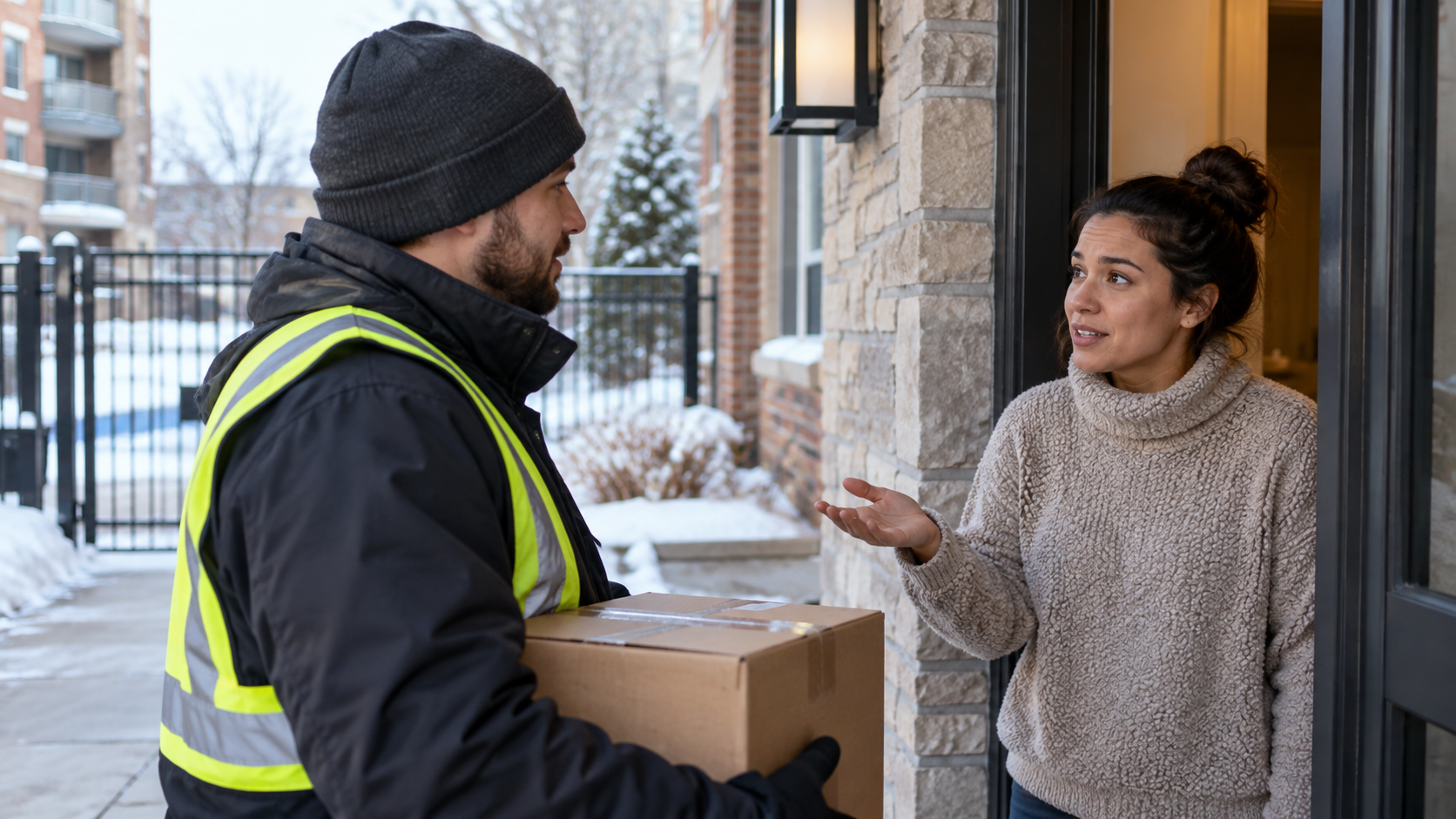
A driver reaches an apartment with a parcel, and the resident asks, “Can I have your cell number? I want to text you next time the gate is stuck.” The request sounds practical. It also asks the driver to become a private contact for a future delivery they may not handle. A Minnesota delivery driver personal phone number request is best handled by explaining the approved route or customer-support channel, keeping the current parcel's instructions in the work system, and giving the resident a way to solve the gate problem without a personal number.
Carriers offer customer-facing tools for shipment instructions. UPS's delivery-change page describes tracking-based changes and instructions for eligible packages. FedEx's delivery-instructions FAQ points to FedEx Delivery Manager. Those examples do not establish another employer's exact app features, but they show why the recipient's instruction should attach to the shipment or address through an official path. The FTC's phone-security guidance notes that a personal phone can hold sensitive messages, photos, and account information.
The driver can be helpful without sharing a private number. The immediate delivery may need a gate code, a person to receive it, or an approved exception. A future delivery may need an address-level instruction managed by support. Identify which need the resident has, then use the employer's authorized contact route for that need.
Recognize the personal contact boundary at delivery
A personal contact boundary at delivery means the driver does not turn a private mobile number into a standing work channel merely because a customer asks. The number may be tied to personal accounts, family contacts, and off-duty time. The driver also may not be assigned to the customer's next package. A private text thread would not automatically carry the parcel ID, service restrictions, or route owner who needs to act.
The customer might have a reasonable motive. A locked gate delayed this delivery, and they want to prevent another delay. Respond to that problem directly: ask whether the gate information can be entered into the service's delivery instructions or sent to customer support. Avoid treating the request itself as suspicious. A calm answer makes it easier to keep the interaction focused on the package.
An employer may supply a work phone, a masked call function, a route-app message tool, or a dispatch number. Check what is actually approved and available. Do not assume a call is masked merely because it starts inside an app; verify the employer's method before using it. A company-issued phone number may also have rules about when and how it can be given to customers.
If the person asks to photograph the driver's badge, call screen, or vehicle number in place of a phone number, follow the employer's identification policy. The parcel's tracking ID and official support path usually identify the delivery issue more reliably than a personal device detail. Do not show private notifications or contacts while trying to be accommodating.
The request can come from a business receptionist as easily as from a resident. A front desk may ask for a driver's personal number to arrange future receiving hours. Give the company's authorized dispatch or account-contact route instead. If the business has a standing delivery window, ask the route owner how that instruction should be recorded for the address. A private number should not become the building's unofficial appointment system simply because the current driver was willing to help once.
Find the approved customer contact channel for this parcel
An approved customer contact channel may be the route app's call button, an in-app message, a carrier support page, a tracking number, or dispatch. Choose the channel the employer has assigned for this service. The driver should not invent a new support address or promise a feature that the customer cannot access. If the device offers no customer contact option, ask the route owner for the correct fallback.
Tie the communication to the parcel ID. “The gate code for tracking number ending 4182 needs an update” is more useful than “text me next time.” A customer-facing change tool may ask the recipient to sign in or verify the shipment. That account process can help connect an instruction to the right delivery. The driver should not bypass it by storing the code in a personal note.
For the current stop, use the approved contact method to ask for a safe, authorized way in. Record whether the call connected, a message was sent, or no response came. Do not write “customer contacted” if the driver only heard voicemail. If access remains blocked, follow the employer's access exception and keep the parcel in the correct custody path.
For future deliveries, direct the resident to the employer or carrier's delivery-instruction process. UPS and FedEx provide examples of recipient-managed instructions through official systems. Another service may use a different portal or a support agent. A note entered there can be available to the next assigned driver, while a private text to today's driver may never reach that person.
If the recipient cannot use the web tool, offer the available phone-support or assisted route that the employer provides. Accessibility, language, or account problems may be why the person asked the driver directly. The driver should not treat that as permission to collect sensitive account details at the door. The support team can verify the recipient and enter the change under its own process. Record that the person requested help with the instruction, not that the driver completed an update they did not make.
Give a short answer that offers a real alternative
“I use our delivery system for package updates, so I can't give out my personal number. You can add the gate instruction through the tracking page or contact support; I can report today's access issue on this stop.” That response sets a boundary and names an action. Adjust the wording to the employer's actual tool. If the tracking page does not accept gate details, give the approved support route instead.
Do not promise, “I'll be back tomorrow,” unless dispatch has assigned that return. The same driver may have a different route or no shift. A personal promise can leave the resident expecting a call that never comes. The work system should show the parcel's next status and who owns it. Tell the customer only what is confirmed.
If the resident asks for a supervisor's direct number, provide only an authorized public or dispatch contact. A manager's private number belongs to that person. The driver can open a case or ask dispatch to contact the customer through approved channels. A handoff to support should include the parcel ID, access problem, and time, without copying the customer's details into a private address book.
If the person remains disappointed, repeat the actionable option once. A long debate about why the driver values privacy is unnecessary. “I can report this gate problem now, and customer support can update future instructions” keeps the conversation respectful. The driver should not imply the customer has done something wrong merely by asking.
Handle a request tied to the current delivery
Sometimes the customer wants the number because the driver is carrying a heavy item, needs a signature, or cannot find the entrance. Those are current-stop problems. Confirm the task's recipient and service requirements, then use the assigned call or dispatch channel. A personal call from the driver's own phone should be considered only if the employer's policy explicitly allows it and the driver understands whether their number will be visible; otherwise use the fallback process.
If the customer says, “Text me when you reach the lobby,” ask whether the app can send an arrival notice or whether dispatch can relay the message. If there is no supported feature, state that plainly and agree only to the delivery attempt the route permits. Do not make a private-text arrangement that the next driver cannot see or that leaves the customer with an unsupported expectation.
If a gate code is offered verbally, enter it only in the approved field if the employer permits that. A gate code can be sensitive for building security. Do not save it in personal contacts, photos, or a notes app. If the code fails, record the attempt and ask for an authorized alternative. The customer can update the official instruction for future routes.
If a signature is required, the customer may ask for a personal number so they can meet the driver later. Explain the carrier's approved delivery or rescheduling options. Do not leave the package and ask the customer to text confirmation afterward. A later message cannot create the required physical handoff or signature at the delivery time.
Keep a customer's personal number in the work system too
The boundary goes both ways. A customer may write their mobile number on a door note or tell it to the driver. Use it only under the employer's approved contact rules for the relevant parcel. Do not add it to personal contacts, share it with another customer, or keep it for an unrelated future route. A route app may already supply a verified contact method that avoids copying the number.
If the customer asks the driver to send a photo of the delivered package to a private number, use the official proof-of-delivery process. A personal message might reveal the driver's number and expose the customer's address or parcel details outside the employer's record. The official photo, if required, should be attached to the right parcel event and follow the employer's privacy rules.
If the app lacks a place for a useful access note, tell dispatch about that limitation. The driver can describe the entrance and attempted contact in an approved exception case. Do not create a parallel private contact list as a workaround. A system limitation is a work-process issue for the route owner to resolve, especially if other drivers will serve the address.
If the customer wants to call the driver later about a missing parcel, give the carrier's support path and tracking reference. The driver may no longer have the package or access to the complete case. A personal phone call could turn into a dispute with no case record, while support can review the scan, photo, signature, and route history.
If a customer asks for a number after a missed attempt, explain that the next attempt may be assigned to another driver. A private callback cannot change a shipment's attempt history or create a delivery appointment. Give the redelivery, hold, or support option actually available for that parcel. If the customer has a valid new access instruction, route it into the service's record so the next person sees it before reaching the door.
Work through a gate-code request at an apartment
Imagine a driver reaches a building gate with a parcel for Unit 5A. The access code in the route note fails. The driver uses the approved in-app call and reaches the recipient, who provides a new code and asks for the driver's personal number “so we can do this faster next time.” The driver enters the current code through the employer's permitted access process, confirms the parcel's service rules, and completes the delivery if the path and handoff are authorized. They tell the recipient how to update the gate instruction in the official system.
The driver does not copy the new code to a private note or text it to themselves. They record that the prior access instruction failed and that the recipient supplied a working code through the approved call, if the system allows that detail. The next driver can then use an updated route instruction rather than needing to find today's driver. The proof of delivery describes the actual receiving person or approved location.
Change one fact: the recipient does not answer the in-app call. The driver records the failed contact, follows the blocked-access exception, and keeps the parcel for the instructed next step. They should not look up the recipient on social media or call from a private number in hopes of reaching them. The route record should say no contact was made.
Change another fact: the resident answers but says the parcel should be delivered tomorrow and wants the driver's number to arrange it. The driver asks dispatch whether a reschedule is available and directs the resident to the official recipient option. They do not promise a personal appointment. A reschedule request must become a valid task before anyone treats tomorrow's delivery as assigned.
The customer has a real access problem, and the driver can address it through the route record. A private number would leave future deliveries dependent on someone who may be off duty or assigned elsewhere. The updated instruction belongs with the building or parcel task, where the next driver can find it.
Respond if a private number was already shared
A driver may have given a personal number during a rushed stop before understanding the boundary. The next step is to move the conversation back to an approved channel. Tell the customer that future delivery questions should go to carrier support or the tracking page, and inform a supervisor if the employer's policy requires it. Do not continue handling parcel changes through private texts because the first exchange already happened.
If the customer sends a message about a live parcel, preserve the message as evidence under the employer's approved process without copying more personal information than necessary. Ask dispatch how to route the request and whether the driver should respond. A customer's text may describe a useful instruction, but it is not automatically an accepted delivery change. The central task needs an authorized update.
If unwanted calls or messages follow, use the device's privacy controls and the employer's incident route as appropriate. Do not argue with the sender or make claims about their motive. Record the times and content needed for a workplace report, avoiding public posts or retaliation. The FTC's phone-security guidance is a reminder that a personal device holds more than one work conversation.
If a work app accidentally exposes the driver's private number, that is a system issue rather than a doorstep script problem. Preserve the screen or call evidence through the approved channel and ask the employer how to prevent recurrence. The driver should not promise the customer the number will always work or use it as a substitute for the service's contact tool.
Close the stop through the route record
At the end of the stop, the parcel should have the correct delivery, attempt, or access-exception status. The customer should have an official way to provide future instructions. If a support case was opened, keep its reference with the parcel ID. A polite refusal to give a personal number does not finish the delivery task; the physical package and route record still need a truthful outcome.
Drivers comparing employers can ask how customer calls are routed, whether personal numbers are masked, what happens when a customer cannot access the official tool, and who handles after-hours messages. The Saint Paul delivery driver Careers hub is the current entry point. The published delivery job-offer review guide can help frame those questions before accepting a role.
The resident's problem deserves a usable channel, and the driver's private phone should remain private under the employer's process. Report the gate, entrance, or delivery concern through a parcel-specific route. The next assigned driver can then act on a current instruction, and the customer does not have to depend on a number that belongs to someone off duty.