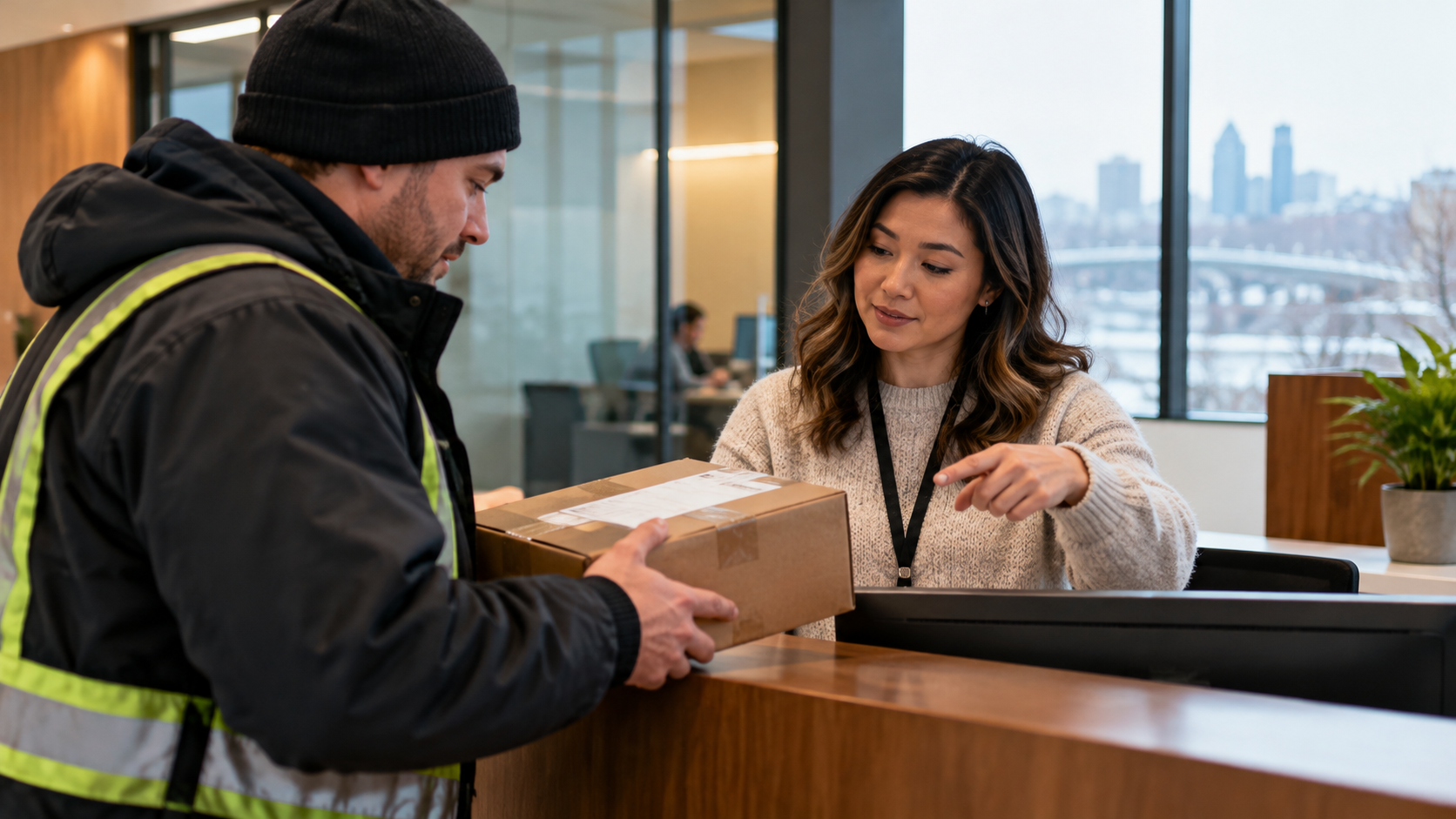
The parcel label names Dana Lee in Suite 420. A person at the correct desk says, “I'm Jordan; I take all deliveries for this office.” The street and suite appear right, but the name at the handoff differs. A Minnesota delivery driver recipient name mismatch calls for a short verification, not an automatic refusal or an automatic release. Confirm the destination, the person's receiving role, and the shipment's own handoff rule before the parcel leaves your custody.
Some deliveries permit a responsible person or staffed desk to receive for the named recipient. Others restrict release to the named person or an authorized agent. The same name difference can be acceptable for one parcel and disqualifying for another. Read the app and label as they apply to this shipment. If the rule is unclear, ask the employer's support contact. Do not make up a recipient name in the proof field simply to finish the stop.
This guide covers a person who is present but whose name does not match the label. The adjacent article about an absent signer begins when no eligible person is available. Other guides cover unit-number checks and recording proof after an authorized transfer. Here the decision is whether the person offering to take the package is allowed to receive this specific item at this specific address.
Confirm the address and unit before judging the name
Check the street number, building, suite or unit, and recipient line. A wrong unit can make a plausible office employee appear to be an alternate recipient when they actually work for another tenant. Do not compare names while overlooking a mismatch in the destination. If the parcel is addressed to Suite 420 and the desk serves Suite 402, pause and clarify the location. A familiar company logo in the lobby may not settle the suite number.
USPS Publication 28 § 213 identifies secondary address elements such as apartment, suite, building, floor, and room. The standard shows why those details are distinct from the main street address. It does not tell a delivery driver who may accept a package at a particular suite. Use the unit as part of the destination check, then apply the shipment's release rule to the person present.
Check whether the name on the parcel is a person, business, department, or attention line. “Northstar Design, Attn: Dana Lee” may indicate a business destination with a contact name. “Dana Lee, Suite 420” may still go through a staffed reception desk if the shipment rules permit it. Do not infer a universal policy from the label format. Ask the desk whom it receives for and what the employer's app requires.
If the label and app show different names, preserve the discrepancy. A shipper may have updated an order after printing a label, or the app may have imported incomplete data. Those are possibilities, not facts to assert. Contact dispatch or the shipper through the approved process before editing the destination. Do not overwrite the parcel's original name to match the person standing in front of you.
Make the delivery handoff name check specific
A delivery handoff name check asks what connection the person has to the parcel and whether that connection satisfies the service. “I work here” is a start, but it may not show that the person accepts deliveries for the named tenant or resident. At a reception desk, ask whether the desk signs for this suite and whether the parcel type is accepted. At a residence, ask whether the person is an eligible household member or authorized agent under the shipment rule. Do not demand information beyond what the employer's process permits.
The answer may be a role rather than a matching name. A receiving clerk can be authorized to accept shipments for a department without being the person in the attention line. Record the clerk's actual name or role according to the proof method. If the desk refuses to give a name but can issue a receipt, ask whether that receipt satisfies the employer's rule. If no approved proof can be captured, pause before release.
The USPS Signature Confirmation FAQ describes a service in which a recipient or responsible person at the residence signs, with the signature and recipient name recorded. USPS also describes restricted services that direct delivery only to the addressee or an authorized agent. These differences are USPS-specific, but they show why a name mismatch cannot be resolved without reading the exact service condition. Another carrier's definition may differ.
If the parcel has an adult, restricted, or named-person requirement, follow the verification steps required by your employer. A person saying “I'm their neighbor” or “I handle the office mail” does not automatically satisfy a restricted rule. Do not collect or photograph an ID outside the approved procedure. If eligibility cannot be established, keep custody and ask support for the next authorized step.
Verify an authorized alternate recipient before handoff
An authorized alternate recipient may receive at the original address under the shipment's rule. That differs from someone asking you to take the parcel to another suite, neighboring business, or off-site location. A change of destination may require sender or employer approval even when the person requesting it knows the named recipient. Ask which situation you have before moving the parcel.
Suppose a receptionist at Suite 420 says Dana Lee works there and the desk accepts all ordinary deliveries for that tenant. If the parcel permits desk acceptance, the name difference may be expected. Record Jordan's actual identity or the desk receipt. Do not enter Dana Lee as the signer when Jordan took custody. The record should show the real handoff while preserving the named destination.
Now suppose Jordan says Dana moved to Suite 510 and asks you to carry the parcel there. That may be a current location, but it is not merely a substitute signer at the original suite. Verify the change through the employer's approved address-correction process. A casual instruction in the hallway should not silently amend the shipment's destination. If the parcel must be returned or held until the shipper confirms, record the actual reason.
At a residential building, a concierge may accept packages for residents through a documented system. A neighbor who meets you in the lobby may have no such role. Treat those offers differently. The presence of a person near the address does not prove receiving authority. A building's general package policy may also exclude signature-required or restricted parcels. Check the shipment and site together.
Ask an efficient question when the explanation is unclear
Use neutral wording: “The parcel is for Dana Lee in Suite 420. Does this desk accept packages for that person and this service, and what proof can I record?” The question avoids accusing the person of wrongdoing. It also gives the desk a chance to say it accepts ordinary parcels but not restricted ones. If the person cannot answer, contact dispatch or the named recipient through the approved channel.
Do not argue about a person's identity based on appearance or a guess about a surname. Ask for the role and authorization that the service actually requires. If the employer requires an ID check, follow that rule consistently. If it does not, inventing a personal ID requirement can create an unnecessary conflict and may expose sensitive information. A policy question should be settled by the policy owner, not by a driver's improvisation at the door.
If the person offers a plausible explanation for the different name, record it as their statement until confirmed. “Receptionist says Dana Lee no longer works here” is different from “recipient moved.” “Household member says parcel uses a former surname” is different from a verified address update. If the explanation affects delivery eligibility, ask support what evidence or authorization is needed before releasing the parcel.
If a phone contact authorizes a different person to sign, check whether the shipment rule permits that authorization and how the employer records it. A call from an unknown number is not enough to establish that the caller controls the parcel. A recipient message may be valid for an ordinary shipment but insufficient for a restricted one. Preserve the direction and wait for the approved change to appear or be confirmed by support.
Record the person who actually accepts the parcel
When the alternate is authorized, use the actual receiver's name or role in the approved proof field. Ask them to sign their own name if a signature is required. Do not type or sign the named recipient's name on their behalf. If a staffed desk uses a package log, confirm that it lists the parcel and suite correctly. A signature or receipt should tie this item to the person or desk that took custody.
USPS's domestic extra-services FAQ distinguishes ordinary Signature Confirmation from restricted variants, including who may receive and what record the sender gets. It is an example of how proof and eligibility travel together. The rules for your parcel come from its actual service and your employer. The record should never claim that the named recipient signed if an alternate did.
If the app has a recipient-name field prefilled with the label name, check whether it is a destination field or a receiver field. A prefilled destination name should not be silently replaced with the receptionist's name if that would change the shipment address. A receiver field should show the receptionist, not the person named on the label. If the interface is ambiguous, ask support before completing the event.
For multi-piece deliveries, confirm which items the alternate accepted. A desk may take two cartons for Dana Lee but reject a third requiring a restricted signer. Record separate outcomes by parcel ID. Do not use one person's signature to cover a piece they did not receive or were not eligible to receive. Keep the unaccepted item under controlled custody.
Handle aliases and shared addresses without changing the label
The person at the handoff may explain that the name on the parcel is a former employee, a trade name, or a department alias. Check what that explanation means for the actual destination. If the business at the labeled suite accepts mail under the old name and the service permits a business receiver, the mismatch may be resolvable through the authorized desk. If the named person moved to another business, that is a different destination question. The driver should not decide it by erasing the original label name.
At shared buildings, several tenants can use one reception area. Ask whether the desk receives for the specific tenant and unit. A receipt stamped with the building's name may show the parcel entered the shared desk, but it may not show which tenant it was assigned to. Check whether the desk logs the unit or recipient. If it cannot identify the intended tenant, ask support whether that is sufficient for this shipment before release. A lobby worker's familiarity with the name is less useful than a documented receiving path.
At residences, a household member may use a different surname, and a resident may have changed names. The driver should not assume fraud from that fact. Equally, a matching surname does not prove that a person lives at the destination or is eligible under a restricted service. Follow the employer's permitted verification steps for the parcel. Do not request or copy personal documents beyond the procedure. The handoff decision turns on authority under the shipment rule, not whether the driver finds the explanation socially familiar.
If a label seems to use a nickname while the person presents a formal name, ask the person how the parcel is connected to them and use the approved verification path. Do not edit the recipient field to make the names identical after the fact. If the system needs an alternate-name note, record the person's actual statement and the support decision. A later investigator should be able to see the original addressee, the actual receiver, and why the release was allowed.
When no one at the site can resolve the relationship, the parcel remains in custody. A driver can tell dispatch exactly which names, suite, and roles were checked without broadcasting private details to unrelated people. The sender or recipient may need to correct the address or authorize a new receiver. Preserving the mismatch gives that owner a real issue to solve instead of a delivery record that hides it.
Use a worked example with changed facts
Imagine a parcel for Dana Lee, Suite 420. A receptionist named Jordan meets the driver at the desk. The app permits delivery to an authorized business receiver, and the desk confirms it accepts parcels for Suite 420. Jordan signs their own name, and the driver records “Suite 420 reception desk” through the approved method. The name mismatch was resolved by the desk's receiving role and the shipment rule, not by changing the label.
Change one fact: the parcel requires delivery to Dana Lee personally. Jordan may still be courteous and trustworthy, but the service condition does not permit that release without a formal exception. The driver keeps the parcel and uses the employer's recipient-absent or restricted-delivery process. Jordan's willingness to sign does not change the rule.
Change another fact: Jordan works at a different suite and says Dana is on another floor. The driver should verify the address and destination before carrying the parcel elsewhere. If the suite on the label is wrong, the issue may be an address correction rather than alternate-signer eligibility. Do not hand over the parcel at the wrong suite merely because someone knows the recipient.
These examples are hypothetical. The sequence is address and unit, service condition, person's receiving role, actual proof, and custody outcome. A mismatch is a signal to check those facts. It is not a verdict about the person who offers to help.
Keep the parcel when authority cannot be confirmed
If no eligible person or approved location can accept the parcel, retain it and follow the employer's exception process. Record the person you spoke with, their stated role, the mismatch, any contact with dispatch, and the parcel's next custody point. Do not mark the named recipient absent if you only learned that the desk could not confirm authority; describe the narrower fact. Do not mark delivered because the person promised to pass it along later.
If the app offers only broad status choices, ask support which one represents an unresolved recipient-name or authority mismatch. A false “refused” code could trigger the wrong customer message. A false “address invalid” code could send the next driver to the wrong search. Use a factual note that preserves the actual observation even when the category is coarse.
If a later recipient calls and confirms the alternate, ask whether that direction can authorize a new attempt and how it must be recorded. A later confirmation does not turn a previous unauthorized handoff into a proper one; fortunately, if the parcel is still with the driver, the next action can be planned accurately. Keep the original stop record and the new instruction linked to the same parcel.
Drivers comparing employers can ask how identity mismatches and alternate receivers are resolved on route. The published delivery job-offer review guide can help frame that support question. The Saint Paul delivery driver Careers hub provides broader role context. Neither page can authorize the person standing at a current handoff.
The useful outcome is a truthful transfer or a truthful hold. If an eligible alternate accepts the parcel, record that person's actual identity and the permitted place. If authority remains uncertain, keep custody and ask for a route decision. A different name is a question to resolve, not a field to overwrite.