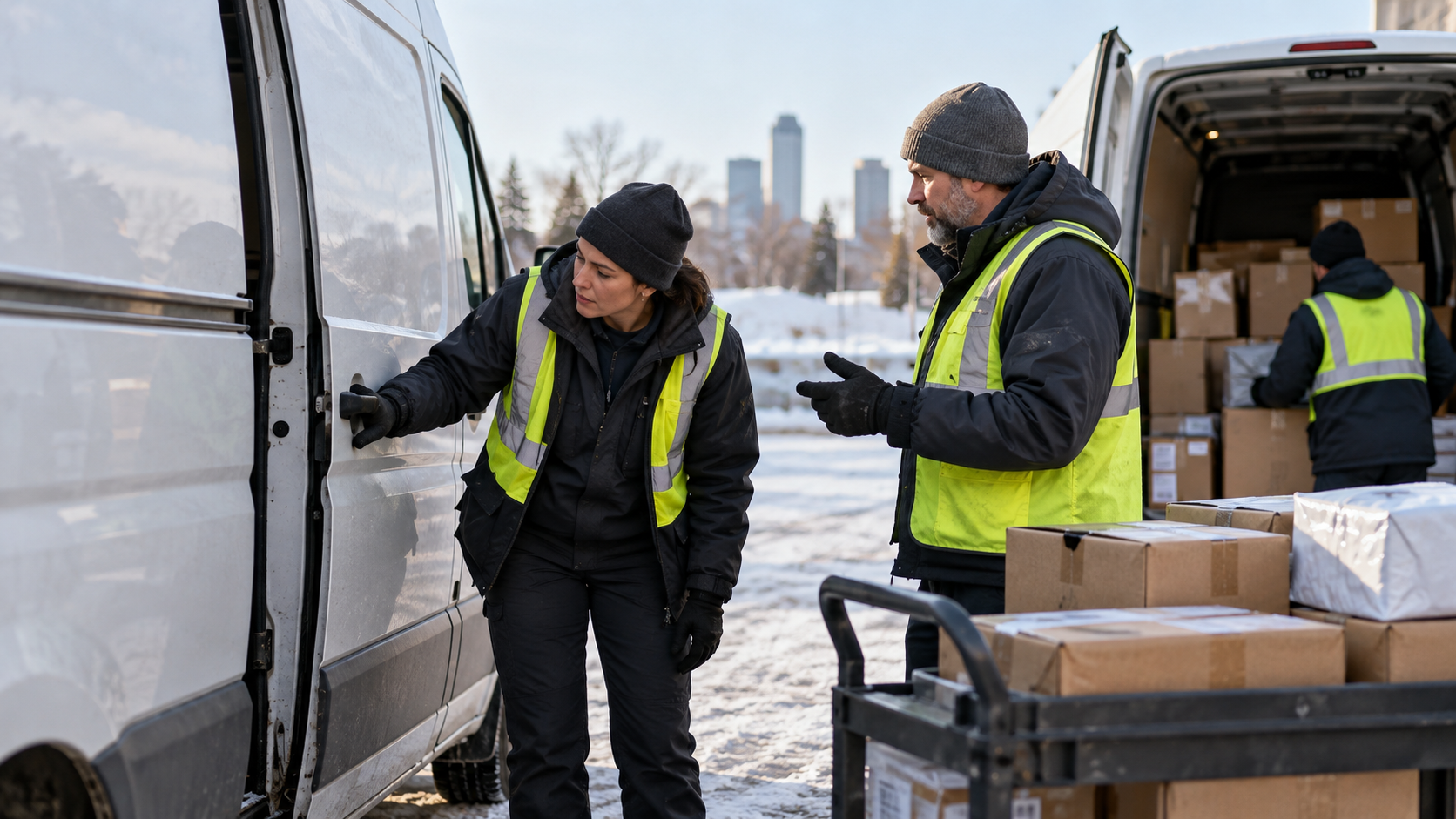
The side cargo door has failed a normal closure check twice. The driver reported it to fleet, and a supervisor has seen the vehicle. The door still opens when the driver checks it in the approved way. Meanwhile, dispatch asks whether the route can leave in fifteen minutes. At this point, repeating the original defect report will not answer the operational question: which vehicle, if any, can carry the remaining parcels?
A Minnesota delivery driver replacement vehicle request connects three facts: the original van is held for an unresolved condition, the route needs a usable vehicle, and the load needs a controlled transfer if a substitute arrives. The driver does not have to diagnose the latch or select a repair. The request should identify the vehicle, what remains unresolved, what decision is needed, and where the cargo is now. Fleet or another authorized person decides whether the original van is repaired and cleared, whether a replacement is supplied, or whether the route is reassigned.
This article begins after a safety concern has already been observed and reported. Separate guides address how to report a particular mirror, tire, door, or cargo-visibility fault. Here the focus is what happens when the condition has not been resolved and the route cannot simply proceed as planned. A replacement request is a vehicle and custody decision, not a declaration that every warning or defect requires a new van.
State the unresolved van safety issue precisely
An unresolved van safety issue needs a current status, not only its original description. “At 8:20 the door opened after a normal close; fleet inspected at 8:34; it still opens on the approved check; van 18 is parked at the station and has not departed” tells the decision-maker what is known now. “The door was bad this morning” leaves open whether it has since been repaired or cleared. Include the incident or maintenance ticket if the employer uses one.
Describe the observed behavior and the last authorized action. A driver can say that a mirror remains unusable after cleaning, a warning remains active after fleet inspection, or a door still fails the taught closure check. The wording should not turn one symptom into a diagnosis. “Starter is defective” is different from “the engine does not turn during a normal start attempt.” The fleet team needs the sequence to decide whether another check, roadside service, or a substitute vehicle is appropriate.
State whether the van is parked, stopped on route, or at a station; whether it is blocking an access point; and whether anyone is waiting with it. If the position creates an immediate traffic or injury hazard, follow the employer's emergency and roadside process first. A vehicle swap cannot solve an unsafe roadside scene by itself. Dispatch also needs to know which stops are still open and whether a time-sensitive delivery is at risk.
Ask for a disposition and a substitute in one message
The request can be direct: “Fleet, van 18 remains held because the side door does not stay latched after your check. Dispatch, six parcels and four stops are open. Please confirm whether fleet is sending a replacement van, clearing this one after repair, or reassigning the route. I will keep the load with me under the custody process until a handoff is approved.” It names a decision without assuming the answer.
Send it through the employer's actual fleet and dispatch channels. A maintenance text may record the defect but never reach the person arranging route coverage. A dispatch message may find another driver but fail to put the original van on a repair hold. Where the systems are separate, link them with the same vehicle ID, route ID, location, and ticket number. Ask for a named owner of each decision so a vehicle does not disappear between queues.
An estimated arrival time for a replacement is not a clearance to move the defective van. If dispatch says “a van may be free after lunch,” record that as a planning estimate. Ask what the route should do meanwhile: wait at the safe location, split urgent stops, return parcels under an approved process, or assign another driver. The driver should not promise customers a new arrival time until dispatch has a real coverage plan.
Keep the original vehicle on a clear hold
While the condition remains unresolved, the original van's status should be plain to the next person who could take its keys. Mark or report the hold in the fleet system the employer uses. Include the defect, location, current custodian, and whether cargo is inside. Do not leave a vague note on the dashboard as the only warning. A second driver may not see that note until after accepting the route or loading the vehicle.
For covered commercial motor vehicles, federal unsafe-operation rules address operation in a condition likely to cause an accident or breakdown, and pre-operation inspection rules require the driver to be satisfied that the vehicle is in safe operating condition. Applicability depends on the vehicle and operation. Regardless of that classification, a driver should follow the employer's vehicle hold and repair authority rather than interpreting a schedule change as mechanical clearance.
If a technician arrives, give the technician the original symptom and what happened since. The technician's finding may change the plan. A successful repair can make the first van usable again if fleet confirms it is cleared. A failed repair may make the replacement more urgent. Keep the event sequence intact. The first report should not be rewritten to imply the driver knew the cause before the inspection.
Confirm what the replacement must actually carry
A substitute vehicle must be suitable for the route, not merely present in the parking lot. Tell fleet or dispatch how many parcels remain, whether any are oversized or have special handling rules in the approved manifest, and whether the replacement needs a particular loading configuration. Avoid guessing about vehicle capacity or claiming a package's contents from its appearance. The person assigning the vehicle can check its specifications and load plan.
The replacement also needs to be available, assigned, and ready under the employer's process. A driver should know its vehicle ID, keys or access method, inspection or pre-use check requirements, and who has authorized the swap. Do not move cargo into a van that another route still owns because its door happens to be open. A parked vehicle is not necessarily a released vehicle.
If no suitable replacement is available, dispatch may split the route or send another driver for particular stops. That may be slower than exchanging one van, but the cargo and route records still need to match physical reality. Ask who owns the remaining stops and when a receiving employee will arrive. A plan to transfer six parcels does not transfer any parcel yet.
Work through a safe vehicle swap handoff
A safe vehicle swap handoff has a specific sending vehicle, receiving vehicle, people, place, and time. Choose a safe loading location under the employer's process. At a station, this may be an assigned bay. At a roadside stop, fleet and dispatch may need to direct a safe meeting point or arrange a tow before unloading. Do not open a cargo door into traffic or leave parcels on a sidewalk while seeking the replacement keys.
Count or scan items as the employer requires when they physically move. Identify items delivered before the defect, items still open in the first van, and items actually transferred. Keep any special handling or signature requirement with the correct item. The receiving driver should acknowledge the load under the company's process. The route app's reassignment can be done before or after physical movement depending on the system, but the record should distinguish planned assignment from completed custody transfer.
If the same driver takes the new van, the vehicle changes even though the employee does not. Record which parcels moved from van 18 to van 24 and whether any item remained in the original vehicle. Check the replacement's load security and visibility before departure. The pressure of catching up should not turn a careful swap into a rushed stack that creates a new vehicle problem.
Follow one hypothetical route from hold to departure
Imagine a driver at a Saint Paul station with ten parcels loaded. Before leaving, the side door opens during the normal closure check. The driver reports the symptom to fleet and the route delay to dispatch. A fleet employee examines the door and asks for another normal check, which still fails. The van remains parked in the designated area. The driver sends a replacement request with the vehicle ID, ticket, route, parcel count, and failed post-inspection check.
Dispatch assigns van 24 and confirms that it is released for this route. The driver and an authorized station worker move ten parcels using the employer's scan process. They verify that van 18 is empty, lock it under fleet direction, and mark it held for repair. The driver performs the required check of van 24, arranges the load without blocking views or controls, and departs after dispatch confirms the remaining stops. The door diagnosis may still be unknown. The route does not need a guessed diagnosis to use a different cleared vehicle.
Change the timing: the same door problem appears after four parcels were delivered. Six remain in the van at a customer stop. The original driver secures the vehicle and informs dispatch of the precise location. A replacement driver may arrive before a replacement van. That driver can receive six parcels only when the handoff is safe and documented. The four completed stops stay completed; the six remaining stops follow the actual load, not the first vehicle's stale screen.
Change the outcome: a fleet technician repairs and clears van 18 before van 24 arrives. The driver tells dispatch before canceling the swap and confirms that the route has not already been assigned elsewhere. A cleared original vehicle may be the correct answer. The key is that the clearance comes from the authorized process after the unresolved condition has been addressed, not from the driver's wish to avoid a transfer.
Separate the safety decision from route urgency
Dispatch may need to tell customers about delays or move a delivery window. That is legitimate route work, but it does not determine whether the defective vehicle may be driven. A driver who hears “we need these packages out today” can reply with the current vehicle hold and ask for a replacement or reassignment decision. The message can be calm and operational: “I can resume once fleet clears this van or a suitable replacement is assigned and the load is transferred.”
Keep estimates honest. “Replacement requested” does not mean “replacement dispatched.” “Technician en route” does not mean “vehicle repaired.” “New route assigned” does not mean “parcels transferred.” Those distinctions help the team give customers realistic updates and prevent another worker from arriving at the wrong vehicle. If plans change, add a new status with time and owner instead of smoothing the sequence into a single success note.
The driver should not negotiate a mechanical shortcut with a customer or a coworker outside fleet authority. A customer cannot approve a defective vehicle because a parcel is urgent. A well-meaning teammate cannot clear a van by saying the same issue happened last week. Put the observation and requested decision in the channels that reach the employer's authorized staff.
Clarify a conflicting instruction before moving
Sometimes dispatch may tell the driver to continue while a fleet ticket still shows a hold. The conflict may be a delayed system update, a clearance that was communicated to one team but not another, or a real disagreement about the vehicle. Ask for the fleet decision and time, then have the teams reconcile the status before departure. Do not convert a dispatch schedule instruction into a repair finding. If fleet says the vehicle remains held, report that status back to dispatch and repeat the request for a substitute or route reassignment.
The same clarification applies when a replacement is promised but not assigned. “Take the spare van” may leave the driver without a vehicle ID, keys, load authorization, or a check of whether another route owns it. Ask which van is released, who approved it, and where the cargo transfer should occur. A specific question usually resolves the gap faster than a long account of why the day is already late.
Keep the written sequence factual. Include who said what, when, and which vehicle each instruction concerned. Do not label someone careless because an update was missing. A later reviewer needs to know whether the original van was cleared, replaced, or simply left parked while another employee took the route. That record also helps prevent a duplicate vehicle assignment on the next shift.
Verify the replacement's own starting condition
The replacement is not automatically ready merely because it is different. Follow the employer's pre-use check for that vehicle, review any applicable prior defect status, and report a new concern if one appears. For covered commercial motor vehicles, 49 CFR § 396.13 addresses driver inspection before operation; the employer's exact process may include more steps for its fleet. Do not transfer the parcels first and assume inspection can wait until the first stop if the company's procedure requires it before departure.
Confirm that mirrors, doors, tires, lights, cargo restraints, and vehicle access work as expected under the authorized checklist, without turning this article into a repair manual for each part. Check that the new load does not obscure the driver's view or block a door. If the substitute lacks space for all parcels, tell dispatch before closing the first van's cargo record. A partial transfer needs item-level clarity, not a blanket “route moved” status.
Once the replacement is cleared and loaded, ensure the route system shows the correct driver and vehicle where the employer tracks both. If a package remained with another employee, do not scan it from the substitute. A replacement request succeeds only when a suitable vehicle is available, the original issue has a named owner, and the active cargo and route match the vehicle that actually leaves.
Leave a repair owner for the held van
The original van still needs attention after the route moves. Record where it is, who holds the keys, the defect ticket, whether any parcels remain, and which fleet person owns the next inspection or repair. A route completion screen does not close a maintenance problem. If the van is towed, record the tow destination and handoff under the employer's process. If it remains at a station, make the hold visible before the next shift tries to assign it.
FMCSA's inspection-report guidance describes defect and carrier responsibilities for applicable interstate commercial motor vehicles. A local delivery employer may use different forms. The driver should still make sure the original condition and its disposition live in the fleet record, not only in a dispatch chat about late deliveries. The repair owner can then use the actual symptom and prior actions without relying on rumor.
Drivers comparing roles can use the Saint Paul delivery driver Careers hub and the published delivery job-offer review guide to ask how an employer supplies another vehicle when one is held. On a current route, the useful request names the unresolved issue, the hold, the parcels, the needed decision, and the people who will complete the swap and repair.