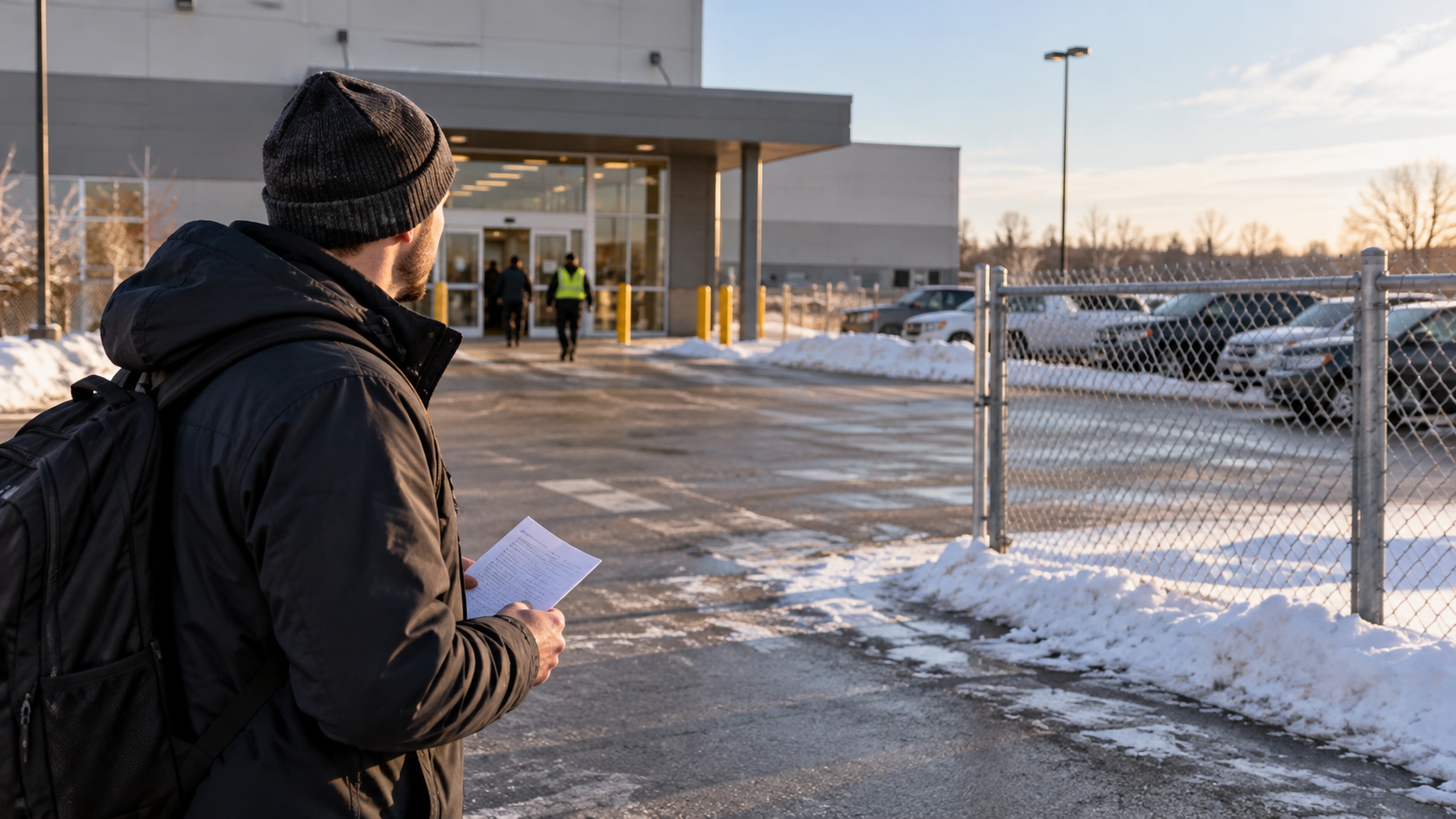
A delivery posting can give a city and start time while saying nothing about where employees park. A map may show a large paved area beside a facility, but it cannot tell you whether new hires may use it, whether spaces are available at check-in, or whether the lot belongs to another business. If you plan to drive to work, first confirm the reporting location for the exact opening, then ask about employee parking at that site.
For Minnesota delivery driver reporting-site parking, keep three questions distinct: where the employee reports, whether the employee can park a personal vehicle there, and what conditions apply. The company vehicle used on routes is a separate matter. A driver can have a company van and still need to arrange a commute; a personal car used for commuting does not necessarily become the delivery vehicle. The current employer posting and role-specific answer should settle these facts.
Confirm employee parking availability at the real site
Read the posting for a reporting station, depot, warehouse, or check-in address. If it gives only a job-board city badge or a service territory, ask where a normal shift begins. A parking question about the wrong facility cannot help your decision. The station versus service-area guide covers that location distinction. This article takes the next step: once the reporting site is known, can this employee park there?
The phrase employee parking availability should mean more than “a parking lot exists.” Look for explicit language such as “employee parking provided,” “parking permit required,” “limited on-site parking,” or “off-site employee lot.” Copy the exact sentence and any qualifier. “Free parking” on a company benefits page may refer to headquarters, while this driver role reports at a separate depot. Attach the claim to the identified location and role before relying on it.
If the page does not mention parking, mark it “not stated.” Do not infer “no parking” from silence, and do not infer “parking guaranteed” from an aerial image. A site may have vehicle storage or customer spaces that employees cannot use. A building may appear to have no lot yet have an off-site employee arrangement. Ask the employer what workers hired into this position actually use.
Check whether the answer applies to new employees. Some sites assign spaces by permit, seniority, shift, or team. Do not assume an established employee's arrangement applies to a new hire. A role-specific question can identify whether parking is available for the shift you would work, not merely whether the company owns spaces somewhere.
Clarify parking at driver check-in time
An early shift may begin before a public garage opens or before an office entrance is staffed. If the employer says on-site parking is available, ask whether the lot and employee entrance are accessible at the required check-in time. A 5:30 a.m. start with a lot that opens at 6:00 would not solve the commute. Conversely, an early lot could be available even if the public front door is closed; the employer should identify the approved employee route.
The phrase parking at driver check-in ties the space to a specific shift. “Parking available during business hours” may not cover an early start, late return, or weekend assignment. If the posting gives a range of start times, ask about the earliest one this role may require. If shifts rotate, confirm the arrangement for each required day type. A single daytime visit to the property cannot prove the lot works for every scheduled shift.
Ask where a personal vehicle may remain during the entire workday. A short-term loading zone or visitor space may allow a brief stop but not employee parking until route completion. If the driver takes a company vehicle out for several hours, the personal vehicle still needs a lawful place. The employer can explain whether its arrangement covers that duration. Do not treat an open space near the loading dock as permission to leave a car there.
If the reporting site has more than one entrance or lot, ask which one employees use. A map pin may direct you to the delivery-vehicle gate rather than the personal-car area. Keep the employer's instructions with the site address. This is a practical location question, not a request for restricted access details before hiring; the employer can provide appropriate directions during onboarding.
Separate personal-car parking from route-vehicle storage
A job ad may say “company vehicles parked on site.” That describes the fleet, not automatically the employee commute. A depot can have many delivery vans and very few personal-car spaces. It can also have a separate employee lot. Ask specifically about parking a personal vehicle while you are on route. If you commute by another means, that fact may be irrelevant to you, but the posting's vehicle statement should still be read accurately.
Suppose a fictional ad says “Drivers pick up vans at East Depot; fleet parking provided.” It confirms where the route vehicle is kept, not where employees park their own cars. Another says “Employees may park personal vehicles in the marked lot during scheduled shifts.” That is a direct answer, subject to any permit or capacity qualifier. A third says “parking nearby,” which leaves whether it is employer-controlled, free, or available early open. These are examples of wording, not current Fast Track Delivery terms.
If a role requires the driver to use a personal vehicle for deliveries, the parking question changes. The car may go on route rather than remain at the depot, but you still may need to know where to check in, load, or wait. Do not assume that personal-vehicle work means no site parking is needed. Ask about the actual shift sequence. This article focuses on the place where the employee reports, not the broader vehicle-supply decision.
If the employer offers a shuttle from an off-site lot, record the shuttle's operating window and where employees board. A space several blocks away may be workable if the transfer is available for the assigned check-in and return times. Do not assume the shuttle runs all day or that a parking permit automatically includes it. Ask for the current arrangement tied to the position.
Ask about cost, permit, and capacity
Parking may be free, paid, permit-controlled, or first-come. The posting might state one of these but not the others. If commute cost matters to your decision, ask whether the employee pays a fee, whether a permit is issued, and whether a space is reasonably available at the assigned start time. “Parking available” may mean access to a paid public ramp rather than an employer-provided space. Keep the exact wording.
A permit can be issued at onboarding or require an application. Do not assume you may park before the permit is active. Ask what a new hire does on the first day and where to park for orientation if it occurs at a different site. The first-day arrangement may be temporary, so also ask about regular route shifts. A one-time visitor pass is not a long-term parking promise.
Capacity matters when the lot is shared with other shifts. If the employer says spaces are limited, ask what workers normally do when the lot is full. The answer may be an overflow lot, another approved area, or a need to find public parking. Do not create your own overflow plan from a satellite image. If the employer points to public parking, verify its hours and rules through the relevant local authority before counting it as a reliable daily option.
Keep parking fees separate from pay deductions. A posting that names a paid garage does not tell you how any cost is collected or whether reimbursement exists. Ask the employer about the arrangement if it affects your decision, and review actual written terms. This article does not decide the legality of a deduction or assume one exists because a parking fee is mentioned.
Compare on-site and nearby options honestly
“Nearby parking” can mean a block away, a longer walk, or a location across a busy road. Once the employer names the approved area, check the walking path to the employee entrance and the time needed before check-in. A space that is available but adds a fifteen-minute walk may change which shift start is practical for you. Do not replace the employer's designated lot with an unverified curbside space because it appears closer on a map.
Public street parking may have posted limits, permit zones, snow rules, or time restrictions. Minnesota Statutes §169.34 identifies certain places where parking is prohibited. Local restrictions can change. A map pin or old online comment is weak evidence for a daily work plan. If an employer relies on street parking, ask which area employees are directed to use and then check current signs and local rules before treating it as dependable. Do not claim a public space is reserved for employees unless an authority says it is.
If you use transit as an alternative, Metro Transit's trip planner can help test a route to the confirmed site. A transit option does not answer whether parking is available; it gives you another commute to evaluate. An early check-in may make transit difficult, while a paid garage may make driving costly. Compare the full options for your own schedule rather than treating one as universally better.
A candidate who can walk or cycle may not need a parking answer before applying. Another candidate may rely on a personal car for every early shift. The unanswered field has different importance for those readers. Ask when the answer changes your decision, and save it with the role ID. Do not delay an application over an irrelevant detail just because a generic checklist included it.
Use the employer's current role page for a precise question
For Fast Track Delivery opportunities, begin with the Saint Paul delivery driver careers page for current public role information. This guide does not claim the company offers or lacks employee parking. If a third-party board lists “free parking” while the employer page is silent, ask whether the benefit applies to the exact reporting site and shift for the active role.
A useful question might say: “For driver role 482, where do employees park their personal vehicles during the early shift at the reporting site, and is a permit or fee required?” Replace the sample ID and shift with the current details. If the reporting site is still unknown, ask for it first. A general “Do you have parking?” may invite a company-wide answer that does not settle this depot's arrangement.
If the employer says parking is available at another site, ask whether this position ever reports there. If it says employees use an overflow lot, ask whether the lot is open at your earliest check-in and where the approved entrance is. Keep the question on the operational facts needed for a commute decision. You do not need a floor plan or internal security details before applying.
Save the reply with date, role ID, site, shift, cost, permit status, and any capacity qualifier. “We usually have spaces” is not the same as a guaranteed reserved spot. “Parking provided at orientation” is not the same as regular-shift parking. Preserve the employer's words and ask one follow-up if the unresolved part changes your decision.
Check shared-property parking rules
The lot beside a depot may be controlled by a landlord, neighboring business, or property manager. The employer may have a set number of assigned spaces or permission for certain rows only. A photo cannot show those boundaries. If the employer says employee parking is available in a shared lot, ask which area its drivers may use and whether access covers your start and return times. Do not take an empty space near the entrance as proof it is assigned to your employer.
Consider a fictional building with three tenants and one large lot. A driver posting says “on-site parking,” while a later note says employees should use the rear marked row. That is still on-site parking, but the location matters for the walk to check-in. Another posting says “parking at the property,” yet its designated employee spaces fill before the early shift arrives. In that case, the availability qualifier matters more than the lot's existence. The examples show why “on-site” and “guaranteed space” should be kept separate in your note.
If parking is managed by a third party, ask the employer which instructions apply to its employees. A public garage website may list ordinary hours and prices while the employer has a separate arrangement. The reverse can happen: an old recruiter note may describe a discount that no longer exists. Use the current employer answer for the role and check any public facility rules that affect your plan. Do not assume either source covers the other's terms.
Test every reporting site the role can require
A role may rotate among two reporting facilities. One could have a free employee lot, while the other relies on a paid ramp or street parking. If the job requires both, make a parking row for each. Ask how often a new hire may be assigned to each site and whether the same check-in time applies. A workable commute to the preferred depot does not solve an unavoidable shift at the other one.
If the employer says workers can request one fixed site, ask whether that assignment is confirmed for this opening or merely a preference considered later. Avoid basing an acceptance decision on a parking arrangement attached to an unconfirmed site. If a second facility is only an occasional backup, note the qualifier and decide whether you have a realistic plan for those shifts.
Temporary site changes deserve the same care. A training week, vehicle relocation, or facility closure could move check-in. This article does not ask you to predict every future change; it asks what the advertised role can reasonably require now. When the employer gives a new site, update the parking plan for that location before the first affected shift. Keep the old plan for the original depot rather than silently applying it everywhere.
Keep a short parking decision record
Your note can list: reporting site; employee entrance; normal check-in time; personal-car parking area; hours of access; fee; permit; capacity or overflow plan; source and date. Mark unknowns. This is enough to estimate commute time and cost without pretending a map proves access. If the role rotates between facilities, make a separate line for each required site.
Imagine a fictional note: “Role 482, East Depot, 5:30 a.m. check-in; employer says employee lot opens at 5:00, permit issued at orientation, no fee stated, overflow plan pending.” The remaining question is clear. Another honest note might say “reporting site confirmed; personal-car parking not stated.” Neither should be rewritten as “free parking guaranteed.” The examples are not claims about a real opening.
If the employer changes the reporting site or shift time, recheck the parking facts that changed. An old lot answer may not apply to a new depot. A later start may make a public ramp usable, while an earlier start may not. Keep the old answer as context and attach the new one to the revised role. A parking plan should follow the actual work assignment.
The useful result is a role-specific answer about where a personal vehicle can stay for the full shift, whether access works at check-in, and what it costs. Confirm the reporting site first. Then ask about employee spaces, not just the existence of pavement near the building. That turns a vague “parking available” impression into a commute decision you can use.