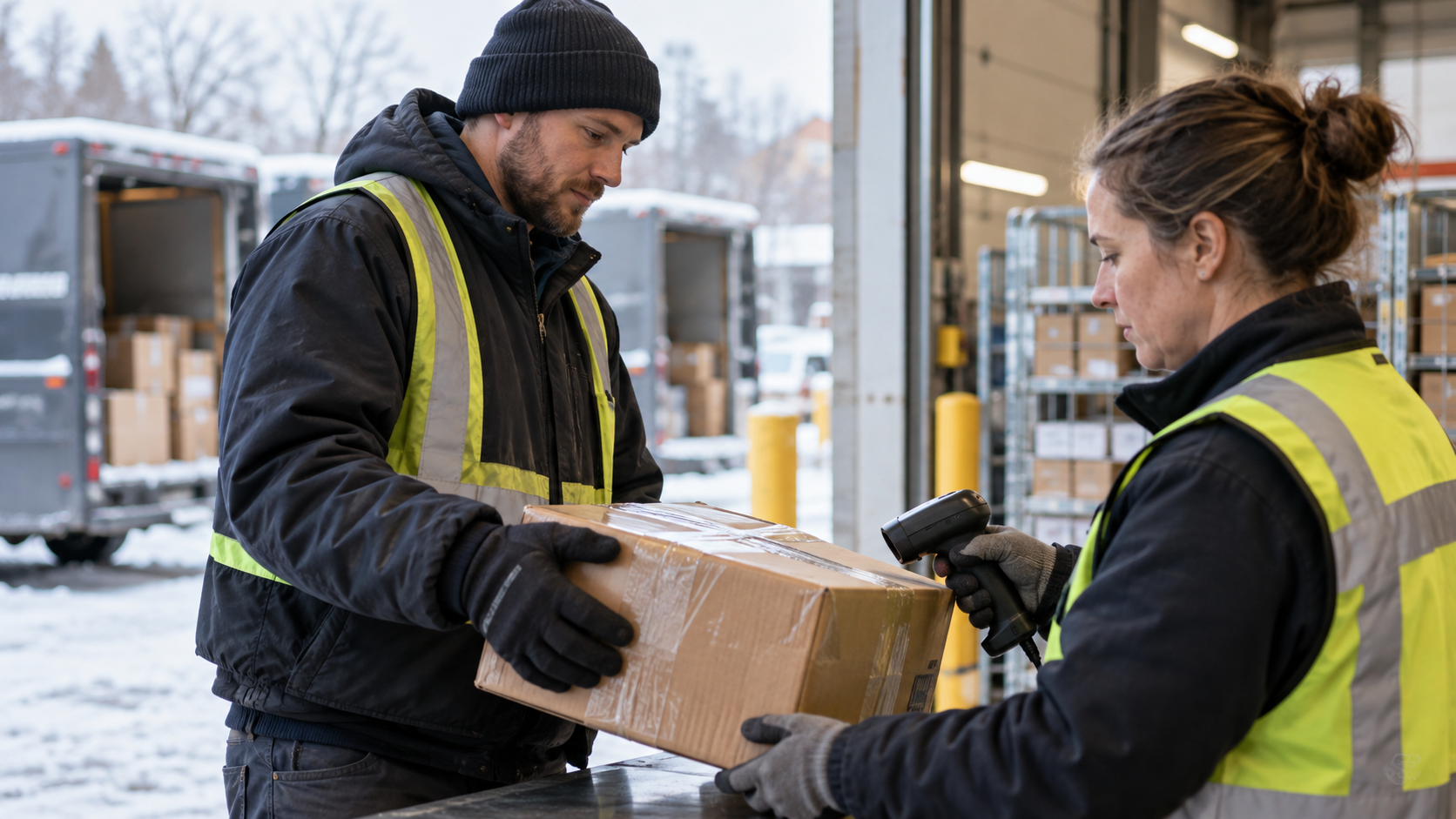
A driver brings an undelivered parcel back to the station and hands it to intake. The route app still shows it as “out for delivery.” Did the return scan fail, or is a screen lagging behind an accepted intake event? A Minnesota delivery driver returned package route status check compares the parcel's barcode, physical handoff receipt, reason for return, and current route state before anyone submits another scan. The item should no longer appear in the driver's vehicle custody after station intake, but it should not be described as delivered to the customer or returned all the way to the sender unless those later events actually occurred.
The word “returned” can hide several destinations. A package may go from driver to station, from station to another route, or through a carrier return-to-sender process. UPS Delivery Intercept lists return to sender alongside hold, reschedule, and redirect as distinct pre-delivery options. The USPS tracking guide also distinguishes multiple public states. Another employer's internal codes may differ. This article focuses on a driver's post-handoff check, not on choosing the original exception reason or predicting a later carrier outcome.
The check begins with physical evidence. A route card changing color is useful, but a package can still sit in the van. Conversely, a station employee can take a parcel while the device still shows an old route state. The driver needs both sides reconciled: who has the item now and what the authoritative record says about that handoff. If either is uncertain, preserve the first attempted write and ask the system owner to resolve it before a duplicate scan.
Find the return-to-station scan check for the exact item
A return-to-station scan check starts with the barcode or item ID on the package and the station receipt. Compare that identifier with the route item that was brought back. A stop may contain several parcels, only one of which was returned. A receipt for the tote or route total does not necessarily prove a particular carton reached intake. Ask the station worker to confirm the item-level record under the employer's process.
The receipt should identify when and where the station accepted the parcel. Some systems also show the receiving worker, cage, hold area, or transaction number. Record the fields actually provided. Do not fill in a receiving person's name from a nearby badge if the system did not capture it. A precise station location makes the parcel findable during a later reattempt or inquiry.
If the station uses a bulk intake scan, verify that the parcel's barcode is included in the batch. A count of ten returned items can be correct while one wrong carton was included and the intended item remains in the van. Item identity matters more than the aggregate count. Compare the physical load after intake as well: the returned item should no longer be on the driver's shelf.
If the barcode is unreadable, use the employer's controlled identification process. Do not scan a similar parcel to make the returned count match. An unidentified physical item needs its own case, and the expected route item remains unresolved until the two are reliably linked. Preserve label condition and any earlier route event.
Identify a returned parcel status mismatch
A returned parcel status mismatch exists when the route, station, and physical facts disagree. The route may say “delivered” while intake has the parcel. It may say “out for delivery” after a valid return receipt. It may say “returned to sender” even though the item is only in a station hold. Each mismatch has a different repair target. State which screen shows which value and who physically has the item.
Do not assume a stale customer tracking page proves the station scan failed. Public pages can update on a different schedule from internal records. Check the employer's authoritative item event or ask station support for the accepted intake event first. A public status that remains wrong may still need correction, but the first question is whether the driver-to-station transfer was recorded.
If a return status is on the wrong barcode, preserve both items' events. A package delivered to the customer should not inherit the return of its neighboring carton. A returned item should not remain delivered because the stop-level card was completed. Ask support for a parcel-level correction with the original receipt and physical custody details. Do not rescan both parcels to “balance” the stop.
If the station receipt itself is wrong, report that before relying on it. A correct route card cannot repair a custody receipt for another item. The station may need to amend the intake batch or issue a new record under its procedure. The driver should not alter a paper receipt or invent a reference number after leaving.
Separate return reason from return destination
The reason a parcel came back and the place it went are distinct. A failed signature attempt, an address conflict, a canceled stop, customer refusal, or package damage may each lead to station intake. The route note should keep the underlying reason, while the custody event should show the station handoff. Do not replace “recipient unreachable” with “returned to sender” simply because the parcel traveled back in the driver's van.
An item can be at the station temporarily and still be scheduled for reattempt. Another may be held for address review. A third may enter a return-to-sender process. The driver should record the actual station disposition if known, and avoid guessing the final plan from the original reason. A dispatcher or station team may decide the next movement after examining the item and service rules.
If the item was damaged during the route, the condition note may need a separate record before intake. The station should receive the parcel with that context. A routine return code should not hide a leak or open seam. Conversely, a damaged-package flag does not prove the parcel was physically returned; the intake event still matters.
The UPS intercept page illustrates that a request to return to sender is a distinct service action before delivery. The driver bringing an item to a local station is an earlier custody step. Do not tell a customer the sender has received the package unless a later verified event establishes that result.
Check the first write before trying another scan
At a busy intake desk, a driver may hear a beep but see no final confirmation. The scan could be queued, accepted, rejected, or attached to another parcel. Preserve the first attempt's time, barcode, device message, and station employee or transaction reference. Ask the system owner what the authoritative event shows before repeating the return scan. A second scan can create duplicate intake records or obscure which event moved custody.
If the app clearly reports a validation error, read the cause. The parcel might still be assigned to an active route, lack a required exception code, or have an unreadable ID. Follow the employer's directed repair. Do not change the reason to a false one merely to make the return screen accept the package. The technical error and the physical handoff need to be reconciled together.
If the station worker has already taken the parcel despite the device error, note that physical transfer and obtain an interim receipt or case number through policy. The driver should not leave the item unowned in a shared pile. If intake refuses it until the system is corrected, the parcel remains with the driver. Do not write “returned to station” while it is still in the van.
Offline uploads need special attention. A device may show a local “return” card that has not reached the server. Keep it in the approved queue and follow the employer's sync procedure. Do not clear app storage, switch accounts, or submit a new return event while the first outcome is uncertain. Support can reconcile the event ID with the server and station intake.
Keep the station and driver views consistent
After a valid intake, the driver route should no longer demand delivery of that barcode. The station system should show the item at its actual receiving point. If one view is behind, report the exact fields and event references. A “route closed” summary may be too broad; reopen the parcel detail when the app permits it. One carton can remain active inside an otherwise complete stop.
Station staff may move the parcel again after intake. The driver should not overwrite the original handoff with the later shelf, route, or sender state. Each movement needs its own event. If the station assigns it to another driver, that new driver becomes the next custodian after a physical transfer, not at the instant a dispatcher changes a route card.
If the driver discovers the parcel still in the vehicle after recording a return, stop and report the false custody event. Do not put it on a station shelf without a new authorized handoff while pretending the first scan was accurate. The time gap between recorded and actual return may matter. Preserve the first event and make a correction under the employer's process.
The opposite error is also possible: the driver physically hands over the parcel but forgets to complete the return scan. Report the omission promptly with station receipt and actual handoff time. Do not backdate or create a fictional scan time. The system owner can enter or annotate the missing event using the verified physical evidence.
Review the public result without confusing it with intake
The recipient may still see “out for delivery” after a parcel has been scanned into a station. That customer-facing lag can matter, but it is a separate observation from the driver's intake receipt. Use the employer's authorized view to check the public message when the workflow calls for it. Do not make another return scan solely because the public page has not refreshed. First ask whether the original internal event was accepted and whether a downstream update is pending.
A public “delivered” message is more serious when the package is physically at the station. Report the exact tracking number, public wording, time observed, route event, and intake receipt. The status can cause the recipient to look for a parcel that never reached them. Support may need to correct tracking and any automated notice. The driver should not send an independent explanation that promises a particular correction time without approval.
Public tracking may compress several internal steps into one label. “Returning to sender” can describe a process that has begun without proving the sender received the item. Ask the system owner what the public wording means in that service. The driver should report only the last physical transfer they witnessed. An item in the station cage has a known station custodian even if a later carrier leg is planned.
Keep public screenshots in the approved support channel and include the observation time. A page captured hours after intake may differ from one shown at the curb. The sequence helps support distinguish a short display delay from a persistent wrong result. Do not overwrite the earlier observation when the page later changes; the complaint may depend on what the customer saw at the time.
Preserve return evidence across the shift boundary
A return near closing time can be handed to a station worker before the route system finishes syncing. Record the receiving location, worker or intake reference, barcode, and the device's pending state. Tell the next shift or supervisor which event still needs reconciliation. A note that says only “returned” leaves the next person unable to tell whether the parcel is in the station, the van, or an upload queue.
If the station uses a sealed return cart, confirm which cart or batch holds the item. A bulk cart scan can provide a custody reference, but the parcel should still be tied to that batch. If the item is moved to a hold shelf overnight, that later move belongs to station staff. The driver should not claim personal knowledge of a location they did not see. The handoff record can still identify the station as current custodian.
At the next available check, compare the pending event with the authoritative item history. If the original return posted, close the incident with that event ID. If it was rejected, use the employer's distinct correction path and preserve the rejected attempt. A fresh scan should not be made from memory while the parcel is inaccessible. The station has to confirm its physical item and current record before any new write.
A driver leaving employment or changing routes should still hand off an unresolved return case to a named supervisor. The parcel cannot depend on the original driver's personal notes or device after they leave. The approved case should contain enough identity and custody detail for someone else to finish the reconciliation without inventing a new return event.
Work through a split return at one address
Imagine a driver has two parcels for Suite 420. The receptionist accepts Box A with a signature. Box B requires a different authorized signer, and no eligible person is available. The driver records A as delivered and retains B. At shift end, the station scans B into its hold area. The driver checks that B's barcode appears on the intake receipt and its route status reflects a failed handoff followed by station return. A's delivered status stays attached only to A.
Suppose the route app shows the whole stop as delivered after A's signature. The driver should not assume B is covered. They report the parcel-level mismatch before station closeout, preserving the signature for A and intake receipt for B. A support correction can then keep each item's true outcome. The driver should not undo A's valid delivery just to reopen B.
Change one fact: the station worker scans B, but the device says “upload pending.” The physical item is with the station, and the digital return is uncertain. The driver records the station receipt and first event ID, then follows the sync or support process. Another return scan is not the first diagnostic. If the server later accepts the queued event, the route and station views can be matched to that original handoff.
Change another fact: the station refuses B because the route still shows it assigned to the driver and no exception was entered. B remains in the driver's custody. The driver asks support to correct the status path, then completes intake when authorized. Saying “returned” before the station accepts it would hide the parcel's actual location.
Close the route only after the parcel has a current custodian
At shift end, compare every returned barcode with the station intake list and the vehicle's remaining packages. An empty van is useful evidence, but it does not identify where each parcel went. The intake receipt, item history, and physical count should agree. If one barcode lacks a receipt, locate the item or preserve a missing-custody incident rather than treating a route summary as proof.
Ask who owns any unresolved discrepancy. A station supervisor may need to fix an intake record; dispatch may need to remove a stale delivery assignment; support may need to correct customer-facing tracking. Record the case references and next actions. The driver should not close the issue merely because one screen looks right while another still assigns them a parcel they no longer hold.
For drivers comparing employers, the published delivery job-offer review guide can prompt questions about return handling and route support. The Saint Paul delivery driver Careers hub gives local role context. During onboarding, ask what barcode-level receipt proves station intake and which view is authoritative when a route card and station record disagree.
The route status is correct when it describes the parcel's actual movement and current owner. A driver-to-station handoff is a real event with its own proof. Later reattempt, hold, or sender return should follow as separate events when they occur.