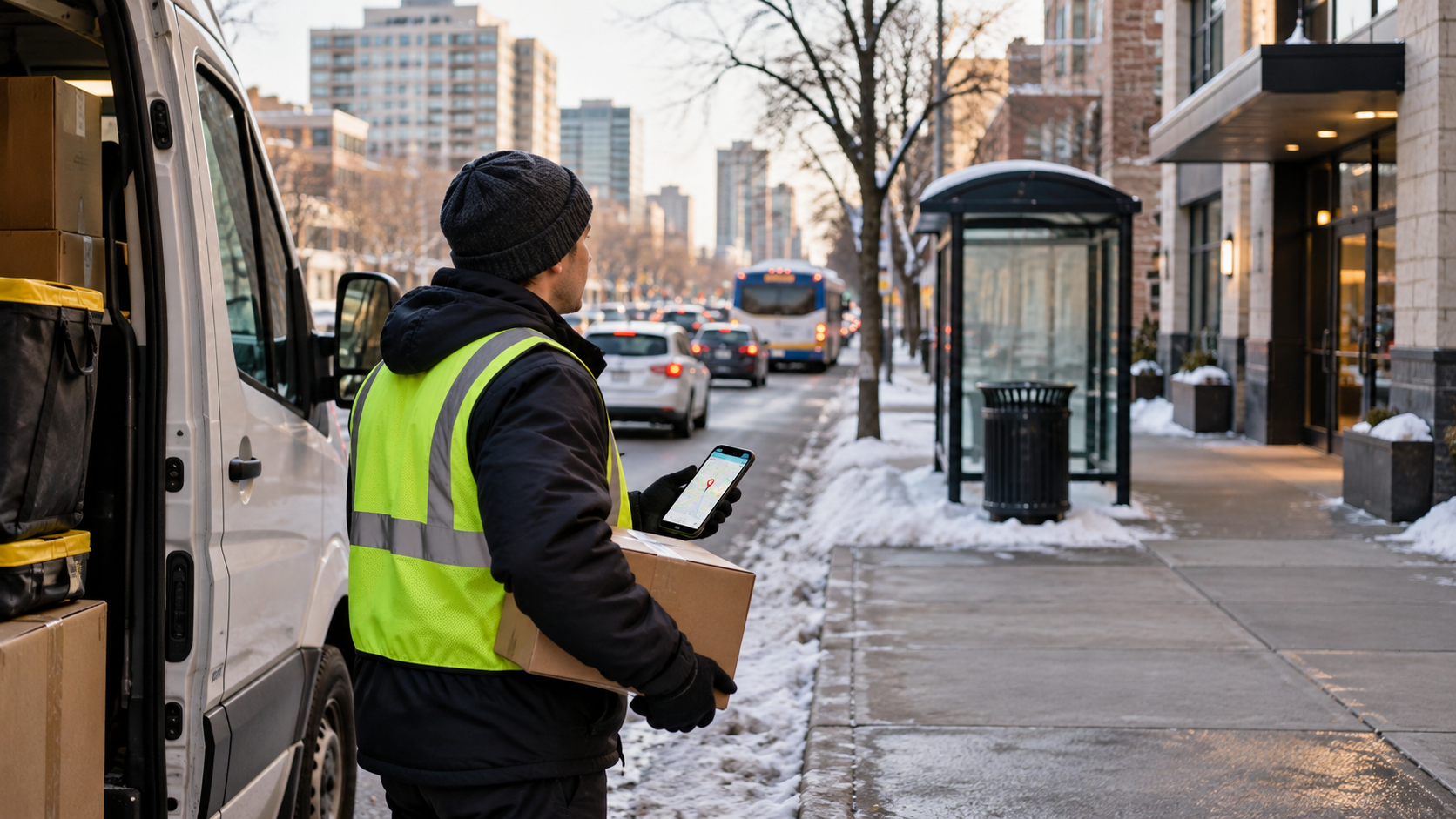
The route app places a delivery pin beside a busy road. Traffic is steady, the building entrance is hard to see, and the curb directly in front of the pin may be a bus stop, a turn lane, or a place where standing is prohibited. The map can help locate the address; it cannot grant permission to stop at the nearest point. The driver needs to find a lawful, workable place for the vehicle and a safe path to the actual entrance.
A Minnesota delivery driver safe stop busy road decision begins before the vehicle is parked. Identify the destination, observe signs and traffic, and look for a stopping location that fits the vehicle and the delivery task. If no such place is available, continue to a safe location and contact dispatch or the customer through the employer's process. A delivery deadline does not make a travel lane, crosswalk, or blocked driveway into a loading zone.
This guide covers the moment when a mapped address is on a busy street. It does not provide a universal parking exception for delivery vehicles or authorize a driver to use private property. Minnesota law, posted restrictions, local rules, and the actual site all matter. The employer's route and customer-contact procedures determine how to handle a delivery that cannot be completed from a safe and lawful stop.
Verify the entrance before choosing a curb
Confirm the street address and look for the building entrance, delivery entrance, or loading access the employer's instructions identify. The map pin may sit at the parcel center, a driveway, or a point on the road that is not where drivers should approach. Large buildings can have entrances on a side street. A unit number may correspond to a different door than the main storefront. Use posted building information and the employer's notes rather than driving straight to the pin and stopping there.
Scan ahead for a legal way to reach the likely entrance. A short side street, authorized loading area, customer lot, or designated dock may provide better access, but each has its own signs and restrictions. Do not assume an empty private lot is open to delivery vehicles. If the building lists a receiving entrance, check whether it is accessible during your arrival window. A locked dock gate can turn a promising route into a second stop search.
Ask whether the item can reasonably be carried from the candidate stop. A document envelope and a heavy carton create different walking and handling needs. If the parcel requires a cart, confirm the path has a usable surface and no stairs or barriers that the cart cannot handle. A distant legal space is not automatically a workable delivery point for every item. Report an access conflict rather than improvising a hazardous carry.
Do not inspect a map or read a long note while moving in traffic. Continue to a place where you can legally and safely pause to review the address details. A wrong turn can be corrected by a legal route; a sudden stop in a busy lane creates a new hazard. The pin is a navigation aid, not a command to stop immediately.
Evaluate the busy road delivery stopping point
A busy road delivery stopping point has to satisfy more than proximity. Check signs, curb markings, lane markings, sight distance, vehicle length, and whether you can enter and leave without blocking moving traffic. Look for bus stops, hydrants, crosswalks, intersections, driveways, accessible spaces, and no-standing zones. Minnesota Statutes § 169.34 identifies several places where stopping, standing, or parking is prohibited, subject to its terms and exceptions. Read the actual provision and local signs; do not rely on a vague memory of a permitted distance.
If the route passes a candidate location too quickly to evaluate it, do not brake hard or reverse in traffic. Continue on a lawful path, find a safe place to turn or loop, and approach again if needed. A second pass can be safer than forcing a stop at the first sight of the address. The app's ETA should not decide whether a maneuver is safe.
Consider how the vehicle will sit while you unload. Will a door open into a bicycle lane or passing traffic? Can you step out on a protected side? Is there a legal curb space long enough for the whole vehicle? Will other road users see the stopped vehicle in time? The answers depend on the site and vehicle. If you cannot answer them from the road, stop elsewhere before planning the delivery.
Minnesota Statutes § 169.32 also addresses stopping and parking on highways in the situations it covers. Do not generalize its provisions to every city curb or assume a hazard signal creates a parking privilege. The practical driver question is which rule and sign applies to this actual location. Ask dispatch for an approved alternative when the route notes conflict with observed restrictions.
Compare candidate stops with the same four questions
Consider a hypothetical storefront on a busy Saint Paul road. The navigation pin lands at its front door. Space A is immediately in front, but the curb is marked for a bus stop. Space B is around the corner on a side street with no visible prohibition, though it is farther from the door. Space C is a private lot behind the building with a gate and a sign limiting access to tenants. The pin makes A look convenient; it does not settle whether A can be used. The driver needs to read the real signs and find out whether B or C is authorized.
For each candidate, ask four questions: Is stopping there permitted for this vehicle at this time? Can the vehicle enter, stand, and leave without disrupting traffic or blocking a protected area? Is there a workable pedestrian path to the correct entrance for this package? Does the employer or site require a particular entrance or check-in? A space that passes the first question can fail the third because of a median, snowbank, or inaccessible walkway. A private lot may pass the physical tests but fail the authorization question.
Suppose B is lawful and the package is a small carton that can be carried along the sidewalk to the front entrance. The driver can use B and note the side-street access for the next visit. Suppose instead the item is large and needs a cart, while the side-street path has stairs. B no longer works for this item. The driver should ask dispatch whether the building has an authorized receiving access or whether a different delivery arrangement is needed. The package changes the walking-path decision even though the curb condition stays the same.
If a customer says C is available, verify the gate and use conditions before entering. The customer may have permission for their own vehicle without authority to admit a delivery van. Ask for the site's delivery instructions through the employer's process. Do not drive into a constrained private lot and discover there is no legal turn-around. The example illustrates a method, not a parking decision for any real address.
Check mapped address curbside safety on foot
mapped address curbside safety includes the path after the vehicle stops. The driver may need to cross a street, navigate a busy driveway, or move a package around a sidewalk obstruction. Choose a stop that permits a safe pedestrian route to the entrance. A legal parking space across several lanes may still be a poor choice if there is no safe crossing or the item cannot be carried that distance under the employer's handling rules.
Look for marked crossings and signals where applicable. Do not dart across traffic because the building is directly opposite the van. If the safe crossing is far away, calculate whether the delivery can be made within the route plan and package handling limits. A short drive to a side-street entrance may be better than a risky walk from the closest curb. The driver can explain that choice if a route metric later shows extra time.
Check the surface and access path. Ice, snowbanks, construction barriers, outdoor steps, and parked vehicles can change what is possible even at a familiar address. If a walkway is blocked, do not enter an active traffic lane to go around it while carrying a parcel. Look for an authorized alternate entrance or ask for direction. The map cannot reflect every temporary condition.
If a package is too heavy or large for the available pedestrian route, contact dispatch before unloading it into a hazardous location. Do not leave it on the sidewalk while looking for a better path. The employer may arrange a dock appointment, another vehicle, or an assisted delivery. The driver should report the actual constraint and keep the package secure while a decision is made.
Separate a loading area from a general parking space
A marked loading area may be intended for deliveries, but it can have time limits, permit conditions, vehicle restrictions, or hours of operation. Read the sign before using it. A curb space labeled for loading is not always open to every vehicle at every time. If the sign is unreadable from traffic, inspect it from a lawful stopping position before committing to the space.
If the building has a private loading dock, follow its access and appointment rules. An open gate does not necessarily mean a driver can enter, wait, or unload. Ask the receiving contact or dispatch through the employer's approved channel.
Do not block a driveway while waiting for a customer response. A driver who occupies an entrance to avoid a busy curb can impede other vehicles or pedestrians. If the only apparent loading space is occupied, continue to a safe legal location and ask whether an alternate access point exists. The presence of another delivery van in a prohibited spot does not make that spot authorized.
Keep the vehicle attended or secured according to the employer's policy and the site's requirements. A brief stop can still conflict with a no-standing rule or obstruct traffic. Do not treat the word “delivery” on a route manifest as a blanket exemption. If you cannot use a candidate space without violating a restriction, choose another or record the access problem.
Use a second pass without creating a new hazard
Sometimes the best first action is to keep driving. If you miss a safe turn into a side street, follow a legal route back. Do not stop in a through lane, make an illegal U-turn, or reverse across an intersection to save a minute. The route app may recalculate, but it does not authorize a maneuver. Keep attention on the roadway and use the employer's navigation policy.
At a safe pause, compare the mapped pin with street-view notes, building instructions, or a dispatch message if those sources are available. Confirm the address before contacting a customer; do not share another customer's information because two nearby buildings look alike. If the route note names a loading entrance on another street, check that street's signs when you arrive. An instruction written for an earlier visit may no longer match current construction or restrictions.
Plan the second approach: where you will turn, which side of the road you need, what sign you must read, and where you will continue if the space is occupied. That plan reduces last-second decisions. It can be very short; the driver does not need a formal map packet for one stop. The relevant facts are the legal access point, the space, and the pedestrian path.
If repeated passes still reveal no lawful and workable stop, stop trying the same curb. Contact dispatch from a safe location with the observed constraint. A route exception is preferable to an unsafe parking decision. Keep the package on board until the employer directs a lawful delivery method or records a failed-access outcome.
Tell dispatch what is actually blocking the stop
“No parking” may be accurate but vague. Give the address, current location, candidate entrance, posted restriction or traffic condition, package size, and what alternate access you checked. For example: “The mapped curb is a bus stop, the side-street loading bay is occupied, and the package requires a cart. I am safely parked one block away; is there an approved receiving entrance or should this be rescheduled?” Those are hypothetical facts. Use the real signs and conditions.
If a customer suggests stopping in a travel lane “for just a second,” explain that you need a lawful safe place to unload and ask whether they know an authorized entrance. Follow the employer's customer-contact rules. A customer's willingness to meet at the curb does not change a posted stopping prohibition or eliminate traffic risk. If they can meet at a legal location approved by the operation, confirm that plan through the required channel.
Record the response. If dispatch directs a different entrance or stop order, update the route note and follow the new plan. If the delivery is deferred, use the correct exception status and describe the access issue, not a false customer absence. Keep the time of the attempt and the relevant sign or obstruction if the employer's system allows it. Do not take photos from a moving vehicle to prove a curb restriction.
NIOSH's work-driving safety guidance provides broad context for occupational road risk. It does not select a lawful space for this address. The driver and dispatch need the site-specific observation, applicable restrictions, and an approved route decision.
Leave a useful note for the next visit
Once a safe access point is found, record only the details that will help the next driver: entrance street, permitted loading location and hours as observed, path to the delivery door, and any contact or dock process. Label a temporary condition as temporary. “Construction blocked the usual bay on October 21” is more useful than permanently marking that bay unusable. A note should not promise the same curb will be free next time.
If no workable stop was found, record what you tried and which condition prevented delivery. Another driver may have a different vehicle or time window, so avoid turning one failed attempt into a blanket statement that the address is impossible. A precise note helps dispatch choose a better plan rather than sending the next driver to repeat the same unsafe approach.
Drivers comparing delivery roles can ask how busy-road stops and access exceptions are handled. The published delivery job offer review guide can help clarify route expectations and support before accepting a role. The Saint Paul delivery driver Careers hub offers broader role information. Neither page supplies parking permission at a particular address.
Before leaving the vehicle, confirm three things in the actual setting: the stop is permitted, the vehicle can stand without creating a traffic hazard, and the path to the entrance is workable for this package. If one fails, move to a safe place and ask for another method. The map pin remains the destination reference; the driver makes the stopping decision from the road in front of them.