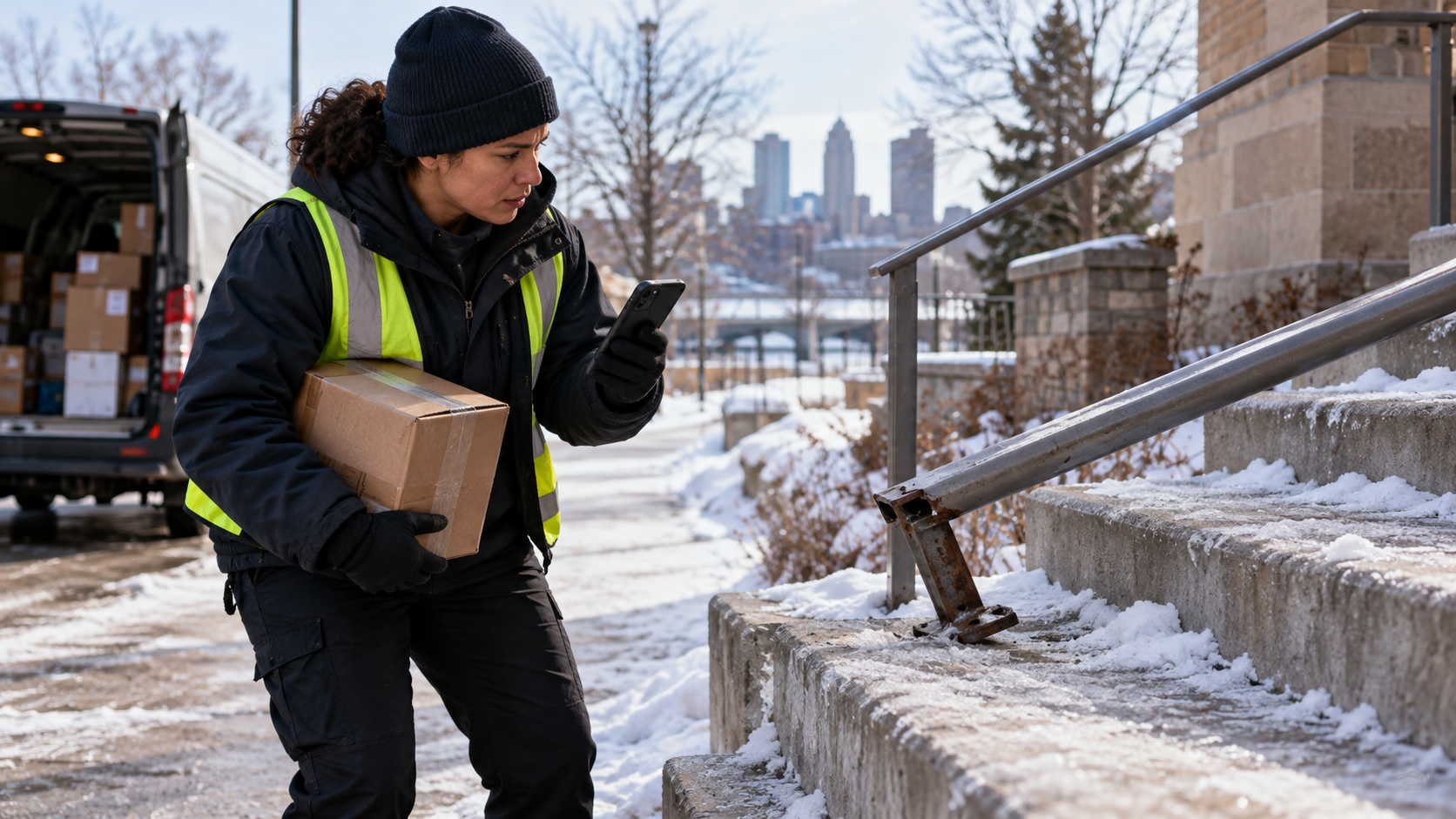
A driver reaches a delivery building and finds a stair rail detached beside a steep entrance. A routine route chat is full of pickup timing and lunch-break messages. Posting “stairs bad” there may be seen late or read as a minor access note. A Minnesota delivery driver safety concern escalation needs the hazard, exact location, immediate work state, and a named person or channel that can respond. The driver should not bury a live safety issue under ordinary scheduling talk and then assume it was addressed.
Minnesota DLI's worker-safety page explains safety and health protections in the state. Its MNOSHA complaint page says employees may report workplace safety hazards. NHTSA advises drivers to park safely before reading or sending a text. The employer's emergency and supervisor procedures determine the first operational contact for an active route hazard; state reporting is a separate path when a workplace concern needs it.
The first priority is the present situation. If there is an injury or immediate danger, follow the employer's emergency process and contact emergency services when appropriate. For a hazard that can be paused and reported, move to a safe location, keep the parcel and vehicle secure, and send the concern to the correct supervisor or safety channel with enough detail for action. A route status update can follow; it should not be the only place the hazard appears.
Write an urgent route hazard report from observation
An urgent route hazard report begins with what the driver saw, not a diagnosis of why it happened. “Handrail detached on the east stair to Unit 4B; lower bracket hanging loose at 14:10” is clearer than “building unsafe.” Include the address or stop ID, which entrance or lane is affected, and whether the driver has already used it. If a photo is permitted, capture it from a safe place without entering the hazard for a better angle.
Identify who may be exposed. A broken rail on the required route to an apartment affects this delivery; a spill beside a station loading dock may affect coworkers and future loads. State the immediate task at risk. If the driver cannot use the stairs safely, report that the parcel remains in driver custody. Do not mark the delivery “attempted” or “completed” solely because the hazard was observed; use the employer's actual access or safety exception process.
Distinguish observed facts from reports by others. A customer may say the stair is unsafe, but the driver has not seen it. A coworker may send a photo from yesterday. Those can justify checking or escalating, yet the incident note should attribute them. “Resident reported loose rail by phone; driver remained at ground level” preserves the source and action without claiming a firsthand inspection.
If the danger changes, update the case. A rail may be repaired, a spill cleaned, or a new obstruction added. Do not edit the first observation to make it match later conditions. Each event needs its own time and source so the supervisor can tell what the driver faced at the moment of the delivery decision.
Use a safety issue supervisor handoff
A safety issue supervisor handoff identifies the person or team responsible for the next action. The driver should use the employer's urgent safety line, supervisor call, incident form, or dispatch escalation as required. A message in an ordinary chat room may help others avoid the area, but it may not create an accountable response. Ask for acknowledgment from the supervisor or safety owner when the hazard affects current work.
Give the supervisor a concise operational state: exact location, hazard, whether anyone is hurt, whether the vehicle and parcels are secure, and which task is paused. Then ask for the decision needed: alternate safe access, reassignment, site contact, station return, or another authorized step. A long narrative about the building's maintenance history can wait until immediate work is safe.
If the first contact does not answer, use the employer's next escalation level. Keep the call or message attempt time. Do not treat a message marked “sent” as proof that a supervisor read it or took ownership. If a severe situation requires an emergency response, use the appropriate emergency channel instead of waiting for a routine route reply.
When the supervisor responds, confirm the exact instruction and its conditions. “Try the front entrance if clear” differs from “leave the parcel at the front entrance.” The driver still needs to check the alternate path and shipment's handoff rules. Record who gave the direction, when, and what task it covers. A safety report should not become permission to make an ineligible delivery release.
Separate immediate danger from a routine route exception
Not every delay is a safety incident. A closed gate may be an access problem; a gate sparking from exposed wiring is a hazard. A full loading dock may slow work; an unstable pallet leaning into the travel path raises a safety concern. The driver should describe the observed condition and use the employer's classification, asking for help if the app offers no fitting category. Avoid inflating a routine issue into an emergency to get a faster response.
The opposite error matters too. A note that says “weather delay” can hide icy steps the driver cannot use, or “customer unavailable” can hide an aggressive dog blocking the entry. The route result and the hazard report answer different questions. The driver can record an unsuccessful delivery under the correct service code and separately report the safety condition that caused it.
If a person is injured, follow the employer's injury and emergency response, not a generic parcel exception. A dispatcher may need to reassign the route, but that scheduling decision comes after immediate safety needs. The driver should not spend time composing a detailed chat update while someone needs urgent aid. Preserve key facts once safe and under the correct incident process.
If the concern involves the vehicle, state whether it is parked and safe to operate. A warning light or unusual sound may require supervisor or maintenance direction. Do not promise a return ETA while the vehicle's condition is unresolved. The packages still need a named custodian and secure location, but route throughput is not the first decision in an active vehicle-safety problem.
Choose the channel before composing a long message
Before sending anything, decide what response the situation requires. A call is useful when someone must decide whether a stop can proceed now. The incident form preserves detail for follow-up. A route note tells dispatch why a parcel has not moved. Those records may all be needed, but they serve different readers. If the driver's first report goes into a channel no one watches for urgent problems, send it again through the employer's designated safety path and make clear which report needs an answer. Keep the time of both contacts so the next person can follow the sequence.
A short opening message can carry the necessary facts: “East stair at Building C, 214 Cedar Street: handrail detached at the landing. I have stopped access at this entrance and still have Unit 4B's parcel. No injury reported. Please confirm who will handle the hazard and whether I should try a permitted alternate entrance or mark the stop inaccessible.” The address and parcel are an example, not a required template. A driver should use the real location, actual condition, truthful injury status, and employer's approved channel. Avoid pasting a customer's personal details into a broad team chat when the responsible supervisor can identify the stop from its route reference.
If the supervisor asks for a photo, take it only when the driver can do so safely and the employer's process permits it. A photo can show the condition at a moment in time; the written report still needs location, timing, work state, and the instruction sought. Ask for confirmation that the person responsible received the concern. When the response is a call, write down the name, time, and decision afterward. That leaves the next shift with more than a vague “we talked” note.
An urgent concern can be lost in a crowded route chat because readers may skim or assume someone else answered. Use the employer's designated incident channel or call the supervisor when immediate direction is needed. Afterward, post a brief task-level note if dispatch and the next driver need the route consequence. Link it to the incident case rather than copying sensitive details into every chat.
The channel should match the audience. A safety team may need a location and photo; dispatch needs to know which stop is paused and where the parcel is; a customer may need only an approved delay notice. Do not publish an injury detail, home address, or security code in a broad channel. The driver can report the same event to the required teams without making every team read the same private information.
If the employer has an incident form that takes time to complete, the driver can make the immediate call first and complete the form when safe, under policy. The form is not a substitute for timely help at a live hazard. Preserve the call reference and later form ID so the two records can be connected. Do not claim the incident was submitted when it is still a draft.
NHTSA advises parking safely before reading or sending texts. If the driver notices a hazard while driving, reach a safe stopping point before using route chat or forms. A dangerous shoulder is not an appropriate place for a routine report. If the danger is immediate and traffic-related, use the employer's emergency process or emergency services as appropriate.
Work through a damaged stair at a delivery stop
Imagine a driver has a signature-required parcel for Unit 4B. The route note says to use the east stair. At 14:10, the driver sees that the lower handrail bracket has pulled away and the stairs are wet. They remain at ground level with the parcel, note the exact entrance and condition, and call the designated supervisor. The supervisor acknowledges the hazard, asks the driver to check whether the staffed front entrance is safely accessible, and opens incident case S-218.
The driver checks the front entrance from a safe approach. If it is open and an eligible person can sign under the shipment's rule, the driver may complete that authorized handoff and record the actual front-entrance location. The safety case still records the damaged stair for later routes. A successful delivery does not erase the hazard or make the original stair safe.
Change one fact: the front entrance is locked and nobody answers. The driver records the actual contact attempt and applicable access exception, keeps the parcel, and follows the supervisor's station or later-attempt direction. They do not leave the signature-required box at the bottom of the unsafe stair. The safety case and parcel outcome remain separate records.
Change another fact: the driver had already stepped onto the stair and slipped, with possible injury. The immediate response moves to the employer's injury and emergency procedure. The parcel can be secured or handed to a named coworker afterward. A routine chat message about a delayed delivery cannot replace the incident response.
The stair example is specific, but the same communication principle applies to an unstable load, exposed electrical hazard, threatening animal, or unsafe vehicle condition. Name the observed hazard and present work state, use the right response channel, and obtain a supervisor-owned next step rather than leaving a vague warning in a busy thread.
Keep the route state and safety case connected
An incident report may explain why a stop remains open, but it is not a delivery scan. The driver should check that the parcel's status matches the physical event: delivered to an eligible person, attempted with the actual reason, held in the vehicle, or accepted by station intake. The safety case should reference the stop or parcel ID, and the route note can reference the case number. Each record retains its own purpose.
If dispatch reassigns the stop, identify the next driver and tell them the hazard before they approach the same entrance. The new owner may have an alternate safe route or may need to wait for site repair. A reassignment without the safety case could expose another person to the same condition. Do not transfer a parcel physically until the item and custody process is confirmed.
If a site manager reports that the stair was repaired, keep the original observation and the repair statement with its time and source. A later driver or supervisor may need to verify the path before use. Do not backdate the repair or change the initial report to “no hazard” merely because the condition improved. The route can resume based on current evidence while preserving the history.
If the incident remains unresolved at shift end, give it a named owner and next action. “Supervisor to contact building management before next Unit 4B attempt” is actionable. “Safety aware” is not. Include the case reference in the handoff and keep any affected parcels under the correct custodian.
Use external reporting when the workplace issue remains
Minnesota DLI says employees may report workplace safety and health concerns to MNOSHA. That public channel exists alongside employer reporting. A driver who believes a workplace hazard remains unaddressed can review DLI's complaint guidance and contact the agency through its listed methods. This article does not decide whether a particular stop meets the agency's complaint criteria or replace emergency help for immediate danger.
Keep the report factual. Record dates, location, what was observed, who was notified, and what response occurred. Avoid adding claims about other workers' experiences unless they provided them. A narrow, truthful record is useful to an employer safety team and to an external reviewer. Preserve photos and messages through approved channels.
If the concern involves retaliation or pressure to ignore a hazard, use the appropriate worker-rights and safety channel. Minnesota DLI's worker-safety information explains protections and complaint paths. The driver should not rely on a public route chat to discuss sensitive employment concerns. A private, documented inquiry can identify the exact issue and requested action.
The external route does not transfer package custody. The driver still needs dispatch to account for any open deliveries or pickups and a supervisor to direct immediate safe work. Separate those operational tasks from the longer safety review, and keep both records honest.
Close the concern with a verified next action
Before leaving the stop or shift, check that the supervisor actually received the report, the parcel has a truthful status, and the next person knows whether the hazard remains. If a repair or alternate route is promised, identify who will verify it and when. Do not treat a read receipt or “thanks” as a completed corrective action when the stair is still broken.
Drivers comparing delivery roles can use the Saint Paul delivery driver Careers hub as the current entry point. The published delivery job-offer review guide can help a candidate ask how safety concerns are reported and who handles route interruptions. On an active route, the employer's incident process and actual hazard state govern the decision.
A route chat can alert coworkers, but an active safety concern needs a person or channel responsible for the response. State what was seen, where, when, and what work stopped. Preserve the supervisor's instruction, any incident case, and the parcel's true outcome. That record makes the hazard visible without turning a delivery exception into a substitute for safety action.