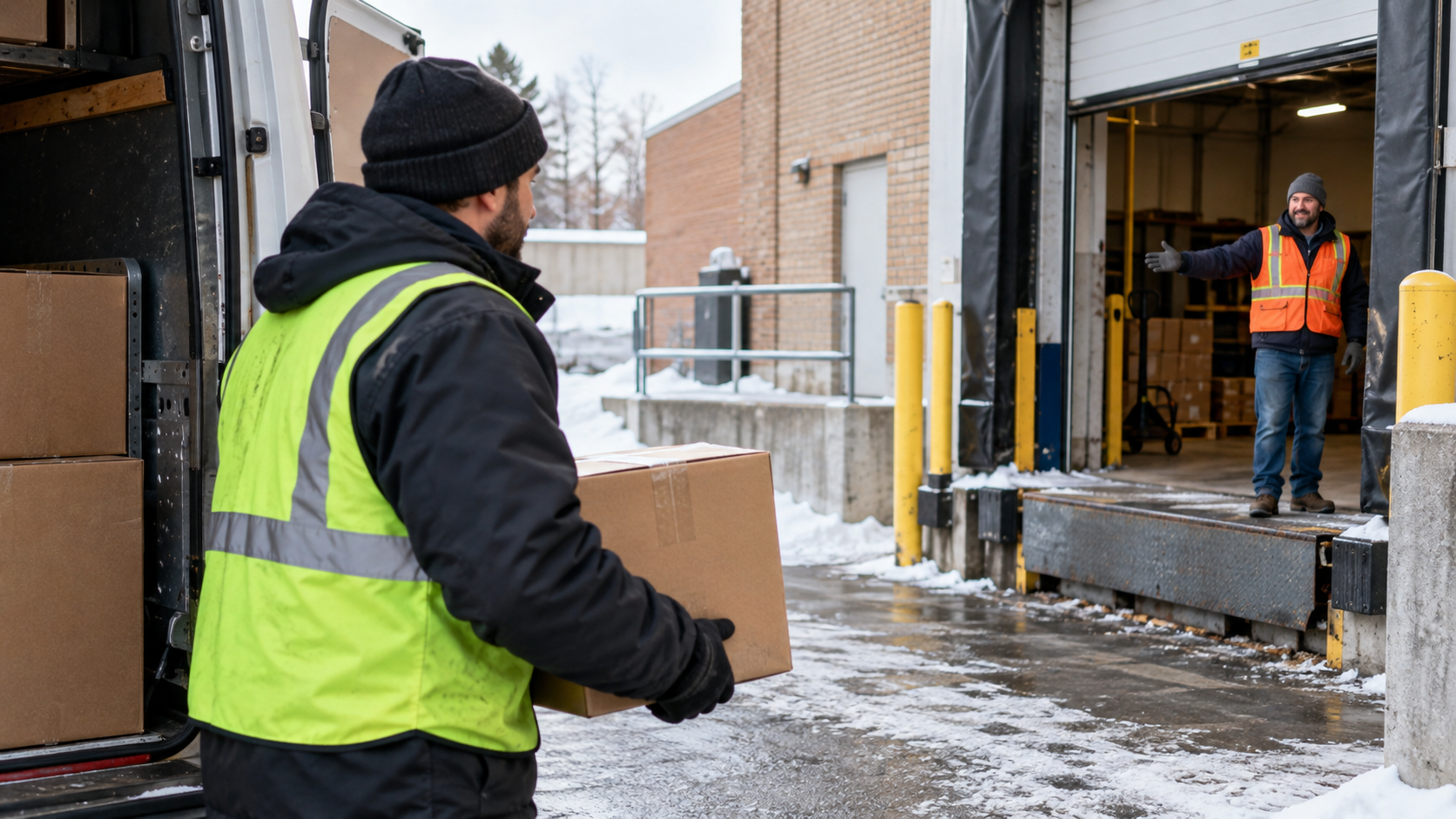
A delivery address can appear to have one front door while its receiving dock sits around a corner, behind another building, or on a lower level. The public lobby may be open, but it may not accept shipments. A Minnesota delivery driver separate receiving dock stop calls for a deliberate match among the parcel, the vehicle, and the receiving point. Confirm the dock location and hours, approach it by an allowed route, and learn who will accept the shipment before unloading.
The street address is still the destination, but the handoff may occur at a different side of the property. A map pin does not establish the dock approach. A sign saying “Deliveries” does not prove every vehicle or parcel belongs there. Read the route note and site signs together, then use the employer's contact path for any gap. If the dock cannot accept the delivery, keep custody and report the exact obstacle instead of turning a lobby drop into an assumed substitute.
This guide addresses a site that has a separately designated receiving dock. It differs from locating a public entrance in a multi-tenant building and from responding to a door that unexpectedly closes. The dock may be open and clearly labeled; the decision is still whether this vehicle and shipment should use it, where the driver should check in, and what counts as a completed handoff.
Match the address to the delivery receiving dock entrance
Read the full delivery address and any dock directions before entering the block. A building may use the same street number for its public front and its service access from an alley. The route note may list a dock on a named side street or a gate number. If the note only says “rear,” do not assume the first driveway behind the building is correct. Look for current signs naming receiving, deliveries, or a tenant, and compare them with the parcel's destination.
The delivery receiving dock entrance might be marked with a different building number or shared by several businesses. Check that the tenant or receiving department accepts deliveries at that dock. A loading bay for a neighboring tenant may be physically close to the correct address yet still be the wrong handoff point. If signs conflict with the route note, contact the site or dispatch from a lawful place before entering a controlled lane.
Approach matters. A dock driveway may have one-way movement, a height limit, a gate, or a turn that a larger van cannot complete safely. Do not enter until you can tell whether there is a way to leave without backing blindly into traffic or crossing a pedestrian path. If an entrance is restricted to trucks of a certain size or requires an appointment, respect the current sign and ask for another authorized plan. A parcel's destination does not make the assigned vehicle suitable for every receiving lane.
If the site uses a gate or intercom, identify the delivery and ask where your vehicle should wait. Do not follow a larger truck through a gate just because it opened. The truck may have a scheduled bay or credential that your route does not. Record the gate or dock number the site gives you and repeat it back if several bays look alike.
Confirm dock handoff instructions before unloading
Dock handoff instructions should answer who receives the parcel, where the driver waits, whether an appointment is needed, and what proof of delivery is required. A route note may name “receiving” without naming the person on duty. Check in through the designated window, bell, intercom, or staffed desk. Do not unload at an empty bay and assume someone inside will find the items later.
Ask whether the dock accepts this type of parcel. Some receiving areas handle palletized freight, while small packages go through a separate counter. Others accept small parcels but require a booking for large items. The site can clarify its current process. Do not infer a universal rule from the word “dock.” If the parcel has a signature or restricted-release condition, follow the employer's shipment instructions even if a worker says leaving it on a shelf is common practice.
Distinguish a person who directs traffic from a person authorized to receive the shipment. A guard may tell you where to park but may not take custody. A forklift operator may ask you to wait for the receiving clerk. Use the named handoff point or confirm authority with the site and employer. A completed delivery requires the permitted recipient or drop method and the required record, not merely arrival inside the dock area.
If the receiving clerk asks for an order or reference number, look in the approved delivery information. Do not invent one to move the line. If the number is missing, contact dispatch or the shipper under the employer's process. Record what was requested so a later attempt can arrive prepared. Keep customer and shipment details within authorized systems.
Keep the vehicle out of an unsafe queue
A dock can be busy with reversing trucks, forklifts, carts, and pedestrians. OSHA's loading-and-unloading guidance describes serious hazards in those operations, including workers being struck or crushed by equipment. The page is not a site-specific traffic plan. Follow the posted lane markings and instructions from authorized dock staff; stay out of equipment paths and do not improvise a waiting position beside an active bay.
If the queue extends toward a street or driveway, do not block a travel lane or pedestrian crossing while waiting. Minnesota Statutes § 169.34 includes restrictions on stopping and parking in front of driveways and other locations. The dock's popularity does not create a general exemption. Find a lawful staging area, ask the dock how to join the queue, or ask dispatch for a different time. Hazard lights do not resolve a prohibited position.
Check vehicle size and bay design. A small delivery van may not need a raised trailer bay; a dock may have a ground-level door nearby. A larger vehicle may need a designated approach. Do not back into a bay without a clear, authorized instruction and a safe maneuver. If a spotter or traffic control is required by the site's procedure, wait for it. Drivers should not operate forklifts, dock plates, or other equipment unless they are trained and authorized for that work.
NIOSH's work-driving safety information provides broad context for preventing vehicle injury on the job. At a dock, the practical point is to slow the decision down enough to understand traffic flow and avoid a rushed turn or stop. The source does not certify any individual dock as safe. Your employer's training and the site's current controls govern the actual movement.
Plan for a dock with limited hours
Receiving hours can differ from the public building hours. A hospital lobby may remain open while its vendor receiving window closes earlier. Read the dock sign and confirm any appointment requirement. A route note saying “business open until 5” does not establish that the receiving clerk is there until 5. If the dock is closed, ask whether another authorized point exists for this shipment. Do not move the parcel to a public counter merely because that counter has longer hours.
If the dock opens later, decide with dispatch whether waiting, resequencing, or returning is feasible. Consider the lawful parking available, the parcel's condition, and the effect on the rest of the route. An estimated opening time from a passerby is weaker than a current posted schedule or a receiving contact's instruction. Record which source you relied on. If an appointment was required but absent from the route note, report that missing prerequisite.
Do not describe a closed dock as a closed building. Other entrances may be open, yet none may be authorized for this parcel. The accurate issue is that the designated receiving point was unavailable at the arrival time. If a site contact offers an alternate, verify its location, accepting person, and shipment restrictions before changing the handoff plan.
A driver may reach the dock during its posted hours and still face a long line. The remaining open time matters. If the line cannot reasonably clear before receiving ends, ask staff whether they will accept the vehicle, then tell dispatch what was said. Do not rely on a place in line as proof that the shipment will be received. Keep the parcel in custody until the actual handoff occurs.
Keep unloading within the site's permitted area
Once staff assign a place, confirm where the vehicle should stand and which pedestrian path the driver should use. A dock area may have a marked pedestrian lane, a check-in office, and equipment-only space. Do not walk behind a reversing vehicle to save a few steps. Keep packages secure until the receiving person or approved area is ready. If the site asks you to wait in the cab, follow that instruction and the employer's safety process. Do not begin unloading simply because another truck has opened its doors.
Check the size and handling needs of the shipment. A cart can help with several cartons, but the route may include stairs, a lift, or a narrow doorway after the dock. Ask which route is approved. Do not use a powered lift, forklift, or dock plate without the training and authorization required for that equipment. OSHA's loading guidance describes why those environments need controls; it does not turn an untrained parcel driver into a dock operator. If the only offered path depends on equipment you cannot use, report that limit and ask staff for an authorized handoff method.
Count and identify parcels before custody changes. If the shipment has three cartons, make sure the receiving record accounts for three, not merely the first carton placed by the counter. Follow the employer's scan and signature requirements at the point of actual transfer. A worker may direct you to stage cartons briefly while they prepare a receipt; that staging is not necessarily a completed handoff. If the site refuses to sign or accept one item, record the partial outcome under the employer's process. Do not mark all pieces delivered because most were accepted.
When the bay is shared, keep the parcel for the named recipient separate from other tenants' freight. A receiving worker may need an order number or department before moving it inside. If the label and site record disagree, pause. A nearby cart holding similar boxes is not evidence that yours belongs on it. Ask the clerk to confirm the tenant and destination. Accurate custody is more important than clearing the vehicle quickly.
Resolve conflicting directions before changing the drop
A route note, sign, security guard, and recipient may point to different entrances. Determine whether they describe different shipment types or reflect an outdated instruction. Tell dispatch the exact conflict: “Route note says dock A; current sign sends parcel vans to door C; receiving clerk says this tenant uses the lobby counter.” An authorized person can then decide which instruction applies. Do not treat the newest spoken suggestion as an automatic override of a signature condition or restricted delivery rule.
If the recipient asks for delivery at a new location on the same property, confirm that it is within the employer's permitted change process. A new street address, a neighboring building, or an off-site warehouse can be a destination change, not merely a different doorway. The driver should not edit the address or proof of delivery to disguise the move. Ask for a documented instruction that identifies the new handoff and preserves the parcel's identity.
Sometimes the site says the dock is for vendors but the employer's route note says to use a public entrance. This may mean the note is tailored to smaller parcels, or it may be stale. The driver can ask the receiving staff whether the parcel's size and tenant qualify for the dock, then ask dispatch how to proceed. Keep the package with you until the answer is clear. If the site will not accept it at either point, document each contact and the reason given. That is more useful for the next attempt than “wrong door.”
Use a worked example to test the handoff
Suppose an office building's route note says “deliver to 800 Park Avenue.” The label names a tenant on the sixth floor. The front desk says all vendor shipments go to a receiving dock on Cedar Lane. A sign at the dock lists weekday receiving hours and a check-in window. The driver is in a vehicle that can use the signed approach and has a lawful place to wait. The next step is to confirm at the window that the dock accepts parcels for that tenant and to follow the required proof-of-delivery method.
Change one fact: the dock handles pallets only, and a receiving clerk directs small parcels to a staffed mail counter in the public lobby. The driver should confirm that the counter accepts the named tenant's parcel and that employer instructions permit that release. The clerk's specific direction is stronger than an assumption based on the route note. Record the corrected path for this delivery; ask the route owner whether it should become a future note.
Change another fact: the dock sign says vehicles above a certain height must use a different gate, and the assigned van does not fit the lane safely. The driver should not force the approach. Find a lawful staging place and ask the site or dispatch for an authorized route. A correct street address does not make an unsafe gate usable. If no suitable access exists during the window, report the physical limit and keep the parcel for the employer's next step.
These examples are hypothetical. The decision is made from the current site instructions, vehicle, shipment, and authorized receiver. An open bay alone cannot prove a handoff is permitted. A signed proof of delivery should reflect the person or approved location that actually took the parcel.
Record the dock outcome for the next attempt
After a successful handoff, note the dock or counter used, the receiving person or approved drop method, and any relevant appointment or check-in instruction. Do not put private access codes in a broadly visible route note. If the dock declined the parcel, record the reason stated: wrong tenant, missing reference, appointment required, size restriction, or closed receiving hours. Those facts lead to different repairs.
If the parcel was not accepted, use the employer's actual exception status. Do not mark “customer absent” when the barrier was a dock appointment, and do not mark delivered merely because a dock worker saw the parcel. The physical custody of the shipment should match the route record. If another driver or station receives it, document that transfer under the employer's process.
For future routes, a concise note can save a search: “Receiving dock on Cedar Lane, check in at window B, ground-level parcel counter for small packages; confirmed October 21.” Treat that as a dated observation, not permanent permission. Hours, tenants, and procedures can change. The next driver should still read current signs and confirm any unusual parcel conditions.
Drivers comparing delivery roles can ask whether the employer supplies dock directions, appointments, and help when a vehicle cannot use a receiving lane. The published delivery job-offer review guide helps frame that support question. The Saint Paul delivery driver Careers hub gives broader role context. Neither page supplies authority to enter a specific dock.
The useful outcome is a verified receiving route or a clear reason it failed. The driver should know where to approach, whether the vehicle fits, who may take the parcel, and what record the employer needs. If any part remains unresolved, preserve custody and ask for the next authorized step.