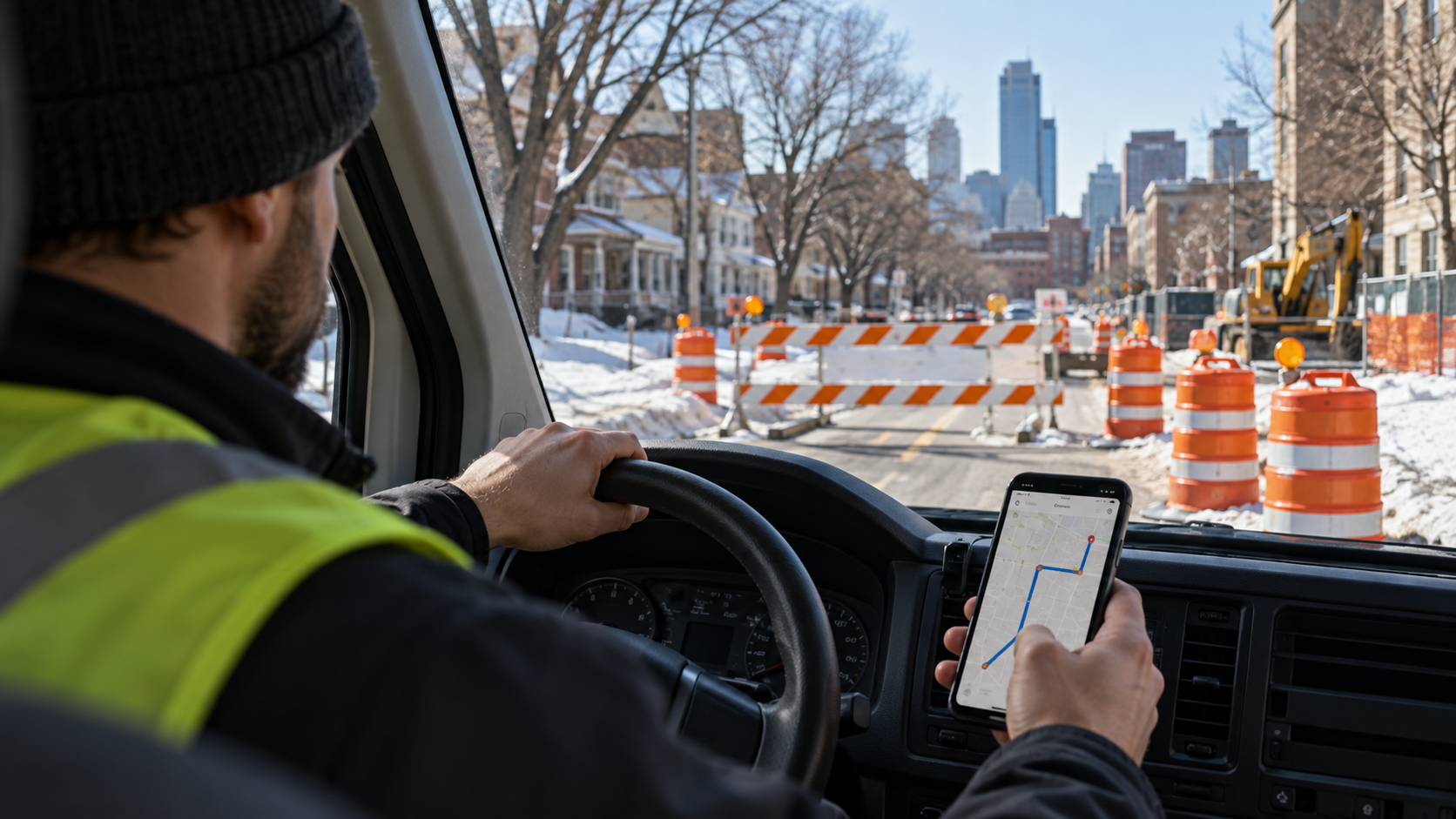
The route app still directs a driver down a familiar street, but cones and a barricade block the entrance. A delivery stop may be just beyond the closure. The driver is already close, traffic is behind the van, and the map may draw a line straight through the work zone. This is the moment to follow the road controls and find a lawful place to reset the route. Trying to salvage the original turn with a sudden U-turn, driveway backup, or movement through a gap in the cones can create a bigger problem than a delayed stop.
A Minnesota delivery driver street closure detour begins with what is actually closed: the full street, one direction, one lane, a turn, or access to the specific address. Obey the posted controls and any authorized direction. Continue by a legal movement from the lane you are in, then inspect the alternate route from a safe stopped location. Tell dispatch what the closure affects before changing a customer promise or marking a stop complete.
This guide covers the first response and route reset when a street closure interrupts a delivery. It does not give a universal detour for every block or decide a later legal turnaround maneuver. A closure can be temporary, partial, or limited to certain vehicles. The driver must use the current signs, traffic direction, vehicle requirements, and employer instructions at the actual site.
Read the closure before assuming the destination is unreachable
Look for advance warning, barricades, detour arrows, flaggers, and signs that identify which movement is closed. A barricade across an approach may mean through traffic is prohibited while local access follows a separate marked path. It may also mean all entry is barred. Do not assume a delivery vehicle qualifies for an exception because the customer is inside the zone. Ask a flagger or dispatch through an approved safe channel if the sign or direction is unclear.
Identify the affected segment. The address may be reachable from the other end of the block, a side entrance, or a legal receiving access; it may also be inside an active work area where no delivery is allowed. Keep the difference visible. “Street closed at the north approach” is more useful than “address inaccessible” before you have checked the authorized access. Conversely, an app route reaching the far end does not prove that end is open.
Minnesota Statutes § 169.06 addresses obedience to applicable official traffic-control devices and directions by authorized persons under its terms. The driver should follow current controls, not a cached route line. Do not move a cone, enter a signed closed road, or follow another vehicle through a barrier as an informal permission signal.
If the closure is on a highway or major route, Minnesota 511 may provide traveler information when consulted safely. It may not show every local block closure or last-minute work zone. Treat it as a planning source, not a substitute for what the road shows. Stop in a lawful safe place before checking a map or report.
Use a delivery route closure response that starts with the lane
A delivery route closure response begins with the movement available from the lane you occupy. If an advance sign directs traffic straight, continue straight. If a flagger directs a different movement, follow that authorized direction. Do not cut across lanes at the last second to reach a side street or stop in the travel lane to study the barrier. The closure is a route problem that can be solved after the vehicle is moving safely away from the conflict.
If you are at the front of a blocked turn lane, watch for the traffic-control plan and authorized instructions. Do not reverse through a queue or mount a curb to escape. A flagger or officer may direct vehicles one at a time. Follow the instruction actually given. If there is no clear path, remain alert and seek authorized direction rather than improvising a move that other road users cannot predict.
Minnesota Statutes § 169.19 addresses turning and signaling. A desire to recover a delivery route does not create an exception from ordinary turning rules. A legal alternate may require continuing to the next intersection and looping through several streets. A few extra blocks are an operational delay; an illegal or unsafe maneuver is a road-safety problem.
If the road is still open to another lane or direction, do not assume you can use it against traffic to reach the address. Read signs and lane controls. Temporary traffic setups can be unfamiliar, so reduce speed as appropriate and leave room for workers and other vehicles. Keep attention on the road rather than repeatedly tapping the app's reroute button.
Match the response to the kind of closure
A full barricade, a single closed lane, a turn restriction, and a temporary flagger hold call for different responses. At a full barricade, do not enter the closed segment unless an authorized traffic-control plan clearly permits your movement. At a lane closure, merge as directed and keep the route if the remaining lane legally reaches the destination. At a temporary hold, wait for the flagger's signal rather than inventing a detour through a side street. Describe what you saw before treating all four as the same “road closed” event.
Look for a sign that specifies local access or a delivery entrance. It may indicate a permitted route, but the driver should still confirm the vehicle can use it and that workers or flaggers have opened the path. Do not drive around a barricade because a sign somewhere mentions local traffic. The permission, if any, has a direction and boundary. Ask the authorized person at the site when the meaning is unclear and it is safe to do so.
At a crash scene, police or emergency personnel may direct traffic away from a route that appears open on the map. Follow their current direction. Do not stop nearby to photograph the scene for a route note or ask a responder to justify the closure so a package can be delivered. Once clear, record the blocked segment and contact dispatch from a safe location. The employer can decide how to update the affected stops.
An event closure may have a published time window, while an unexpected utility repair may not. An estimate such as “reopens at noon” is not a guarantee. If the route plan depends on reopening, ask dispatch whether to defer the stop or return later, and recheck actual controls before entry. Do not mark the address accessible solely because a public notice's end time has passed.
Some closures leave pedestrian access open while vehicles cannot enter. That may help with a small package if there is a lawful place to park and an approved walking route, but it does not automatically solve a large-item delivery. Ask about the package, distance, work-zone boundary, and employer handling policy. Do not walk through an active work area because the destination is visible. Record whether the delivery could be completed on foot only after the authorized access is clear.
Find a lawful place to inspect alternatives
After leaving the immediate closure, find a place where the vehicle can stop lawfully and safely. A travel lane, bus stop, crosswalk, or blocked driveway is not a route-planning spot. If no curb is available, continue to a suitable lot or side street where access is allowed. Then check the map, 511 if relevant, employer route notes, and dispatch messages. Do not read a long closure alert while moving.
At the stop, identify the next delivery and its service window, the road segment blocked, and the vehicle you are driving. An alternate route suitable for a small car may not suit a longer van or box truck. Check turns, low clearances, weight restrictions, and local signs as you travel. A detour arrow can direct general traffic, but the employer may have vehicle-specific restrictions that require a different approach.
Ask whether the customer entrance is on the closed segment or another street. A map pin at the property center can obscure a legal rear or side access. Use employer notes and any authorized customer contact. Do not promise to drive through a work zone simply because the door is visible from the barricade. If the building has a loading dock, confirm its current access and appointment conditions.
The detour may affect several stops, not only the next one. A closed bridge or one-way segment can change the order of a whole neighborhood. Check the route as a sequence and ask dispatch whether to skip ahead, reverse a small group of stops by lawful roads, or transfer a time-sensitive item. Keep the original plan as the baseline for explaining the change; do not rewrite it as though the closure was known at departure.
Compare two possible paths without trusting either blindly
Consider a hypothetical closure on the block containing stop 12. The app proposes turning around at the next driveway and approaching from the other side. A posted sign at the driveway says private access, and traffic is dense. That proposed maneuver is not an acceptable shortcut. A public street loop four blocks away may be slower but can be evaluated under posted controls. The driver should use the lawful network, then check whether the far approach to stop 12 is open.
Now suppose the far approach is also barricaded, but an employee at the site says deliveries can enter through a marked receiving gate. Ask whether that gate is authorized for the vehicle and whether a flagger or site contact must escort entry. The customer's willingness to accept the package does not override a road closure. If the gate is not accessible or permission is unclear, keep the package on board and contact dispatch.
Another driver may report a path that worked earlier in the morning. Treat that as a lead, not a guarantee. Crews can shift cones and traffic direction during the day. Note the time of the report and recheck signs on arrival. A route app may lag in either direction: it can miss a new closure or still show one that has reopened. The actual on-site control remains decisive.
The example highlights two separate facts: a street segment can be closed to through traffic, and a particular delivery entrance may or may not be reachable by an authorized path. Keep both in the dispatch report. “Closure at east end; receiving gate open under flagger direction” is different from “street open.” Do not erase the closure because one permitted access exists.
Make a closure route status update with observed facts
A closure route status update should tell dispatch what the driver observed, where, and when. Include the intersection or block, direction of approach, sign or barricade wording, whether a flagger gave instructions, and which stop or stops are affected. State what lawful alternate you have checked and whether the destination remains reachable. Use the employer's approved message channel from a safe stop.
For example: “At 10:40, northbound entry to Pine Street between Third and Fourth is barricaded; detour sign sends traffic west. Stop 12 is on the closed block. I am parked legally on Fourth, checking the receiving entrance; please confirm whether to attempt from the west or move to stop 13.” The street names and time are hypothetical. A message like this gives dispatch a decision to make without implying the driver drove through the closure.
If a detour changes the ETA, report the best estimate and its uncertainty. Do not alter scan times or invent a delivery attempt to make the route appear on schedule. If dispatch reorders stops, record the instruction and the new route state. If customer contact is required, let the employer's process decide who sends it and what promise can be made.
Keep the reason specific. “Road closed” can mean construction, a crash, an event, flooding, or a temporary flagger hold. Do not diagnose the cause if the sign does not say. The material fact for the delivery is the blocked movement and whether a lawful approach exists. NIOSH's work-driving information gives broad safety context, while the real routing decision depends on that local observation.
Choose the correct stop outcome
If you reach the delivery site by an authorized route, complete the delivery under the normal scan and proof process. Keep the detour note if it explains a meaningful delay or route variance. Do not mark the stop “access blocked” just because the first approach was closed when you later used an open entrance.
If no authorized vehicle access exists, ask dispatch about rescheduling, a different vehicle, an approved walking approach, or a later attempt. A package's size and handling needs matter. A driver may be able to carry an envelope from a lawful stop outside the zone, while a heavy carton requires an accessible receiving point. Do not leave the package at a barricade or with an unapproved person to clear the stop.
Use the employer's actual exception status. “Customer unavailable” does not describe a road closure when the customer was never reached. “Road access blocked” or another approved code may be appropriate if offered. If the app lacks a fitting code, ask how to document the attempt rather than choosing a false one. Note the actual closure and directions received.
If a closure clears before the end of the shift, dispatch may return the stop to your route. Confirm that the road is open when you arrive and that the delivery window or customer instruction still applies. An earlier closure report should stay in the history; it explains why the stop moved. The later completion is a separate event.
Leave a reusable note without freezing a temporary condition
After the route, report a closure that the app missed with enough detail for the route team to investigate: block, direction, time, observed signs, alternate access, and affected vehicle type. Mark it temporary if it appeared to be construction or an event. Do not write “never use this street” based on one day's work. A later driver needs current information and a way to verify it.
If the closure appears in 511 or another public source, include the link or observation time in the employer's approved record. Do not treat a public map as a permanent identity for a local street closure. A city street may not be covered or may reopen at a different time. The next driver should still follow on-site controls.
Drivers comparing roles can ask how dispatch handles closures, time-sensitive stops, and inaccurate navigation. The published delivery job offer review guide can help turn broad route claims into concrete questions. The Saint Paul delivery driver Careers hub offers broader role context. Neither page authorizes entry through a real barricade.
If a closure blocks the planned approach, report the location and observed restriction before asking for a new route. An open-looking side street may still have event controls or a vehicle restriction. Follow official signs and the employer’s direction rather than treating a navigation suggestion as permission to cross a barricade.
If the stop is deferred, save the closure location, the lawful route you tried, dispatch's decision, and the exception status. The next driver can verify access instead of repeating a blocked approach.