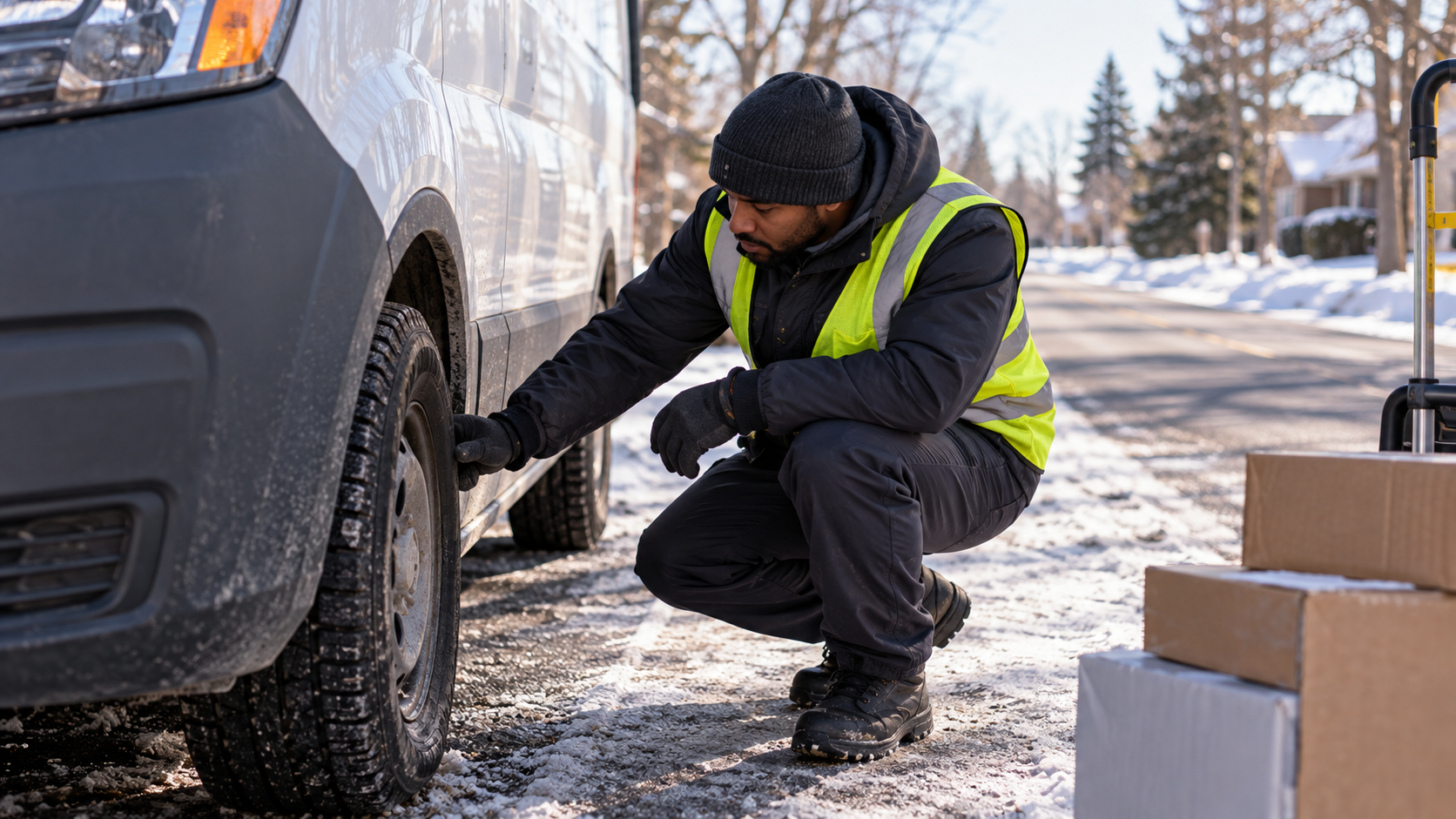
A delivery van feels different on a familiar street. The steering begins to pull, a tire-pressure warning appears, and the next stop is four blocks away. The driver does not yet know whether the tire is simply low, has been punctured, or has another problem. Continuing to the next address just because it is close is a poor way to find out. Stopping abruptly in moving traffic would create another hazard. The immediate decision is where and how to bring the vehicle under control, then what evidence is needed before anyone authorizes more driving.
A Minnesota delivery driver tire stop decision is based on the actual symptom and the safest available stopping option. A blowout or a vehicle that is losing control calls for a different response from a tire-pressure indicator on an otherwise stable vehicle. Visible cuts, bulges, or severe wear also matter. The driver can observe and report these conditions; a qualified tire or fleet professional decides the repair and return to service under the employer's process. The remaining parcels stay tied to their real custody state while the vehicle question is resolved.
NHTSA's TireWise guide explains that a tire-pressure monitoring alert means at least one tire is significantly underinflated and that drivers should inspect tires and check pressure as soon as possible. It also identifies physical damage and worn tread as reasons to stop using a tire. Those are stronger guides than a driver's guess from how a tire looks at a glance. This article applies that guidance to a delivery shift without inventing a universal mileage, speed, or “just finish the route” allowance.
Respond to a sudden tire failure while maintaining control
A blowout can change vehicle control quickly. NHTSA's blowout guidance advises holding the steering wheel with both hands, avoiding an abrupt reaction, releasing the accelerator gradually, correcting steering as needed, and slowing and pulling off when the vehicle is stable and it is safe to do so. Follow the vehicle's instructions and the road situation. A driver should not try to solve the parcel schedule during those first seconds.
Once stopped, assess whether the location itself is safe. A narrow shoulder, curve, busy ramp, or loading area may expose the driver to traffic. Use the employer's roadside and emergency procedures, and contact emergency services if the situation requires them. Do not walk around the van or change a tire beside moving traffic when the location is unsafe. Tell responders the exact location, direction of travel, and whether the van obstructs a lane.
If the vehicle has come to rest after a blowout, the tire should not be treated as suitable for the remaining stops. Report the event and arrange authorized roadside help or recovery. The driver can note any impact with a curb or other object, because that may change what fleet staff need to inspect. A blowout is a vehicle event; it does not by itself mean that a parcel was delivered, returned, or transferred.
Use a tire pressure warning route check
A tire pressure warning route check begins when the indicator appears, even if the van still feels normal. NHTSA says the tire-pressure monitoring system warns when pressure is significantly below the acceptable level, and underinflation can be hard to recognize visually. Reach a safe stopping place, inspect the tires from a safe position, and check pressure using the employer's approved gauge and procedure. If the driver is not trained or equipped to do that check, tell fleet support what is known and what remains unmeasured.
Record the exact warning pattern. NHTSA distinguishes a pressure warning from a monitoring-system fault that may flash for a period and then remain illuminated. A system fault means the warning system itself needs attention; it is not assurance that the tires are properly inflated. The driver should report whether the light was steady, flashing before it stayed on, or appeared only briefly. Do not diagnose the tire solely from the dashboard display.
The recommended inflation pressure comes from the vehicle manufacturer's tire information label or owner's manual, not the maximum pressure printed on the tire sidewall. NHTSA explains that cold pressure has a specific meaning and that warm tires can read differently. A delivery driver should use the fleet's approved pressure-check process and avoid improvising a side-of-road adjustment when the cause, reading, or safe location is uncertain. If a tire is losing pressure, a one-time reading may not settle whether it can hold air for travel.
Recognize a tire damage stop threshold
A tire damage stop threshold is crossed when the driver observes a condition that makes continued use of that tire questionable: a bulge, deep cut, exposed material, obvious flat, severe uneven wear, or a rapid change in pressure or handling. NHTSA lists cuts, cracks, bulges, worn tread, and irregular wear as reasons tires may need to stop being used. The driver should not drive a visibly damaged tire to the next delivery simply because the package is time-sensitive.
Inspect only from a safe location. A glance from the sidewalk may reveal a flat or bulge. Closer inspection may require a service professional, especially if traffic, vehicle position, or equipment makes it unsafe to approach. Take a photo if the employer permits it and the driver can do so safely, but do not let a photo replace the written location and symptom report. “Right rear tire appears flat; van parked safely; no pressure reading taken” is honest and useful.
Tread and pressure problems may be discovered at a stop without a dashboard warning. NHTSA says tread worn to 2/32 of an inch is not safe and should be replaced. A driver need not perform a formal roadside tread measurement in an unsafe place. Report the observed condition and let the employer's qualified inspection path determine whether the tire should remain in service. A tire that repeatedly loses air after inflation also needs professional attention rather than another routine top-off before each cluster of stops.
Compare the tire symptom with the vehicle's behavior
The dashboard is only one source of information. A new vibration, thumping sound, pulling to one side, or change in steering can signal a tire performance problem. NHTSA advises consulting a tire service professional for issues such as failure to maintain pressure, noise, or vibration. Note when the symptom started, whether it changed with speed or turns, and whether a warning appeared. Avoid naming a specific mechanical cause unless a qualified person has confirmed it.
If the van feels unstable, stop as soon as it can be done safely and seek help. If a light appears without any handling change, that is still a reason to perform the tire and pressure check promptly. “It drives fine” describes a limited observation, not a tire clearance. The driver should tell fleet support both facts: the indicator is on and no handling change has been noticed. This lets the authorized vehicle owner decide with accurate information.
Road conditions matter when choosing the stop. A wet, icy, or uneven shoulder can be dangerous even if it is only a short distance from the warning's first appearance. The driver should follow the vehicle's condition and the safest available stopping option. If the vehicle is losing control, managing control comes first. If it remains controllable, choose a safe place without stretching the drive to a convenient customer address merely to avoid a route delay.
Tread deserves particular attention when the road is wet or icy. NHTSA explains that tread supplies grip that helps prevent slipping in those conditions. A driver who notices severe wear should report it alongside the road condition, even if no pressure warning appears. That observation does not require a roadside prediction of how much traction remains. It does require an authorized tire assessment before the van is assigned more deliveries. A dry parking lot test or a short successful drive is not proof that the same tire will perform safely on the next slick street.
Work through a low-pressure alert between deliveries
Consider a hypothetical van leaving a completed stop at 11:05 a.m. A tire-pressure symbol illuminates. The driver notices a faint thumping sound and reaches a safe parking area at 11:08. They secure the van, tell dispatch the route is paused, and contact fleet support. The right rear tire looks lower than the others from a safe position. The driver reports the visual difference and sound without asserting that a puncture caused them.
Suppose an approved pressure check shows the tire well below the vehicle placard's recommended cold pressure, but the driver has just been driving and cannot make a cold measurement. The driver reports the actual reading and conditions to fleet support. NHTSA's guidance explains how pressure recommendations relate to cold tires; it does not authorize this driver to declare the tire fit for a delivery route from one warm reading. Fleet staff arrange a service evaluation. The driver keeps the parcels secured and records the stop as open until their real outcomes are known.
Change the facts: the indicator flashed and then stayed on, no tire appears low, and the van has no unusual sound. The monitoring system itself may have a fault, according to NHTSA's explanation of that pattern. The driver still reports the display and seeks the employer's vehicle decision. It would be a mistake to say “all tires are fine” on the strength of a quick visual check. It would also be a mistake to present a monitoring fault as confirmed tire damage.
Another change is a sudden loud failure with a strong pull. The driver uses the control and safe-stop response for a possible blowout, then calls for assistance from the stopped location. The earlier low-pressure decision path no longer describes the current event. A route plan can be revised; the driver should not cling to a previous instruction when the physical condition has changed.
Do not mistake a TPMS fault for tire clearance
NHTSA explains that a tire-pressure monitoring light can flash for roughly a minute and then remain on when the system itself is malfunctioning. That pattern differs from a steady low-pressure alert. The driver can report the pattern accurately without diagnosing a failed sensor. A monitoring fault also means the dashboard may not give the usual warning if pressure changes later. The actual tire condition still needs attention through the employer's inspection process.
Suppose a driver sees the light flash and remain on after leaving the station. The van feels normal. The driver reaches a safe place, reports the display, and checks what can be checked safely under the fleet procedure. If a gauge check is available, record the measured pressures and whether the tires are warm from driving. If the driver lacks a gauge or cannot reach a tire safely, say that no measurement was made. “The warning system may be malfunctioning” is a different report from “the tires have correct pressure.” One cannot prove the other.
If fleet staff direct a service visit, confirm whether the van may be driven there under its manual and current condition, who authorized the movement, and how open delivery tasks will be handled. If a tire is visibly flat, damaged, or the vehicle behaves abnormally, report that new evidence before moving. A planned service appointment does not erase the roadside observation. Once a technician has inspected the vehicle, keep the actual finding and return-to-service decision with the vehicle record; the driver should not close the concern because the icon disappeared after a restart.
Report the vehicle and route states to the right owners
Fleet support needs the vehicle identifier, exact location, tire position if known, dashboard pattern, pressure reading if measured, visible damage, handling changes, and what the driver did to stop. Dispatch needs the route effect: which stops remain open, where the parcels are, and whether a replacement driver or vehicle is required. One message may reach both teams, but each team has a different decision to make. The driver should not present dispatch's delivery plan as a mechanical clearance.
If the tire service professional says the tire must be replaced, record who gave that finding and what happens next. If the fleet process allows a spare or repair, follow its authorization, load, and speed limits for that vehicle. Do not assume every spare is suitable for a fully loaded delivery route. NHTSA notes that spare tires can age and that a full-size spare is not a routine replacement for worn tires. The employer's vehicle and tire instructions decide the specific use.
Package custody requires its own update. If the van remains parked, the parcels remain with the current driver or in the employer's controlled vehicle location until an approved handoff occurs. A second driver receiving the route electronically has not necessarily received the items. Record the receiving person, time, and actual transfer under the employer's process. Keep the vehicle service case and parcel handoff separate so neither looks complete merely because the other has advanced.
Handle a roadside wait without creating another hazard
A disabled van may be at a location where the driver cannot safely step out to inspect the tire. Tell fleet or roadside assistance about traffic, shoulder width, and any obstacle to reaching the tire. Wait according to the employer's roadside procedure and the situation. Do not kneel beside moving vehicles to photograph a valve stem or read a sidewall. A responder can make the close inspection when the scene is suitable.
If the driver needs to send a written update, do it after the vehicle is safely stopped. NHTSA's distracted-driving guidance advises pulling over and parking before reading or sending texts. A tire warning is a reason to focus on vehicle control, not to type a detailed dispatch explanation while rolling. The first message from a safe place can be short; the fuller tire observation can follow after immediate risks are addressed.
The waiting period should not turn an uncertain tire condition into a silent return to service. A light may go off after the van sits, or a tire may look less flat from a different angle. Preserve the earlier observation and the service request. Ask the authorized fleet owner what inspection or repair is needed before movement. If the location becomes unsafe, seek roadside or emergency direction rather than deciding alone to drive an unassessed vehicle across town.
Close the tire decision and parcel handoff separately
Before the driver leaves the location or ends the shift, confirm the vehicle disposition: inspected and cleared under the employer's process, awaiting service, repaired, or towed. Record the person or team responsible for the next check. A successful air fill is not necessarily a diagnosis of why pressure was low. A tire that was visibly damaged should not return to service solely because the dashboard light has gone out.
For the parcels, verify which items remain in the van, which were actually transferred, and which stops need an approved exception or reassignment. Do not scan a delivery, station return, or transfer before the physical event. Drivers comparing roles can use the Saint Paul delivery driver Careers hub and the published delivery job-offer review guide to ask how roadside tire help and route recovery work.
A tire issue is resolved for the driver when an authorized vehicle decision matches the observed condition and the route has an accurate owner. The driver does not need to know the mechanical cause at the roadside. They do need to stop safely, describe what changed, protect the load, and leave a record that lets fleet and dispatch finish their separate work.