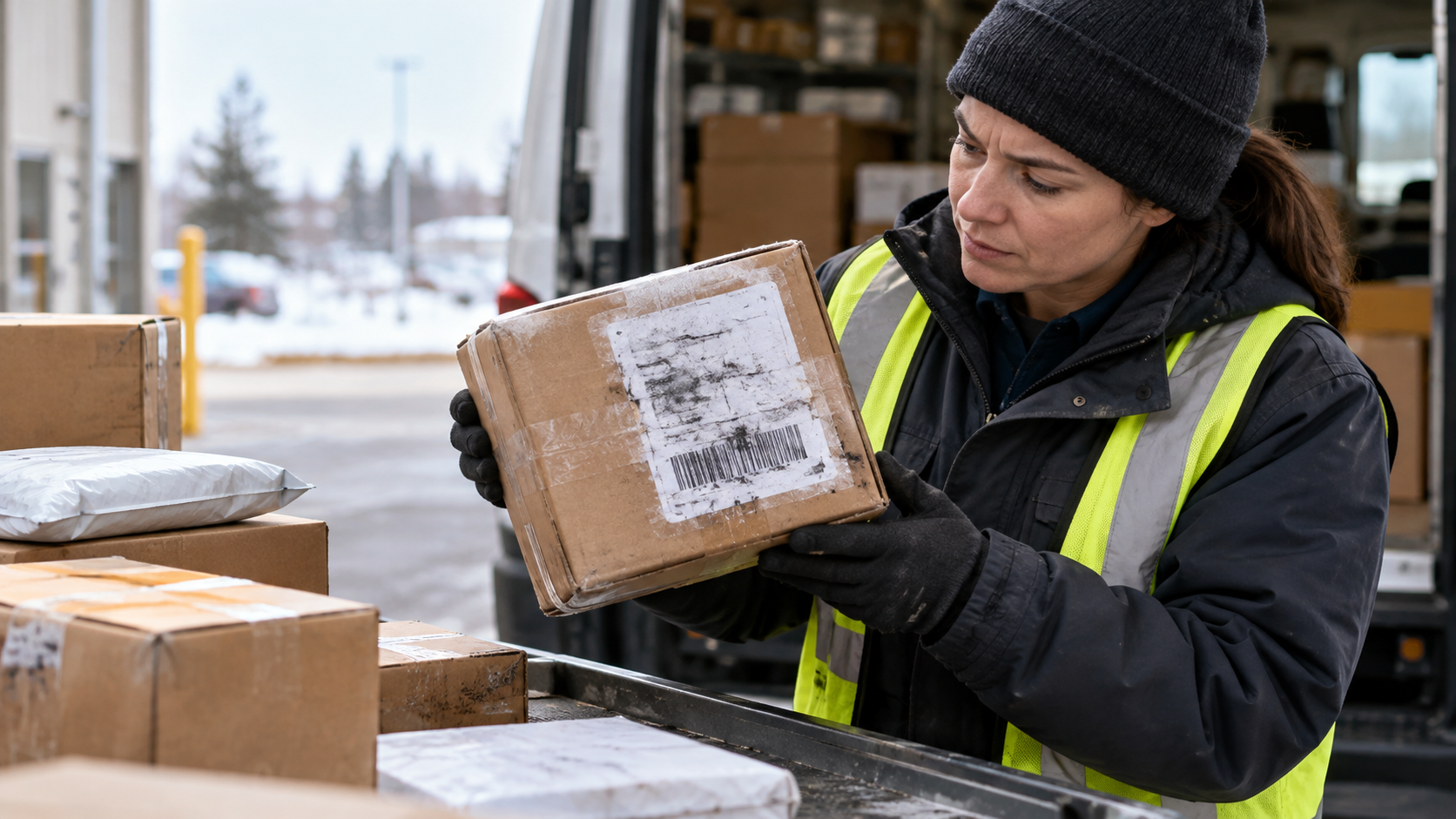
At the start of a route, one parcel has a smeared label. The package looks like the right size for a listed stop, but the address cannot be read and the barcode will not scan. It is tempting to put it with the other parcels and decide what to do later. Once it is in the van, though, the driver may lose the chance to compare it with the station record or ask the person authorized to correct the label. The uncertainty travels with the package.
A Minnesota delivery driver unreadable package label hold is a short, visible pause for that item while its identity is resolved through the employer's approved process. The driver keeps the item physically separate from the ordinary route load, records the problem, and asks the designated team to verify or replace the label. The hold ends when the physical item and the route record agree under that process. It is not permission to invent an address from nearby parcels or to make a new label from memory.
This guide addresses the loading decision for one uncertain package. It does not define an employer's scanning codes, approve relabeling by the driver, or set a universal shipping-label standard. A USPS example can explain why readable labels matter, but a private delivery company may use different identifiers and custody rules. Follow the actual operation's instructions, especially where multiple parcels share a stop or where a package has special handling requirements.
Decide whether the label or the scanner is the problem
An unreadable label and a failed scan are different observations. The print may be torn, wet, covered, folded around an edge, or too faint to read. The barcode may look intact while a handheld device has a connection or camera problem. Before declaring the package unidentified, examine the label under ordinary safe conditions and use the employer's approved scan troubleshooting steps. Do not peel away a label layer or alter the package just to test a theory.
If the printed address and tracking identifier are legible but the barcode does not scan, tell the designated team exactly that. Some systems may permit an authorized manual entry; others may require a new label or device check. Do not assume your own process. If the address is unreadable but a package identifier remains legible, the station may be able to match that identifier to a route record. If neither is trustworthy, the item needs a stronger identity check before it can be treated as a normal route parcel.
Keep the description factual: “Barcode will not scan; last four characters of printed ID visible” is more useful than “bad package.” Do not write the full customer address in a personal note outside approved systems. If more than one label appears on the parcel, do not choose the cleaner one by appearance alone. A return label, old shipping label, or overlabel could point to a different movement. Ask the team which identifier controls the current assignment.
The USPS Verify Postage page gives its own advice about placing labels so barcodes remain accessible. That is an illustration of the importance of label presentation, not an instruction for a delivery driver to repair a different carrier's label without approval. Your immediate task is to report the condition accurately and protect the package's identity.
Create a package identity hold before loading
A package identity hold before loading needs a physical place and a record. Use the employer's designated exception area, hold shelf, or supervisor handoff point. If no such place is clear, ask before leaving the parcel among the sorted route packages. The item should be visible to the person who can resolve it and unlikely to be swept into another driver's load by mistake. Do not leave it unattended in a public area.
Mark its hold status in the approved system if one exists. The entry can identify the package by the reliable information still present, the time found, the route or bin where it was found, and the exact label defect. Use only a status you are authorized to use. A personal sticky note may help at the station, but it cannot replace an official exception record when the employer requires one. It can also detach and create another identity problem.
Keep the uncertain parcel separate from items already scanned for your route. If you slide it into the van while waiting for a response, the normal load count may become misleading. A later driver could see it and assume it was accepted. A scan or route record should match what is physically on board. If the employer expressly directs you to transport an exception item under a documented procedure, follow that procedure; do not silently count it as a normal delivery.
The hold is not a punishment for the person who prepared the package. Labels can be damaged after printing or while moving through a facility. Focus on the observable defect and the next authorized step. A calm, narrow report makes it easier for the correct team to work the problem while the rest of the route remains organized.
Request an unreadable shipping label correction from the right owner
An unreadable shipping label correction may require a station lead, dispatch, shipper, returns team, or another person specified by the employer. Ask who has authority to verify the item and generate or approve a corrected label. The driver who discovered the problem may be able to supply observations without being the person authorized to relabel. That separation matters when the destination or service level is uncertain.
Give the correction owner the reliable evidence: route ID, package location, any readable identifier, label condition, and scan result. If a system record points to a likely package, ask how the team will confirm the physical item is the same one. Similar box sizes, neighboring stop numbers, or a familiar recipient name are clues, not proof. A wrong relabel can send a parcel to the wrong person with a clean-looking barcode.
Do not cover the original label, write a new address, or copy a barcode from a screen unless the employer's approved process specifically assigns that action to you. An overwritten original can remove evidence needed to resolve a mismatch. If the team produces a replacement label, ask which old identifiers should remain visible and how the new one should be placed. The operation's process controls; there is no universal rule in this guide for removing or obscuring prior labels.
If the parcel has special handling markings, damaged packaging, or signs of a leak, report those separately. A label fix does not solve a packaging or safety problem. Minnesota's manner-of-loading statute addresses preventing a load from escaping on a highway. It does not authorize carrying an unidentified or damaged item simply because it can be physically secured. Identify each issue and let the appropriate team decide its disposition.
Handle partial identifiers without making a destination guess
Some labels are partly readable. You might see a street name but not the house number, or a tracking suffix but not the full barcode. Write down which characters are actually visible in the approved exception record. Do not complete the missing characters from a route list just because one candidate looks likely. Two packages can share a street, building, recipient surname, or carton size. A package count at the stop may also change while the station is sorting.
Ask the correction owner which independent identifier can confirm the item. The employer may have a package record, shipping manifest, internal sort label, or a second machine-readable mark. The driver should not assume that every printed code serves the same purpose. An internal handling sticker may identify a bin without identifying a recipient. If the owner can match a reliable identifier to the physical package and authorized route record, the correction can proceed under the employer's process. If not, the hold remains.
Treat a handwritten address as information to verify, not as a replacement for the shipment record. It could be an old routing note, a shipper's instruction, or a mark from a prior attempt. Likewise, a customer call saying “that is my box” does not give the driver a reliable basis to relabel an unidentified parcel. The authorized team can decide what evidence it requires and whether it needs to contact the shipper. Keep the driver report limited to what you observed.
When several labels or barcodes appear, ask which is current before scanning one to clear the alert. The wrong barcode might record a return, a previous leg, or another service. If one scan produces a route mismatch, stop and report the mismatch instead of trying every visible code until the app accepts one. An accepted scan is useful only when it identifies the correct physical movement.
This is also a good point to check whether the item is already associated with another route. A station can have lookalike parcels close together. The correction owner can compare physical and system identifiers; the driver should not move an uncertain item into the van merely because it sat in the assigned bin. The bin location is evidence of where it was found, not final proof of destination.
Preserve the route while one item is on hold
One held parcel should not erase the route plan for the other packages. Confirm with dispatch whether you should depart without it, wait for a correction, or receive a revised assignment. The answer depends on service commitments and operational capacity that the driver may not see. If dispatch asks you to leave, record that the parcel remained at the station under the approved hold. Do not mark it delivered, attempted, or loaded just to clear a route alert.
If the affected stop has several packages, distinguish the held piece from the pieces you can take. The route record should show which physical items are on board. Do not assume that the customer should receive none of them, or all of them, without the employer's direction. A multi-piece delivery can be easy to misstate if the app shows only a stop-level status while individual packages have different states.
If a correction is completed before departure, return to the parcel and verify it under the release criteria below. If it is completed after you leave, ask whether another driver, later dispatch, or a return trip will handle it. Avoid a private promise to the customer based on an unresolved station item. The operations team should manage the commitment and route status.
NIOSH's ergonomics guidance provides general context for avoiding unnecessary physical strain. A practical application here is to avoid repeatedly loading and unloading the uncertain parcel while waiting for someone to decide its identity. Hold it at the designated station point until the correction is ready, using employer handling practices for size and weight.
Release only when item and route record agree
The correction owner may say “fixed,” but the driver still needs a usable handoff. Look at the physical parcel and the corrected information. Can the approved system identify it? Does the route assignment show the same destination and service movement? Is the corrected label attached to this parcel, rather than lying beside it? Did the required scan or manual exception step succeed? These are observable checks, not a second approval ceremony.
Use the employer's release rule. In one operation, a successful scan of an authorized replacement label may be required. In another, a station supervisor may document a manual exception and hand the item over. The driver should follow that actual instruction and note any remaining discrepancy. Do not turn a verbal “probably this one” into a completed identity match.
Check the package count after release. If the route originally listed 42 parcels and one was held, the on-board count should reflect what was actually loaded. When the corrected parcel joins the load, update the count and place it in the stop's proper zone. If the route app adds or removes an assignment during the correction, reconcile the changed total rather than forcing the original number to remain true.
An approved correction may change more than the print quality. The destination, service level, route, or pickup/return status may be different from what you first assumed. Read the corrected assignment before placing the package among normal deliveries. If it belongs on another route, leave it with the authorized team and document the handoff. A clean label does not make every parcel yours to carry.
Keep the correction trail short and useful
The driver needs enough record to explain why the parcel was held and what happened next. A concise entry might say: “8:10, parcel from route bin 6 held for unreadable barcode and address; station lead notified. 8:24, replacement label issued under package ID [approved identifier]; scan accepted; item loaded into stop 12 zone.” Use the real times and identifiers, and leave out information you cannot verify. If the item was not released, record where and with whom it remained.
Keep the before and after states distinct. A scan failure at 8:10 is not erased by a successful scan at 8:24. The earlier defect explains why the item was delayed and shows which label was corrected. A route note should not imply the parcel was in the van from departure if it joined later. If the employer's system automatically records events, avoid creating a conflicting personal timeline.
If the correction attempt fails, ask for the next authorized disposition. The parcel may remain on hold, be returned to a shipper, or go to another team. Do not try a slightly different guessed address merely to obtain a scan. A failed correction is a new fact for the team, and the driver should move other assigned work only as dispatch directs. Keep the unresolved parcel physically and digitally identifiable.
Protect customer information while preserving evidence. A photo of the label may be useful if the employer's approved system asks for it. Do not put such photos in a personal messaging app or share them with another driver as a shortcut. The useful trail is the defect, approved correction, release or hold, and route consequence, recorded in the systems that own the package.
Ask about label authority before the first exception
A driver can learn the local process before encountering a damaged label. Ask where held parcels go, who can verify identity, who can print or approve a replacement, which status to use in the route app, and what evidence releases the item for loading. Ask what to do when the station is busy and departure time arrives. Those operational questions are more useful than memorizing an informal workaround from another driver's old route.
If you are comparing delivery roles, the published delivery job offer review guide can help you identify what an employer has actually promised about training and support. The Saint Paul delivery driver Careers hub provides a broader starting point for role research. Neither page supplies the specific label-correction authority for a future employer; ask that employer directly.
The item stays separate while the correction owner checks reliable identity evidence. The driver compares any corrected package with the route before loading. If identity remains uncertain, the hold stays visible and dispatch decides how the rest of the route proceeds.