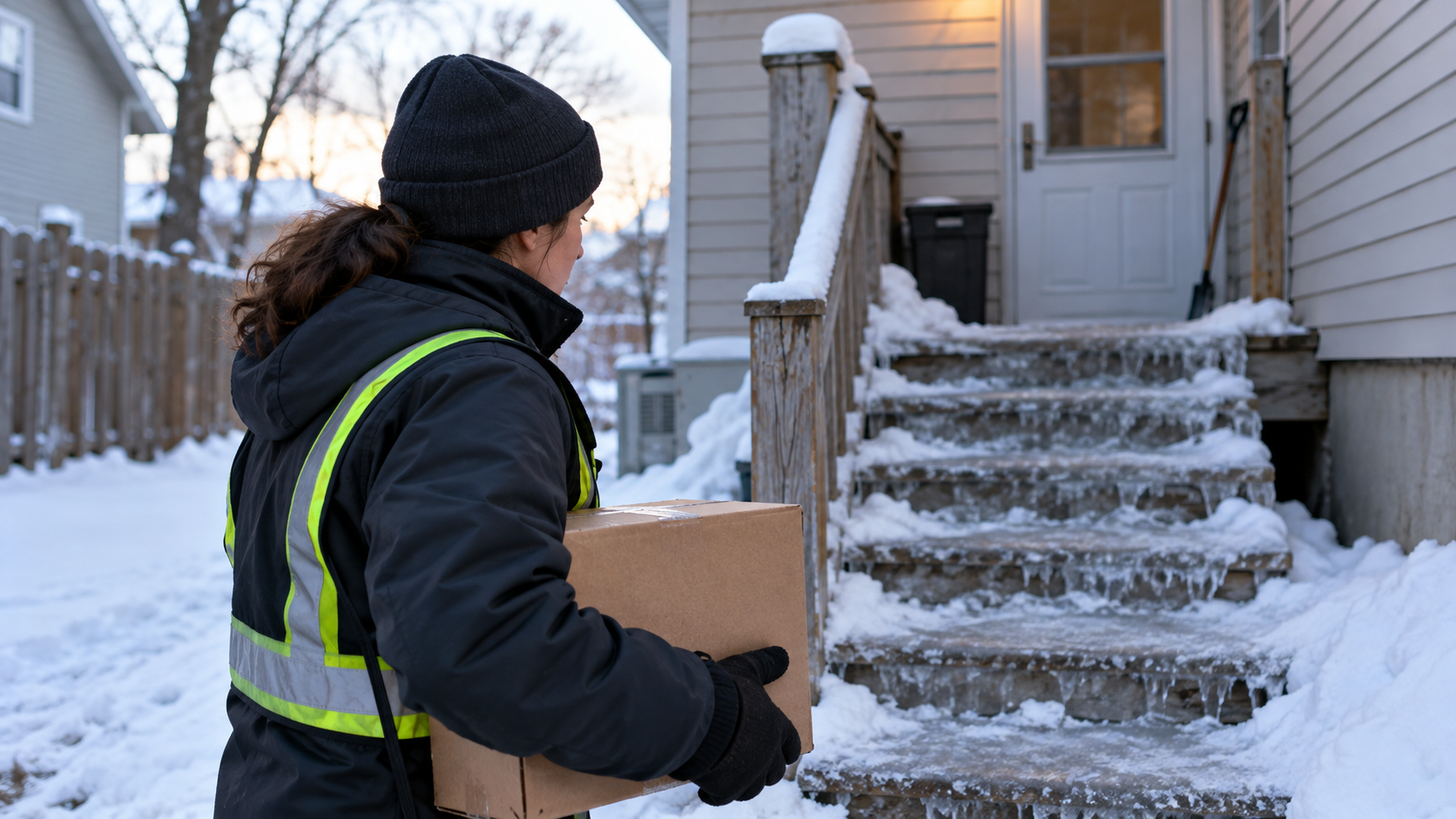
The delivery note says, “Use the back steps and leave the box at the kitchen door.” A driver reaches the property and finds the back steps coated in ice, with no clear handrail. The front entrance appears reachable, but the parcel may require a signature and the customer has not approved a location change. A Minnesota delivery driver unsafe access instruction calls for a stop-level decision: identify the actual access hazard, keep the package in custody, and seek an approved way to complete or defer the delivery. The note does not require the driver to cross a route they judge unsafe.
OSHA's winter-weather guidance discusses snow and ice as slip hazards on walking surfaces. Its delivery and storage guidance also identifies trips and falls in delivery areas and advises using handrails on stairs and carrying items so the worker can see the path. The employer's safety procedures and the parcel's service rules control the driver’s actual choices. UPS's delivery-change guidance illustrates that some customer changes can be requested through an official channel, with shipment restrictions still applying.
The package may be protected from weather once it reaches the kitchen door, yet the route to that door is unsafe. The driver must assess access separately from the parcel's condition at the proposed drop place. If no safe authorized path is available, the stop needs a truthful exception and a next step for the package.
Make an unsafe delivery path check before unloading
An unsafe delivery path check starts where the driver can safely pause. Read the current instruction, locate the named entrance, and look at the route from vehicle to handoff point. Ice, debris, an open excavation, a loose stair, a dark passage, an aggressive animal, or a locked gate can make the instructed path unsuitable. Name the observed condition instead of using “unsafe” alone. The supervisor needs to know what prevented access.
Check whether the hazard is temporary or structural. A snowdrift across a walkway may clear after property maintenance; a missing stair tread needs a different fix. The driver need not diagnose the property's construction. Record the visible obstruction, location, and time. If taking a photo is permitted, frame the path without exposing unrelated residents or entering the hazard to get a better angle.
Consider the package in hand. A large box can block the driver's view of a stair or curb that would otherwise be visible. A heavy parcel can make balance more difficult on an icy slope. OSHA's delivery guidance specifically advises carrying only items that allow the worker to see over them. Put the parcel down in an authorized safe place or keep it in the vehicle while assessing the path; do not use the box as a reason to rush through the hazard.
The driver should not test an icy step by climbing partway up while holding the parcel. An initial look may be enough to stop. If conditions are borderline, follow the employer's safety escalation or obtain help rather than treating delivery completion as the only measure of a successful stop. A route estimate or delivery target cannot tell whether this particular stair is safe under current conditions.
Read the instruction and the shipment restrictions together
Customer notes can identify a preferred entrance, a place to leave the parcel, a gate code, or a person to contact. Read the full live task and any shipper or service restrictions before choosing another route. A signature-required shipment may need a person to accept it. A restricted parcel may not be eligible for release at another door. A customer preference cannot cancel those conditions.
Look at when the instruction was entered. An old note might point to a back door that is now locked or under repair. A new message might ask for a change that the carrier has not accepted. The driver can report the conflict and ask for clarification, but should not write a replacement instruction into the record without authority. UPS's change-delivery page shows why a requested change and an available approved option are separate questions.
If a front entrance is safe, check whether the service permits delivery there. The front door may be the addressed location under the normal service, or the package may require a named recipient who is not present. Contact the customer through the employer's approved channel or ask dispatch for direction. A safe path is necessary for a physical handoff, but it is not enough to make a different drop location authorized.
If the instruction says to enter a yard or use a side gate, confirm that the driver is allowed to use it and that it actually leads to the delivery point. Do not open a locked gate, climb a fence, enter a construction area, or go through an unknown building solely to satisfy a note. A gate code that works does not prove the path beyond the gate is safe or that the shipment may be released there.
Use a delivery access exception report that names the obstacle
A delivery access exception report should connect the parcel ID, address, instructed entrance, observed hazard, time, attempted contact, and next authorized action. “Back steps icy; no safe approach to kitchen door at 14:20; customer call placed through route app; dispatch case 418 opened” is more useful than “bad access.” Record what the driver actually tried, and avoid listing a customer contact that did not happen.
If the app offers a specific unsafe-access code, verify that it fits the event. “Address inaccessible,” “gate locked,” “weather delay,” and “customer unavailable” can mean different things. Choose the approved code for the observed condition. If no code fits, use the employer's exception process and preserve the free-text details. A false “recipient refused” status can misdirect the next attempt and customer support.
Record the package's physical location after the exception. If it stays in the vehicle, say so. If an authorized station worker accepts it later, obtain that handoff receipt. A route card marked “exception” does not by itself establish where the parcel went. The next shift needs to know whether the driver still has it, the station has it, or an approved alternate recipient took it.
If the driver uses an offline device, preserve the queued event ID and the time of the actual observation. Ask support to reconcile the event when connectivity returns. Avoid creating duplicate exceptions with different times simply because a pending icon remains visible. The first report and any later correction should stay traceable.
Contact the customer without promising an unsafe attempt
Use the employer's approved call or message channel if one is available and safe to use. Describe the blocked path plainly: “The back steps are icy. I cannot use that entrance today. Is there an approved accessible handoff at the front door?” The customer may know another entrance, but the driver still checks it and the shipment's rules before moving the parcel.
Do not ask the customer to come out onto the same hazardous steps to solve the problem. If a safe meeting point exists and the service permits a direct handoff, let the customer choose it through the approved process. A customer who says “just leave it at the bottom of the stairs” is proposing a new location. The driver should check whether that location is allowed and whether it protects the parcel under the service, rather than treating the statement as an automatic override.
If the customer does not answer, record the actual contact attempt and time. A voicemail, unanswered call, and two-way conversation are different events. The driver may have an approved safe-delivery alternative, or may need to carry the package back. Follow the applicable route instruction. Do not send a private text or post a public note containing the parcel's details to obtain a quick answer.
If a resident appears at the safe front entrance, verify that the person can receive this shipment under its service rules. A handoff there may resolve the access conflict without a new drop location. Record the actual receiving person and location. Do not mark “left at kitchen door” because that was the original note; proof of delivery should describe the event that occurred.
Compare alternatives without improvising a drop point
The first alternative may be a safe route to the same authorized handoff point. If property maintenance clears the steps while the driver is still there, reassess the path. If the original entrance remains unsafe, a permitted front-door handoff may be possible. The driver should verify both physical access and shipment authorization for each option. A route detour that crosses private property or another resident's yard may create a new access problem.
A parcel locker, front desk, or package room may be available at the address. Those locations have their own authority and proof rules. Confirm the exact parcel is eligible and that someone or something actually accepts it. Do not choose “locker” in the app because the back stairs are unsafe if no locker transaction occurred. A safe indoor location is not automatically an approved recipient.
Holding the package for a later attempt may be the correct outcome if no safe authorized delivery exists. The driver's record should show the hazard and any customer or dispatch contact so a later driver understands what changed. A repeat attempt without that information sends someone else to the same icy steps. If the employer arranges a different time or method, note the exact new task rather than promising a return on the driver's own initiative.
Redirecting to another address may be possible for some shipments through an official service. The driver should not manually alter the label or treat a verbal request as a completed redirect. Dispatch or the recipient-facing system can confirm whether the parcel is eligible and what new destination is authorized. Until then, keep the package under its current custody and route record.
Work through an icy back entrance
Imagine a driver has two parcels for one house. Parcel A is an ordinary package with an approved front-door release. Parcel B requires an eligible person's signature. Both have an old note saying “use the back kitchen steps.” On arrival, the back steps are iced over, while the front walkway is clear. The driver documents the icy path and checks the item-level rules. If the front-door release for A remains valid, A can go to the front door with proof that names the actual location. B cannot be left there merely because the path is clear.
The driver contacts the customer through the route app. The customer comes to the front door and, after any required recipient check, accepts B. The driver records a direct handoff at the front door. Neither parcel is reported as delivered at the kitchen door. The hazard report explains why the old instruction was not followed; the delivery proofs show where the parcels actually went.
Change one fact: no one answers the call or front door. Parcel A's release may still be permitted at the front if the live instruction allows it, while B remains with the driver for an exception or later attempt. The driver should not combine both under a single “delivered” stop status. Item-level restrictions survive the access problem.
Change another fact: the front walkway is also icy. The driver should not carry A to the front merely because that door is an authorized drop point. Stop at a safe position, document the path, and ask dispatch for the correct no-delivery outcome. Authorization to use a door does not remove the physical hazard on the way there.
The example uses ice because it makes the conflict visible. The same decision applies to an unlit passage, blocked fire exit, loose stair, or construction zone: identify the actual obstacle, check the service's permitted alternatives, and record what happened to each parcel. The driver should not copy the example's front-door solution onto a property where the front entrance is restricted or unsafe.
Separate access risk from parcel exposure
A delivery path can be safe while the proposed drop place leaves the package exposed to rain or public traffic. The reverse can also be true: a covered back porch may protect the box, but reaching it requires crossing unsafe steps. For this article, the access risk controls whether the driver should travel the instructed path. Parcel exposure and release permission still matter when evaluating any alternative.
If the customer asks the driver to toss a package over a gate, the driver should not treat that as a safe workaround. It can damage the parcel, miss the intended area, or create false proof of handoff. Ask for an authorized accessible point or use the approved exception. A photo of a box beyond the fence would not show that the driver reached the requested door or that a person accepted it.
If a new safe route is offered, inspect it from a safe position. The customer may know the property well but not the route conditions at the driver's arrival time. A side path can be clear at noon and icy by late afternoon. A working gate code can lead to a dark stairwell. The driver should identify what they can observe and decline a path that remains unsafe under the employer's procedure.
Avoid using another resident's entrance without permission. An apartment courtyard may appear to offer a shortcut to the requested door, but it may enter a private unit or a controlled area. The route system's delivery instruction is not a general license to cross any property. Dispatch or building staff can clarify the authorized access point if the ordinary path is blocked.
Leave the next attempt a usable record
Before ending the stop, confirm the app's outcome matches the physical package. If it was delivered by an approved alternative, the proof should name that location and recipient as required. If it remains with the driver, the record should say why access prevented delivery and where the parcel will go next. An unresolved exception should have a case reference or supervisor owner under the employer's process.
Describe the hazard at the time observed, without claiming it will persist forever. “Back steps icy at 14:20” is stronger than “back entrance always unsafe.” A later driver can reassess conditions. If the issue appears structural, such as a missing stair tread, note the specific feature and ask dispatch whether the address needs a standing access instruction. The driver should not change a permanent route rule alone.
Drivers evaluating a delivery role can use the Saint Paul delivery driver Careers hub as the current entry point. The published delivery job-offer review guide can help a candidate ask how the employer handles unsafe access, customer changes, and repeat attempts. On a live route, the driver needs the current parcel instruction and an actual safe path.
The stop is complete when the package has a truthful outcome and the access conflict has a named next step. A successful delivery can use an approved accessible location. A failed attempt can preserve the parcel for another authorized route. In both cases, the driver records the observed obstacle and avoids a proof-of-delivery scan for a path they never traveled.