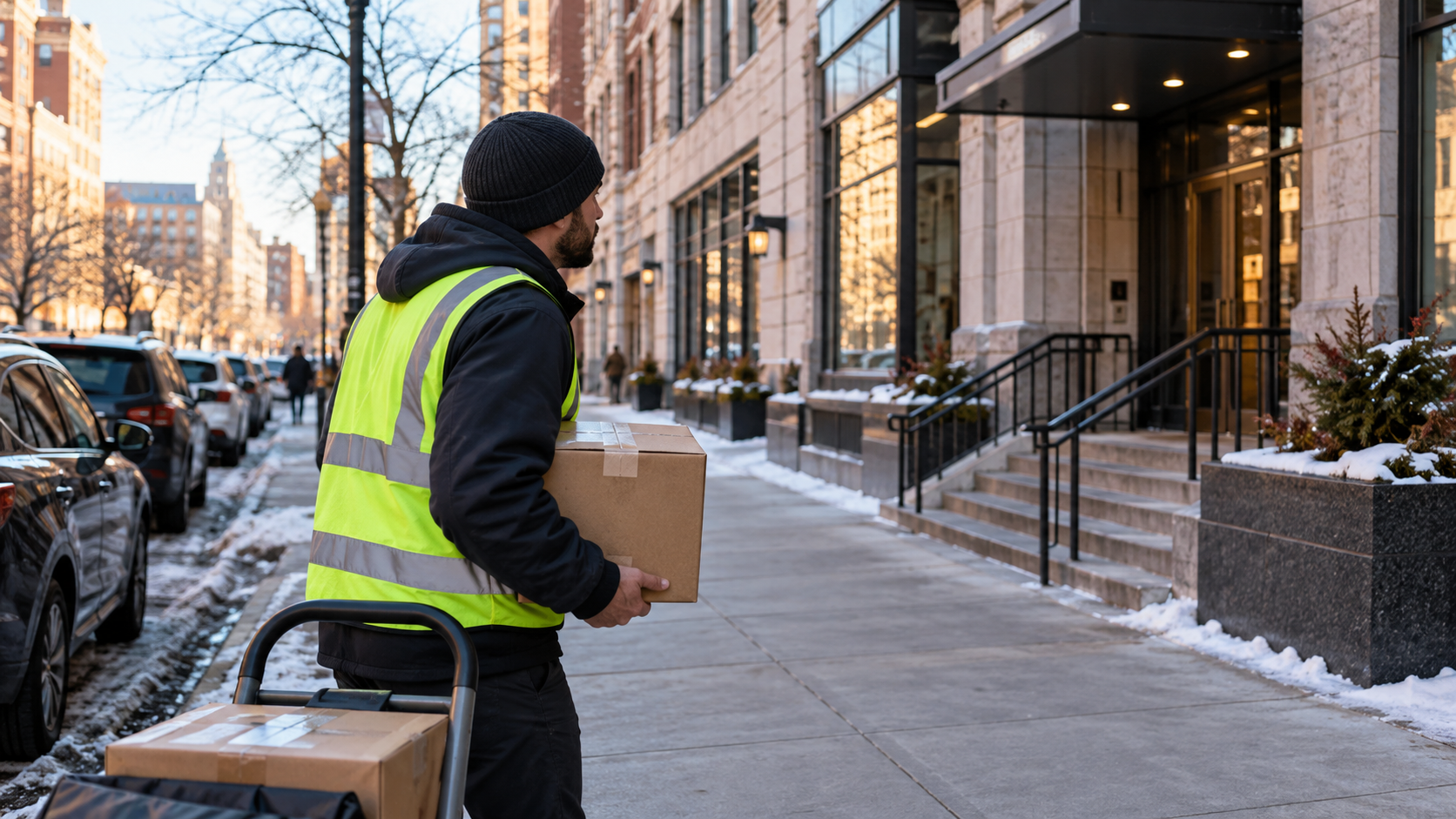
The route shows a delivery address in a crowded block. The driver may be able to pull in front of the building, or the nearest lawful parking may be around the corner. The difference affects how the package is carried, whether a cart is needed, how long the stop takes, and whether the entrance can be reached at all. A map pin gives a destination, but it does not identify a legal vehicle space or a safe pedestrian path from that space.
A Minnesota delivery driver walk from legal parking decision asks whether the vehicle can stop lawfully near the destination and whether the driver can complete the remaining trip on foot under the employer's handling rules. Plan the parking place, walking route, package movement, and return to the vehicle as one stop. Do not assume that a legal space automatically makes every package deliverable from it. A light envelope and a heavy multi-piece order create different choices.
This guide concerns the planned walk from a lawful stop. It does not decide a particular busy-road curb in real time, grant access to a private driveway, or provide a universal lifting limit. Current signs, site access, package size, weather, and the assigned vehicle matter. When no workable combination exists, the driver should ask dispatch for another method rather than parking illegally or carrying a load through a hazardous path.
Identify the real delivery entrance
Before selecting parking, confirm which entrance serves the package. A large building may have a lobby on one street, a loading dock on another, and a resident entrance on a courtyard. The map pin may sit in the middle of the parcel or at an address frontage that is not the receiving door. Read the employer's stop notes and building signs. If the entrance remains unclear, ask through the approved customer or dispatch channel before committing to a distant walk.
Check whether the recipient expects a doorstep, front desk, mailroom, dock, or authorized handoff. Those destinations may be hundreds of feet apart even when they share one street address. A driver who parks near the pin but walks to the wrong entrance can lose time and expose a package while searching. Keep the customer and package identifiers in the employer's system, not in an unprotected personal map note.
If there is a designated delivery entrance, ask about hours, check-in, and equipment. A dock may be open only at certain times. A lobby may require a code or contact. The walking route may include an elevator or secured door. Plan enough information to reach the authorized point; do not assume that every open door is a valid delivery entrance.
The published address and the legal parking location are two separate facts. Start with the destination, then look for a lawful vehicle stop that connects to it by a practical pedestrian route. A closer curb on the wrong side of a barrier can be less useful than a farther space with direct sidewalk access.
Perform a delivery stop walking distance check
A delivery stop walking distance check is not just a map measurement. Estimate the route from the candidate parking place to the actual entrance, including crossings, stairs, ramps, gates, and return to the vehicle. A straight-line distance across a divided road is misleading if the legal crosswalk is two blocks away. The driver should choose a safe pedestrian path rather than the visually shortest line.
Look at the package. Can one driver carry it for that distance under training? Does it require a cart, and can the cart use the sidewalk and entrance? Are there multiple pieces needing repeated trips? An employer may have handling procedures or assistance requirements. NIOSH's ergonomics guidance describes the risks of physical demands and ways to reduce strain; it does not set a universal distance or weight cutoff for this delivery.
Weather and surface matter. Snowbanks can separate a legal curb space from the sidewalk. Ice, standing water, construction, or an unpaved path can make a cart route unusable. Do not plan a long carry based on a summer map image when current conditions differ. If the walking route is obstructed, look for an authorized alternate entrance or ask dispatch for help.
Include the return leg. The driver may need to make a second trip for a signature device, another package, or a cart. A stop that appears to involve a five-minute walk can take longer when a secured entry or multi-piece handoff is included. Mark uncertain access rather than promising a precise stop time before seeing it.
Identify lawful parking before the pedestrian path
Read posted signs and curb markings for the candidate vehicle space. Minnesota Statutes § 169.34 identifies prohibited stopping, standing, and parking locations under its terms. A delivery vehicle does not gain a blanket exemption because the driver is carrying a package. Check bus stops, crosswalks, intersections, driveways, hydrants, accessible spaces, and local restrictions as applicable. Use the real sign and time window, not a generic app parking icon.
Make sure the whole vehicle fits. A passenger-car space may not hold a long van without extending into an intersection or travel lane. A loading area can have posted time, permit, or vehicle conditions. A private lot may require permission. If a candidate spot fails, continue to another lawful place rather than stopping temporarily in the lane to inspect a map.
Ask whether the vehicle can remain secured while you walk. Follow the employer's policy for locking, keys, device, and cargo. A long walk can leave the van out of sight. The employer may require a different stop arrangement or a second worker for certain loads. Do not assume a parking place is workable merely because it is legal; the vehicle and remaining packages still need to be protected under the operation's rules.
NIOSH's motor vehicle safety guidance provides broad context for work driving. For this decision, its relevance is choosing a lawful stop before shifting attention to the pedestrian leg. It does not approve a specific curb, private lot, or unloading method.
Trace the package carry route from parking
A package carry route from parking should be checked for the full trip: vehicle door, curb or sidewalk, crossing, building entrance, delivery point, and return. Note whether you must carry the package beside traffic, up steps, through a narrow gate, or across a surface that a cart cannot traverse. An apparently convenient parking place can fail because the pedestrian path is blocked or requires an unsafe crossing.
If the stop has several packages, decide whether they can be moved in one trip under employer training or whether multiple trips are needed. Do not stack boxes so high that you cannot see the walkway. Ask for a cart or help where the procedure calls for it. If a cart cannot enter the building, ask where an authorized handoff can occur. Do not leave packages unattended on the sidewalk while returning to the van for the rest.
Check the building's delivery rule. Some sites require a loading dock or receiving desk, even if a front entrance is nearer to the legal parking spot. A shortcut through a private courtyard may be off limits. Follow the site and employer instructions rather than choosing a door solely to shorten the carry. A valid proof of delivery depends on reaching the right authorized recipient or place.
If the path crosses a busy street, use a lawful crossing. Do not carry a heavy parcel between parked cars into moving traffic because the recipient is visible across the road. If no safe crossing connects the parking place to the entrance, that spot is not workable for this stop. Choose another or seek an approved alternative.
Plan the number of trips and who holds the load
For a multi-piece stop, count the packages before leaving the vehicle and match them to the assignment. Ask whether the driver can move them in one trip with approved equipment or needs a second trip. A cart can reduce carrying strain, but it may also be too wide for a gate or unable to cross a curb. Check the actual path. Do not balance extra cartons on a cart beyond the employer's equipment instructions just to avoid returning to the van.
If more than one trip is needed, decide where the packages will remain between trips. Leaving pieces in an unattended lobby, on a sidewalk, or beside a loading door may violate the employer's custody process and expose them to loss. The safer plan may be to keep remaining pieces locked in the vehicle and bring them in sequence, or to request another worker or authorized receiving contact. Follow the operation's proof and handoff rules for each piece.
The walking plan should include the driver's return to the vehicle. A timed parking space may expire while the driver waits for a signature or elevator. If the sign allows only a short stop, compare that limit with the realistic walk and handoff time before parking. Ask dispatch about another space or delivery window if the task cannot fit. Do not assume a loading-zone time restriction pauses while the driver is inside a building.
Consider what happens if the recipient is unavailable. The driver may need to bring the package back through the same path, not leave it at an unapproved door. A heavy item carried downhill toward the entrance may be harder to return uphill. Plan for that possibility and follow employer procedure for failed handoffs. A walking route that works only if everything goes perfectly is a weak plan for an uncertain access point.
If the vehicle cannot remain secured and out of sight under company policy, the driver may need a different stop or a second person. Do not solve a long walk by leaving the van open or the keys accessible. Ask the supervisor which arrangement is authorized. Parking legality, package custody, and physical handling must all hold for the same plan.
Compare two candidate spaces in a worked example
Suppose a hypothetical office delivery has three cartons and a receiving desk on the west side of a block. Space A is 30 feet from the building but lies beside a no-standing sign during the delivery hour. Space B is a lawful loading area around the corner, about 250 feet from the receiving door by sidewalk. The short distance to A does not make it available. The driver must assess whether B's time limit, vehicle fit, and pedestrian path work for three cartons.
If the cartons fit an approved cart and the sidewalk has a usable curb cut, B may be a practical choice. If the cart cannot pass a construction barrier, B may fail despite lawful parking. The driver should ask about another entrance or arrange a different handoff. The example does not set a distance threshold; it shows how parking and handling conditions combine.
Now change the order to one envelope. B's walk may be easy even without a cart. Change it to a heavy appliance requiring two workers and a liftgate, and the same space may no longer serve the task. The building and curb have not changed, but the package and equipment requirements have. The route plan should reflect the actual item.
If a nearby paid garage is the only apparent parking, check whether the vehicle fits, whether delivery vehicles are allowed, and how payment or reimbursement works under employer policy. Do not enter a garage on an unverified clearance merely to reduce the walk. A farther surface option or a site-approved dock may be better.
Account for route time without rushing the walk
A stop that requires legal parking and a walk can take longer than a doorstep drop from a driveway. The route estimate may not include circling for a lawful space, securing the vehicle, walking to the entrance, checking in, and returning. Record material delay honestly. Do not use an illegal curb stop to match an unrealistic predicted stop time.
If the stop has a time window, plan when to arrive at the parking area rather than when the vehicle passes the address. The driver may need several minutes to reach the receiving desk. If that makes the window impossible, tell dispatch early. The employer can reorder stops or contact the customer. A rushed carry does not restore a missed appointment.
If a legal parking space is occupied, do not assume one will open immediately. Continue to a safe place and consider another candidate. A driver may need a second pass or a dispatch decision. Do not leave the vehicle in a travel lane while waiting for someone to move. Keep the actual parking and walking time distinct from delay caused by customer access.
When the walk is complete, use the employer's proof process at the actual delivery point. Do not scan “delivered” at the van before carrying the package. If a signature or photo is required, follow the site's privacy and employer rules. The walking distance changes timing, not the requirement to represent the handoff accurately.
Ask for an alternative when the walk is not workable
If every lawful parking option leaves an unsafe or unmanageable carry, report the exact constraint. “Legal curb is two blocks away, the only crossing has construction closure, and this carton requires a cart” gives dispatch more than “no parking.” Ask whether the site has a receiving entrance, surface loading area, appointment, assisted delivery, or a different vehicle plan. Use the employer's channel from a lawful safe stop.
If the customer offers to meet the driver, confirm that the location is lawful and the handoff is permitted under employer policy. A customer cannot authorize stopping in a bus zone or crossing a closed work area. If they can meet at a safe approved point, record the handoff and recipient correctly. Do not convert a failed doorstep plan into an undocumented curbside transfer.
If no method is available, use the actual exception status. Do not mark the customer absent when the driver could not reach an authorized entrance from legal parking. Record the parking and pedestrian constraints, the alternatives checked, and dispatch's decision. Another driver or time of day may offer a workable solution later.
Keep temporary conditions dated. A snowbank or construction barrier can disappear, and a curb restriction can apply only during certain hours. A precise route note helps the next driver verify current access rather than inheriting a permanent “no parking” conclusion from one visit.
Use the lesson when evaluating a delivery role
Drivers comparing roles can ask whether routes include urban buildings where walking from legal parking is routine, what carts and handling help are supplied, and how route times account for access. The published delivery job offer review guide can help clarify vehicle, equipment, and performance expectations. The Saint Paul delivery driver Careers hub gives broader role context. Neither page identifies a legal parking space for an actual stop.
If the stop cannot be completed from legal parking, tell dispatch which part failed: vehicle space, pedestrian route, package handling, or authorized entrance. Record the alternative offered before changing the stop status.