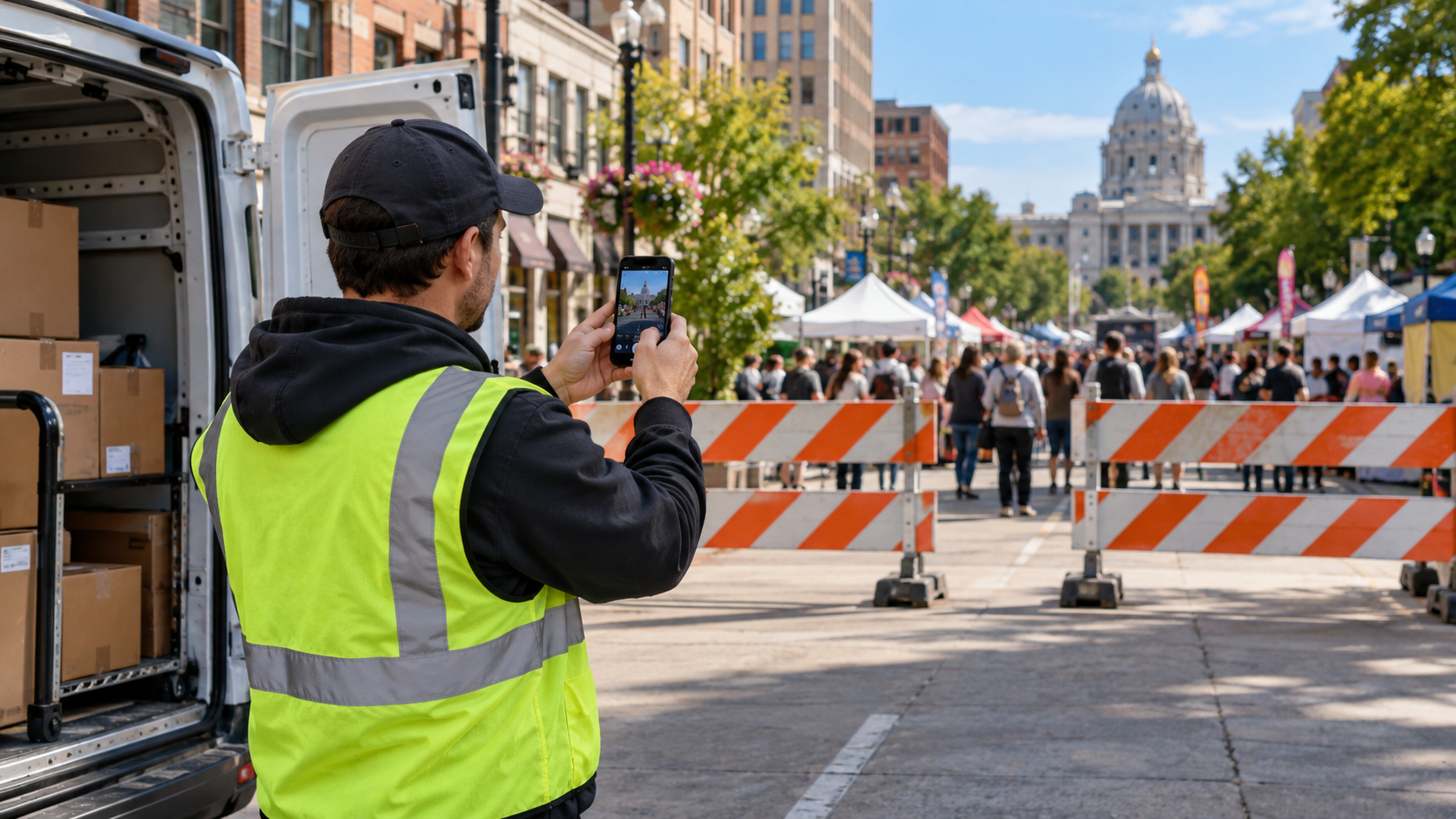
A driver approaches a downtown Saint Paul address while a street festival is underway. Barricades close the block to vehicles, and the building's usual entrance is inside the event area. The package is still in the van. The driver needs to tell dispatch more than “road closed,” because the real delivery question is whether an authorized, safe route to the recipient remains available.
To report an inaccessible stop caused by a public event, identify the exact address and entrance, record the barrier or direction that prevented access, and note the time and package status. Look for an authorized alternate only through the employer's and site's current instructions. If access remains unresolved, contact dispatch with the specific facts and follow its disposition. Do not drive around barricades, cross a restricted crowd area, or mark the parcel delivered because you reached the edge of the event.
Saint Paul permits many types of public events, and Minnesota 511 can display road events and closures. Those sources give context, not a live answer about one doorway. The Fast Track Delivery Saint Paul careers page emphasizes road awareness and clear communication when conditions change. The driver's observed access point and employer's instructions decide the stop record.
Describe the public event delivery access barrier
A public event delivery access problem should name what blocked the intended route. Was there a vehicle barricade, a pedestrian-only perimeter, a police-directed closure, a vendor fence, or a crowd that made the marked approach unsafe? “Festival” alone may explain why the area is busy but does not show why this delivery could not be made.
Note the street, cross street, building number, and entrance in the authorized route system. A business may have a second entrance on a side street; a residential building may not. If you cannot verify an alternate safely, say so. Do not assume that walking from the nearest open intersection is allowed merely because a map shows a short distance.
Read any event sign or barrier notice for dates and times. A closure may begin before the public event or continue through cleanup after it ends. If the sign does not identify the exact access rule, report its wording rather than converting it into a broader claim. “Barricade says no vehicles beyond this point until 6 p.m.” is stronger than “whole neighborhood closed.”
Keep an event-related stop exception tied to the stop
An event-related stop exception concerns one package, address, and attempt time. Record the stop ID and where the parcel is now. A road closure near the route may slow travel without making every address inaccessible. A stop becomes an access exception only when the driver cannot complete the authorized handoff by a safe, permitted path under the current conditions.
If a pedestrian path remains open and the employer permits it, the delivery might still be possible. If the route requires driving to a loading entrance inside the closure, it may not be. Ask dispatch when the answer depends on company rules, package size, or recipient access. Do not apply the same outcome to every stop on the closed block without checking each entrance.
Use the employer's actual exception code and notes when directed. This guide cannot name a universal platform status. A status that implies “recipient closed” may be inaccurate if the recipient is open but event controls block access. State the event barrier in the narrative even if the app's options are limited.
Stop at the barrier without improvising a detour
The driver should obey barricades and directions from authorized traffic or event staff. Do not pull into a crowd, use a sidewalk as a vehicle route, or make an unsafe U-turn to reach the next street. The roadmap has a separate article on navigating a street closure safely. Here the point is to report the delivery stop after the driver has reached a lawful, safe observation point.
Park only where permitted. Event days can change curb use, loading zones, and pedestrian flows. A delivery van stopped at the barrier may block emergency access or event traffic. If no safe place to park exists, continue to one and report from there. Do not read a long map or type a note while driving through the crowded area.
If an event marshal gives a route suggestion, confirm whether it applies to delivery vehicles and the specific address. A suggestion to “go around” may lead to another closure. Follow employer navigation and site rules rather than treating informal directions as permission to enter a restricted zone.
Check the recipient entrance, not only the street
A street closure can leave a building's rear entrance reachable from an open alley, or it can surround every safe entrance. The difference determines whether the stop is truly inaccessible. Read the delivery instructions and the building's current posted access. If a rear entrance is named, ask whether it is authorized for this shipment and safe to approach under event conditions.
Do not hand a package across a barricade to an unidentified person who says they work at the building. Verify recipient identity and employer handoff rules. A customer inside an event perimeter may be willing to meet the driver at an approved boundary, but the company must allow that handoff and the recipient must be identifiable.
If the building has multiple tenants, the event may block one storefront while an office entrance remains open. Match the package's suite and recipient before deciding. A photo of the event gate without the addressed doorway may be insufficient to explain why this particular stop failed.
Use official event information as context
City event pages and Minnesota 511 can help a dispatcher understand planned closures or road conditions. Their coverage and update times may differ from the driver's immediate observation. A permitted event may have a temporary access gate not shown on a public map, and an unlisted crowd may still block a doorway. Do not claim official information proves the package was undeliverable at a specific minute.
If the route owner asks for a public source, share the relevant event notice or 511 view and its time. Pair it with your stop observation: “The map showed a closure on this block; at 11:20 a.m. the addressed north entrance was behind a staffed pedestrian barrier.” The second part is what makes the report useful for the actual delivery.
Do not use an event schedule from a previous year or a cached search result as current authority. If a city notice says a closure ends at 4 p.m., ask whether the employer wants a later attempt; do not promise that the barricades will disappear exactly at 4. Setup and cleanup can affect access outside public event hours.
Contact dispatch with decision-ready facts
A concise update might say: “Stop D123, 100 Main Street, north entrance. At 11:20 a.m. a festival barricade blocked the only vehicle approach, and event staff said delivery vehicles could not pass. I found no authorized pedestrian handoff in the stop instructions. Package remains in my vehicle. Is there a confirmed alternate entrance or should this stop follow the event-access exception process?” Use your actual location and observations.
If you reached a safe alternate entrance, tell dispatch that too. The decision may be whether to try it, ask the recipient to meet at a boundary, or schedule another attempt. Reporting only the blocked front street hides options; reporting an unverified rear route as open can send a driver into a second problem.
Keep the response and time. Dispatch may give a route change, recipient contact, later attempt, or return instruction. A pending support message is not permission to leave the parcel unattended at the barricade. Follow the employer's custody rules until a disposition is confirmed.
Ask the recipient for an authorized handoff option
If the employer permits recipient contact, ask whether the recipient can accept delivery at a safe, approved point outside the event boundary or identify an entrance that remains open. Do not ask the customer to cross a restricted area or carry a large parcel through a crowd to solve a route problem. The recipient may also have no knowledge of the event's current access controls.
Verify any proposed alternate address or entrance through the employer's process. “Meet me at the corner” can mean several corners in a blocked district. A change from the package's addressed building to a different street or person may require support approval. Keep the recipient's message and the employer's instruction separate in your notes.
No answer from the recipient is not proof the business is closed. It means contact was unsuccessful at that time. Report the access barrier and contact attempt honestly. If the package remains undelivered, the next decision belongs to the employer's workflow, not to an inference about the recipient's willingness to receive it.
Work through a parade-route example
Imagine a hypothetical parade closes a downtown block from 9 a.m. to 2 p.m. A driver reaches the lawful edge at 10:30. The package is for an office whose only listed receiving entrance opens onto the parade route. A marshal says vehicles cannot pass, and the employer's instructions name no alternate. The driver parks safely, reports the address, barrier, time, and package status, then asks dispatch whether to contact the office or plan another attempt.
Change one fact: the office's authorized rear receiving entrance is reachable from an open street and the package can be carried safely under employer rules. The driver may be able to deliver after verifying the recipient and handoff instructions. The parade still exists, but this stop is not necessarily inaccessible.
Change another fact: a vendor offers to take the package at the barricade. The driver does not treat that offer as a recipient handoff without confirmation. A person working at the event may be unrelated to the addressed office. The example does not describe a real Fast Track Delivery route or scan policy.
Separate an event barrier from a second stop problem
An event may explain the first obstacle without explaining everything that happened at the address. Suppose the driver reaches an approved side entrance after finding the front street closed, but the receiving door is locked. The event prevented the usual approach; the locked door prevented the alternate handoff. Record both observations in order. Calling the whole stop an event closure would hide a separate access question that dispatch may need to resolve with the recipient.
The reverse can happen too. A building may normally require a code or receiving appointment, and a festival may have no effect on its open entrance. If the driver lacks the code, report the code problem rather than assigning the failure to nearby event traffic. A clear account identifies the point at which the authorized delivery path ended. It also avoids blaming the customer for a barricade the customer may not control.
If several obstacles occur, give dispatch the sequence, not a pile of labels: where you first stopped, what the barrier allowed, which entrance you then checked under company instructions, and what happened there. Preserve the time of each material observation when conditions changed during the attempt. The employer's system may allow only one exception category, but the narrative can still distinguish observed facts. Ask which category to use when the available labels do not fit; do not choose a more convenient status that implies an unmade contact or an attempted handoff.
Reassess access if the event changes later in the day
A temporary closure can change between the morning route and a later planned attempt. Staff may move a barricade, a parade may pass, or cleanup may continue after the advertised end. None of those possibilities makes a later attempt automatically safe or useful. Before returning, check the newest route direction from dispatch and any current recipient or site instructions. A previous note should tell the next driver which entrance was blocked and when, so they can verify the specific change that matters.
If an event notice lists a reopening time, treat it as planning context until the actual approach is confirmed. A posted schedule cannot tell you whether a loading entrance is open, whether the building is receiving deliveries, or whether the employer permits the proposed handoff. If dispatch asks for a second attempt, clarify the intended entrance and what to do if the same barrier remains. That question is more useful than simply circling back to the same barricade.
The package's custody also continues between attempts. Follow the employer's instructions about keeping it on the vehicle, returning it, or transferring it to another authorized driver. Record a transfer or new instruction in the proper system. A later access improvement does not validate an earlier delivered scan, and an earlier access failure does not prove the package must remain undelivered for the rest of the day. Each attempt needs its own time and outcome.
Keep nearby route tasks distinct from the inaccessible stop
An event may delay the whole route while blocking only one delivery. Separate the route-level update from the stop-level report. Dispatch may need to know that a downtown closure changes the order of several stops, but each package still has its own address, entrance, and handoff conditions. Do not copy an exception note across every stop on a street because they share a map segment. A shop at the open end of the block may receive normally while an office inside the perimeter cannot.
The same distinction helps when a pickup and a delivery share an area. A pickup site might move its collection point for the event while a delivery at the same building uses another entrance. Ask about each task's authorized contact and custody step. Likewise, a driver can have a safe detour to the next stop without resolving the blocked stop. Navigation around the closure answers how to continue the route; it does not answer whether the original package was handed off, where it is now, or which exception belongs on its record.
When speaking with dispatch, lead with the blocked stop and its immediate decision. Then mention any wider route delay or sequence change separately. This keeps the operational request focused: identify a lawful way to reach this recipient, authorize another attempt, or give an exception and custody instruction. The resulting note should let someone who did not witness the event reconstruct the stop without assuming every nearby address had the same outcome.
Preserve a useful record for a later attempt
Record the event name if known, but do not guess it from the crowd. The essential facts are the stop identity, barrier, entrance, time, permitted approach, contact attempts, dispatch direction, and parcel custody. If a photo is permitted, frame the relevant barrier or posted closure without capturing unnecessary faces, plates, or private details. A short text description may be enough.
If operations plans a later attempt, give the next driver the actual access question: which entrance should be used and when might it be open? A note saying “festival problem” will not help if the event has ended but a barricade remains. Ask who will verify access before the next visit. Do not turn one day's event into a permanent recipient restriction.
The published guide to last-mile driving work in Saint Paul gives broader context for varied work sites. A public event is one temporary condition within that work. A precise report protects the parcel's custody and gives operations the facts needed to choose an authorized next attempt.