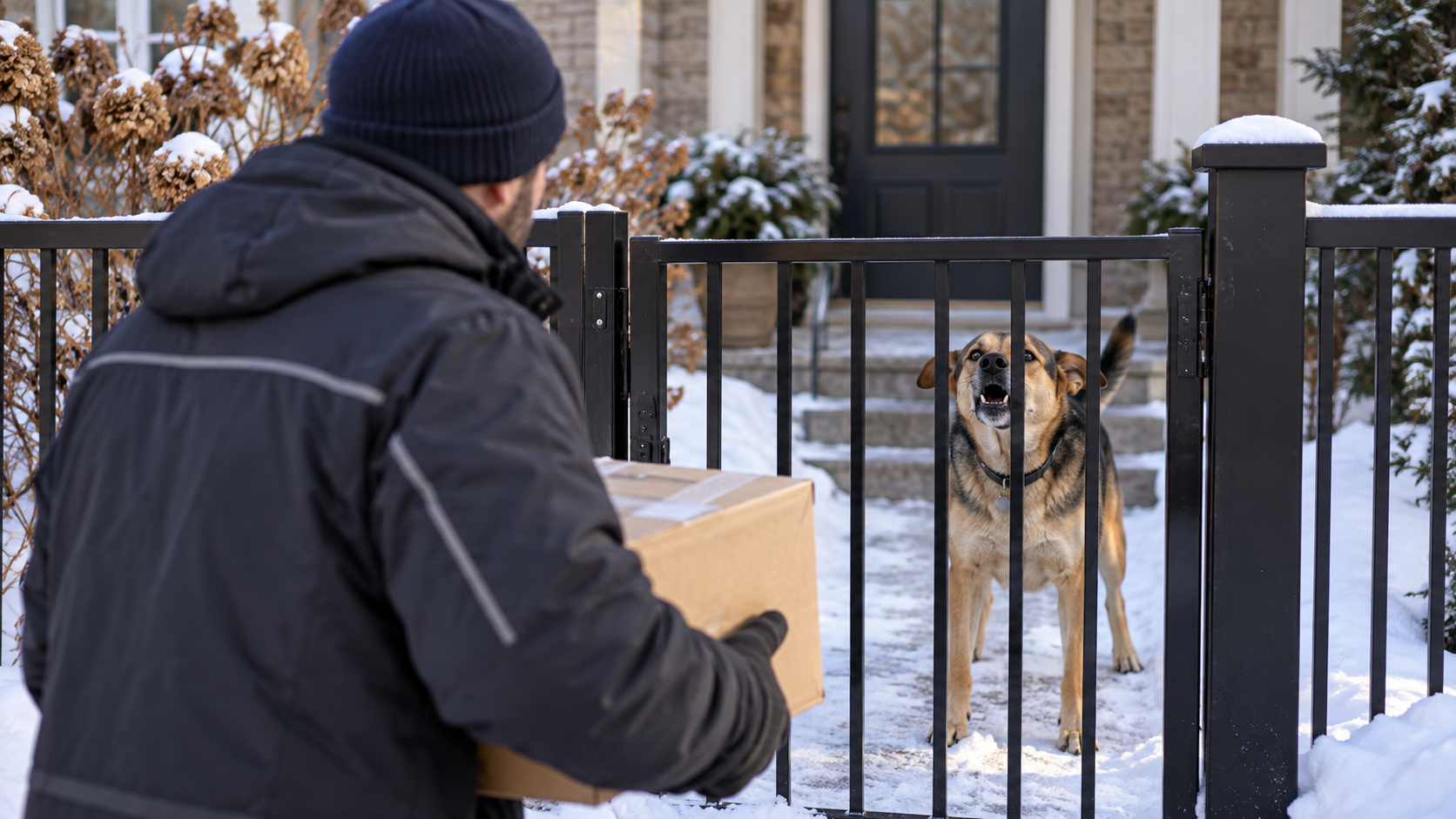
A driver approaches a front walk with a parcel and sees a dog loose near the gate. The animal barks, moves toward the entrance, and blocks the only route to the assigned door. The customer may be inside, and the stop card may allow a doorstep drop under normal conditions. The driver still has to decide whether that path is safe now. A successful delivery is not a reason to test how close the animal will allow someone to come.
To respond to an aggressive animal at a delivery access point, stop outside the animal's reach, avoid provoking or cornering it, and return to a safe position if needed. Use the employer's approved customer or dispatch contact path for an animal-access problem. Keep the parcel in the required custody until a safe, authorized delivery method is confirmed. Record the actual condition and result so the next driver is not sent into the same hazard without context.
The CDC's dog guidance notes that any dog can bite under some conditions. USPS dog-bite awareness material shows why delivery operations take animal encounters seriously. Neither source authorizes a driver at another employer to leave a package in a different location or use a particular defensive action. The task's service level and the employer's current safety process govern the stop.
Read the animal access hazard from a safe place
The animal access hazard may be a loose dog, an animal behind a gate that can open, or one that appears restrained but can reach the path. You do not need to prove the animal will bite before treating access as unsafe. Observe from a distance: where is the animal, what barrier exists, and which path the task requires? If you cannot see the animal clearly, do not step into a yard to find out whether it is secured.
Avoid describing the animal only as “mean.” Report observable behavior: barking, lunging toward the path, following the driver, or blocking the gate. A quiet animal can still be unsafe to approach, and a barking animal may be behind a secure barrier. The precise position and barrier matter to the next decision. If the situation changes while you watch, update the route owner rather than relying on your first impression.
Keep children, customers, or bystanders out of the decision where possible. Do not ask a passerby to hold an unfamiliar dog for you. If the owner comes out, follow the employer's process for confirming the animal is controlled before approaching. A verbal “it won't bite” does not change what the driver can see or what the delivery policy requires.
Do not create contact to finish the stop
Do not reach through a fence, toss the parcel over the animal, or open a gate that releases it. Avoid running toward the vehicle or making sudden movements that increase risk; use the employer's training for withdrawing safely. If you are already close, create distance without trapping yourself against a wall or vehicle. If an animal attacks or someone is injured, seek emergency help and follow the employer's injury process.
The parcel can remain with the driver while the access issue is resolved. A scan that says “delivered” because the driver stood at the property line would be false. A photo of the gate is not proof of delivery. If the app offers an animal-related exception, use it only according to the employer's instructions and only after the actual condition is recorded.
If the vehicle is nearby, enter and secure it when safe. Do not leave the door open while handling the phone. If the animal is between you and the vehicle, move toward another safe position and contact help. The route clock should not push the driver into an improvised confrontation with the animal.
Contact the owner through the approved path
The employer may allow a customer call, app message, dispatch request, or support case to resolve an animal block. Use the authorized method. Tell the owner the stop ID, animal location, barrier state, and whether any person has been injured. Ask for a specific safe next action: can the customer secure the animal, is another approved entrance available, or must the parcel be reattempted or returned?
Do not contact a resident through a personal social account because their name appears on the label. Do not disclose route details to an unverified person who happens to be nearby. If the customer is reached through the approved channel, allow them to secure the animal before approaching. A promise that the dog has been put inside should be checked from a safe position; do not step into the yard while the situation remains unclear.
If the customer cannot be reached, follow the employer's safe-delivery exception process. Do not choose an alternative drop point because it seems hidden from the dog. It might violate the service level, expose the parcel, or require a path that is also unsafe. Dispatch can decide whether another worker, time, or method is appropriate.
Use a safe delivery exception when access remains blocked
A safe delivery exception records that the assigned access path could not be used because of the observed animal condition. It should identify the stop, time, animal location, attempted approved contact, parcel custody, and next action. It should not claim a customer refused delivery if no one spoke with the driver. It should not say the address was inaccessible for a reason you did not verify.
Use the platform's actual exception type and wording. If the app lacks a suitable choice, ask support rather than picking a misleading status. A later customer notification may be generated from that code. The next driver needs to understand whether the animal was loose, behind a questionable gate, or already secured when the driver left. Keep the description short and factual.
If a supervisor authorizes another delivery point, confirm that it complies with the package's service requirements. Record who gave the instruction and what was physically done. A parcel handed to an authorized person at a safe location may be a real delivery; a parcel left outside a locked gate may not be. The label “animal hazard” does not override recipient, signature, or proof rules.
If the exception code sends an automatic customer message, read its meaning before selecting it. Some codes may imply that the driver reached the door or that a contact attempt occurred. An animal blocking the gate may prevent either action. The correct record should say how far the driver could safely go and whether approved contact actually succeeded. If the platform's options are too coarse, a linked support note can preserve the facts while the route owner chooses the appropriate status.
Keep the item available for the next authorized step. Do not leave it unattended in the vehicle while walking back toward the animal to gather a better photo. A scene image is useful only if taken from safety and allowed by the employer. The route owner can investigate the access condition without asking the driver to recreate the risk.
Work through a gated-yard example
Imagine a Saint Paul driver assigned a doorstep drop at a house with a fenced front yard. The gate is partly open, and a dog is pacing between the gate and door. From the sidewalk, the driver sees the dog bark and move toward the opening. The driver stays outside the fence, returns to a safe vehicle position, and uses the approved customer-contact function. The driver does not throw the package into the yard or photograph it beside the gate as delivery proof.
The customer answers and says they will bring the dog indoors. The driver waits for the gate to close and the animal to move out of the path. If the driver can verify the access is now safe under employer training, they complete the assigned method and record the actual delivery. If the animal remains loose or the customer cannot secure it, the driver files the correct access exception and keeps the parcel. Dispatch owns the reattempt or return instruction.
Now change one fact: the dog is behind a solid locked fence and the designated delivery box is outside that fence. The driver should read the service instruction and assess whether the box can be reached safely without animal contact. The mere presence of a dog at the property does not automatically make every permitted drop impossible. The actual barrier, path, and delivery rule determine the outcome.
Protect the next driver from stale assumptions
An animal warning should be tied to the exact stop and observed date. “Dog loose at front gate at 2:40 p.m.; no safe path; customer not reached” helps the next worker plan. “Dangerous dog forever” overstates what one driver knows and may become stale. A later driver may find the animal secured or a different access point approved. They still need a current safety check on arrival.
Ask how the employer carries animal-related warnings into a reattempt. A note in a support ticket may not appear on the next driver's route card. If dispatch reassigns the parcel that day, tell the replacement driver the case reference through the approved handoff. Do not send a personal text with the customer's address and an alarmist description. The work record should hold the relevant condition and instruction.
If a hazard recurs across attempts, the safety owner may need to contact the customer or change the delivery method. The driver can report repeated observations without inventing a permanent rule. A record of dates, animal position, and outcomes helps the owner decide whether the same access problem persists.
The warning should also tell a later driver what did work. If the customer secured the dog and met the driver at a permitted location on a prior attempt, record that as a past event, not a standing promise. The next driver can use the approved contact path to arrange a similar handoff if authorized. If the customer did not answer, say so. A note that includes both the failed path and the successful alternative is more useful than one that only says “watch for dog.”
Handle a bite or injury as a different event
This article concerns an aggressive animal before contact. If a bite, scratch, fall, or other injury occurs, get to safety and seek medical attention. The CDC's dog guidance explains that bites can require medical assessment. Notify the employer through the injury process and follow local official instructions. Do not continue the route because a wound looks small.
Record the animal's location and the injury circumstances as observed. The employer or medical provider may need details about the owner or animal, but the driver should not approach it again to gather them. Let trained responders or the responsible property owner handle control. The parcel's status still needs a separate accurate route entry.
If the animal did not make contact but the driver fell while retreating, report the fall and its symptoms through the injury channel. Do not collapse it into a simple access exception. The route owner should know whether the driver can continue safely and where the parcel remains.
Consider property type and service method
Animal access differs among a detached house, apartment corridor, farm entrance, or business yard. A dog behind a screen door may still reach the driver if that door opens. A fenced yard may have a delivery box outside the gate. A rural property may have a long driveway with no safe turnaround. Use the assigned service method and the employer's safety guidance for the actual layout.
Do not enter a building lobby solely to avoid an animal if the package requires direct handoff at the assigned address and the lobby is not an approved drop. Likewise, do not assume a package can be left with a neighbor. A safer route is not automatically an authorized recipient. Dispatch can help separate physical access from delivery authorization.
If the customer proposes meeting at the vehicle, confirm that the employer permits that handoff and that the person is authorized for the parcel. Keep the driver at a safe location away from the animal and traffic. Record the actual person and handoff method required by the task. A controlled alternate can solve the problem, but it must be both safe and valid.
Do not make the animal's owner perform an unsafe act to satisfy the route. Asking someone to hold a large dog by its collar at an open gate while the driver squeezes past may leave both people exposed. The customer should secure the animal according to their own ability and the employer's requirements; the driver can wait outside or follow the exception path. If a safe handoff cannot be arranged promptly, dispatch can schedule another attempt rather than forcing the stop.
An animal may appear after the driver has already entered the property. In that case, the immediate task is to withdraw under the employer's training without blocking the animal's movement or running into traffic. Once safe, report where the animal appeared and whether the parcel remained with the driver. Do not return to retrieve a dropped package while the animal is still loose. The route owner can coordinate recovery or a later delivery with a safer plan.
Keep route timing from hiding the hazard
A driver may worry that an animal exception will count against route completion. Report the hazard anyway. A false delivered scan, rushed gate entry, or unrecorded skipped stop causes larger problems. Give dispatch the current route state and ask how the time should be handled. The supervisor can reassign or reschedule while the driver proceeds to distinct safe work.
If a contact attempt is queued because the app is offline, note that uncertainty. Do not claim the customer was notified until the message is confirmed or another approved contact succeeds. If the driver leaves the area before hearing back, keep the parcel in custody and the stop open or excepted under the authorized workflow. A later customer reply may require dispatch to coordinate a new attempt.
The route may have another stop at the same property. Do not assume the first animal warning automatically resolves the second parcel's service requirements. Tell the route owner which items remain and whether any can be delivered by the approved alternate path. Keep package identities distinct.
Ask about animal support when comparing driver jobs
Applicants can ask how an employer trains drivers for dogs and other animals at access points. Is there a clear no-entry rule for unsafe paths? Can drivers reach dispatch quickly? How are animal warnings shown to later drivers? What happens when a customer cannot secure an animal and the package has a signature requirement? These questions test the operation's support before a driver has to decide at a gate.
The Saint Paul delivery driver Careers hub provides local role context. The published delivery job-offer review guide can help candidates ask about safety training and route support. An active driver should use the employer's current animal-access, customer-contact, and exception procedures.
The driver should leave the stop with three facts clear: whether the access was safe, where the parcel physically is, and who owns the next action. A customer securing the animal can reopen a safe path; an unresolved loose animal requires a truthful exception. The next driver needs the observed condition and current instruction, not a promise that the animal will behave the same way on another day.