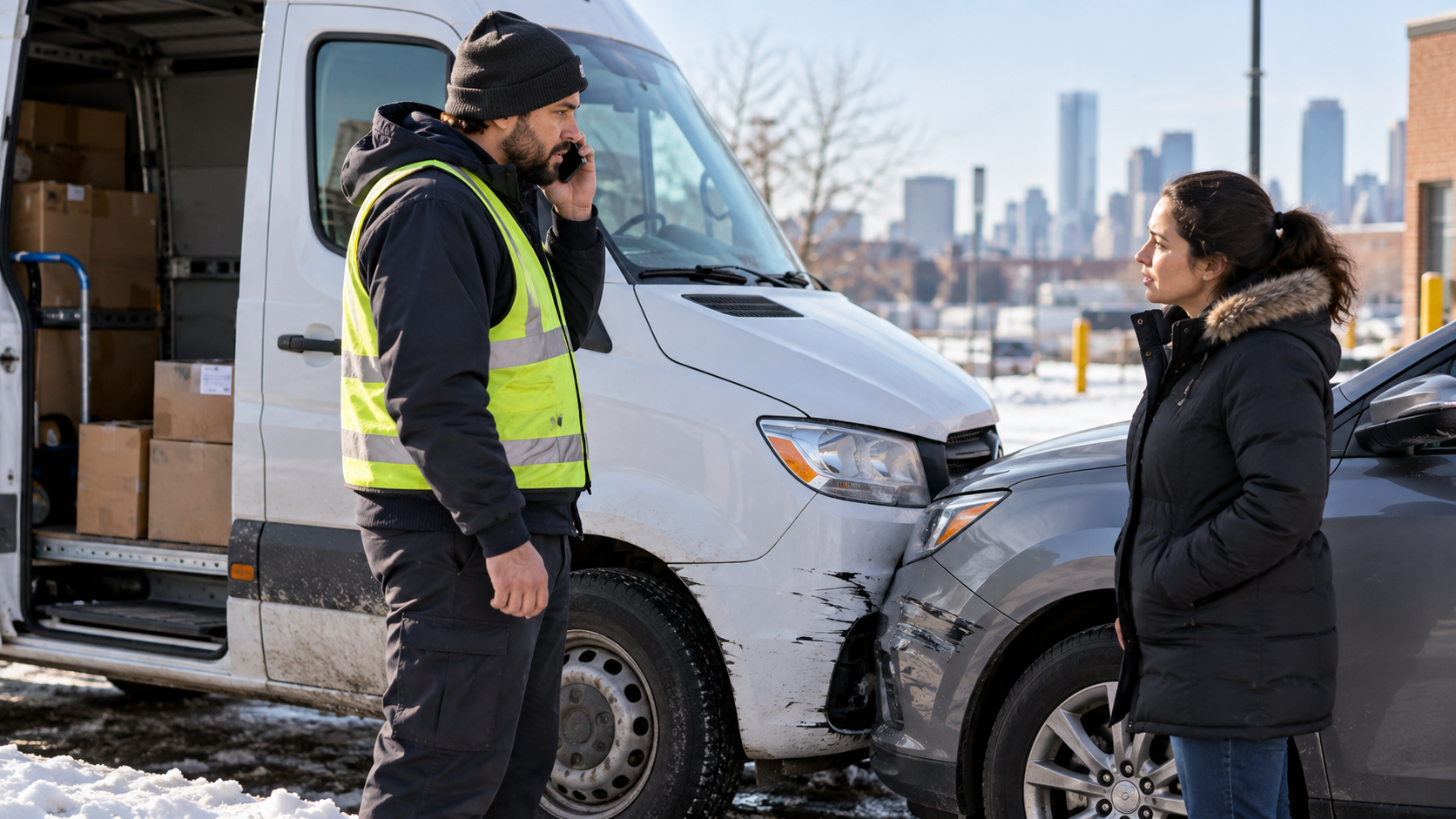
A delivery vehicle taps another car while turning into a loading area. Both drivers step out and see what looks like a small scrape. A route clock is still running, parcels remain in the vehicle, and the next customer expects a delivery. Calling the event “minor” before checking people and damage can push a driver back onto the route too early. The first few minutes should establish safety, the facts of the collision, and who now owns the route decision.
To respond immediately after a minor delivery traffic collision, stop as required, check for injuries and immediate hazards, and seek emergency help when needed. Follow Minnesota's collision duties and the employer's reporting instructions. Preserve the scene facts without guessing fault, protect the parcels, and wait for an authorized decision about the vehicle and route. A small-looking mark does not by itself establish that no one is injured or that no report is required.
Minnesota Statutes § 169.09 sets duties for drivers involved in collisions. Its provisions address stopping, giving information, rendering assistance, and reporting in specified circumstances. The exact duty depends on what happened. A driver should use current employer instructions and official help for the actual event. This guide organizes the immediate work response; it does not decide legal liability or insurance coverage.
Stop and assess collision scene safety
Bring the vehicle to a stop at or as close to the scene as is safely possible, consistent with the applicable law. Set the brake and check traffic before opening the door. A loading lane, intersection, or narrow shoulder can expose people to a second collision. Use hazard signals and other safety equipment according to the vehicle and employer's instructions. If the vehicle can be moved and an authorized responder directs it, note the original positions first when safe to do so.
The collision scene safety check starts with people. Ask whether anyone is hurt or needs help. Pain or injury may not be obvious from a quick look at the vehicles. If there is an injury, danger from traffic, fire, or another urgent condition, call emergency services. Do not treat a verbal “I'm fine” as a reason to skip the rest of the legally and operationally required steps. If a person cannot move safely, avoid making an injury worse while seeking trained help.
Keep bystanders away from traffic when you can do so safely. Do not stand between vehicles or step into an active lane to photograph a bumper. A delivery driver should not prioritize a route screenshot, customer call, or package scan over scene safety. The parcels can wait while people and traffic are addressed.
Use the facts, not the word minor
“Minor collision” describes an initial impression, not a legal category that excuses stopping or reporting. A scuffed panel may conceal other damage. A person may report pain later. A parked vehicle, public property, or an unattended object can involve a different information duty. Record what was actually struck, where the vehicles were, and what each person said. Let the applicable law and employer procedure determine the next steps.
Do not promise the other person that the matter can be handled privately without telling the employer. A company vehicle, personal vehicle used for work, or vehicle carrying assigned parcels may all trigger work reporting requirements. The driver may not be the policyholder or person authorized to settle a claim. Provide required information and contact the designated supervisor or insurer under the employer's process.
Avoid announcing fault at the scene based on a first impression. You can state observable facts: “I was turning right into the entrance and felt contact at the rear panel.” A factual account supports later review. Speculation about who had the right of way can become more certain in memory than the evidence permits. Cooperate with responders and give truthful information without inventing conclusions.
Check people and call for the right help
Ask each involved person if they need medical help, within your own safety limits. If someone is injured or the situation appears dangerous, call 911 and follow dispatcher instructions. Minnesota's collision statute includes duties concerning assistance in relevant circumstances. Do not decide that an injury is too small for help based only on a person's ability to stand or speak. A trained responder can advise on urgent care and scene control.
If nobody reports an injury and the vehicles appear drivable, the driver still needs to follow the applicable collision and employer reporting steps. A supervisor may instruct the driver to stay, meet a responder, move the vehicle, or arrange a tow. Do not drive away merely because the other motorist says they are late. If the other party leaves, record the direction and identifying facts you observed and follow official reporting instructions.
If you are shaken, take a moment before making a route decision. A driver who cannot focus safely should tell the supervisor. The employer can reassign the route or send assistance. Delivery time targets should not become the measure of whether a vehicle or driver is fit to continue.
Ask for another driver when you cannot safely operate the vehicle.
Exchange required information accurately
Follow Minnesota law and the instructions of any responding officer about information exchange. Give and obtain the details required for the actual collision. Check that names, vehicle identifiers, contact information, and insurance details are recorded correctly through the approved incident process. Do not photograph someone's entire wallet or unrelated personal documents merely because they are offered. A clear record of the required fields is more useful than a broad collection of private images.
If the other party refuses to provide information or cannot be located, do not invent it. Record a license plate, vehicle description, location, or witness contact only if safely observed, and follow official reporting instructions. A parked car with no driver present may require a different procedure than a face-to-face exchange. The statute and responders govern the duty; a delivery article cannot replace them.
Keep the information in the employer's authorized collision form or channel. A personal messaging thread may be convenient at the scene but can make the record hard for claims and safety owners to find. If the work tool is unavailable, ask for the designated fallback and later link the temporary account to the official incident.
Create a delivery route collision report
The delivery route collision report should name the date, approximate time, precise location, vehicles or property involved, observed damage, reported injuries, responder or case number, and immediate actions. Add the route ID, vehicle ID, parcel custody, and last verified delivery event for dispatch. Separate what you saw from what another person told you. If the scene was moved for safety, say where the vehicles originally came to rest to the best of your knowledge.
Use photos only when safe and permitted. Capture relevant vehicle positions and damage before a move when possible, without standing in traffic or exposing unrelated people and parcels. Do not edit images to highlight a preferred interpretation. Upload them to the approved incident system, not a social account. If a photograph could not be taken safely, say so; a truthful written description is better than a risky reconstruction later.
The work report may be separate from any official crash report required by law. Ask the supervisor who completes each form and by when. Do not assume the employer's internal ticket automatically satisfies a public reporting duty. Conversely, an officer's case number does not tell dispatch where the parcels are or whether the delivery vehicle can continue.
Keep the official reference, agency name, and name or badge number of a responding officer when provided through the normal process. If no officer attends, record whom you contacted and the instruction received. Do not claim an official report was filed because you left a voicemail or completed the employer's app form. The claims owner may need a later copy, but the driver should follow the authorized request route rather than collecting unrelated records at the scene.
Secure the vehicle and parcel load
After people and the scene are addressed, check whether the vehicle can safely remain where it is and whether the load is secure. Do not unload parcels onto a sidewalk to make room for a tow unless the employer or responder directs a safe transfer. Lock the vehicle if you must step away and it is safe to do so. Tell dispatch the number and condition of assigned parcels, including any item that may have shifted or been damaged in the collision.
A parcel may look undamaged from outside while a box has moved sharply. Follow the employer's inspection rule; do not open a sealed package to check contents. If a label or item is damaged, record it through the work system. The collision report should make clear which packages remain in the driver's custody and whether any were handed to another authorized worker.
Do not keep scanning deliveries from the scene while the vehicle's condition is uncertain. A new delivery write implies the route is proceeding, yet the parcel or vehicle may be under a safety hold. Dispatch should decide whether to reassign, delay, return, or continue the load based on verified facts and the employer's procedure.
Pause the route without falsifying stop status
Notify dispatch or the route owner promptly after urgent scene needs. Give the last confirmed completed stop, next assigned stop, current vehicle location, and parcel custody. If an app submission just before the collision is uncertain, identify it separately. Do not mark future stops attempted or delivered to clear the route. A collision delay is not a customer absence or failed access attempt.
The route owner may need to notify customers or reassign time-sensitive items. The driver should use the employer's customer-facing process rather than sending individual speculative messages while handling the scene. If a replacement vehicle or driver arrives, complete a controlled parcel and route handoff. Record who took each item and which digital events were already accepted.
If the collision involves the work device as well as the vehicle, report its condition. A cracked screen or interrupted upload can leave route history uncertain. Do not reset the app or repeat a scan solely to make the display look normal. Ask support to reconcile the accepted destination record before a later write on the same event.
Work through a low-speed loading-lane example
Imagine a Saint Paul driver turning into a depot loading lane at low speed touches a parked service vehicle. Both vehicles remain upright and the visible damage looks like a short scrape. The driver stops, checks for people and traffic, and contacts the appropriate help if anyone is hurt or the lane is unsafe. They follow the applicable information and reporting duties, then notify the employer's safety and route owners with the time, location, vehicle IDs, observed damage, and route state.
At the moment of contact, nine parcels remain in the delivery vehicle. The last verified delivery was stop 14; stop 15 has not been attempted. Dispatch places the route on hold while vehicle condition and the collision response are resolved. The driver does not mark stop 15 failed, because no delivery attempt occurred. If a replacement driver takes the load, both workers follow the approved item handoff and record the new custodian.
Now change one fact: the other driver says their shoulder hurts after initially saying they were fine. The first driver's “minor scrape” label no longer captures the situation. They seek emergency or official guidance as appropriate and update the report with the new statement and time. They do not edit the earlier observation to make it look as though the injury was known from the first minute. The timeline matters.
Keep the first account factual
Write down road, weather, lighting, vehicle movement, and relevant signals as observed. If you are unsure of a speed or distance, say approximate or unknown. Do not fill gaps with a polished story after speaking to others. A dash-camera or telematics record, if the employer has one, may later refine the facts. Preserve its existence and tell the authorized owner; do not ask a coworker to delete or alter footage.
Witness statements should be attributed. “A loading worker said the service vehicle had been parked for ten minutes” differs from “the service vehicle was parked for ten minutes.” If an officer gives a case number, record it accurately. Do not interpret the absence of a citation as a final insurance or fault finding. The incident owner will handle claims and follow-up using all available evidence.
Avoid putting customer names and addresses into the crash narrative unless a specific parcel or stop is relevant. Dispatch can locate the route from its ID. If a parcel was damaged, reference its item ID in the work system. This keeps the collision evidence focused on the event while allowing authorized staff to trace any affected delivery.
Resume only with a clear safety and route decision
Before driving again, ask whether the vehicle is approved for use and whether you are fit to continue. A supervisor's route instruction cannot replace a needed vehicle inspection or official scene requirement. If the vehicle is towed or held, follow the parcel-transfer process. If it remains in service, confirm the route's current assignment and any customer updates already sent.
Check the next actual stop against the physical parcel and the app's accepted state. An incident can interrupt synchronization or change route order. Use a read-only check before the next live delivery action. If the first resumed scan fails or the route view conflicts with dispatch, preserve that new evidence and ask support rather than repeating the same write without reconciliation.
The collision may generate later insurance, maintenance, or employment questions. Keep official case references and your own authorized employment records through the approved process. Do not retain a private folder of customer route screenshots as a substitute for a claims file. The employer's safety and claims owners should maintain the incident record.
Ask about collision support when comparing driver jobs
Applicants can ask who answers a driver's first call after a collision, how a loaded vehicle is secured, and who decides whether the route continues. Is there a spare driver or vehicle? How are parcels transferred? What training covers information exchange and internal reporting? These are practical questions for any role that puts a driver on Minnesota roads with assigned deliveries.
The Saint Paul delivery driver Careers hub provides local role context. The published delivery job-offer review guide can help candidates raise vehicle, insurance, and support questions. An active driver should follow current Minnesota law and the employer's specific collision procedure for the event at hand.
The first minutes after a collision have several owners. The driver stops, checks people and hazards, gives accurate scene facts, and protects the load. Responders handle urgent safety and legal scene needs; the employer handles vehicle, claims, and route decisions. A low-speed impact may be simple, but only a verified scene and clear route instruction support the next delivery.