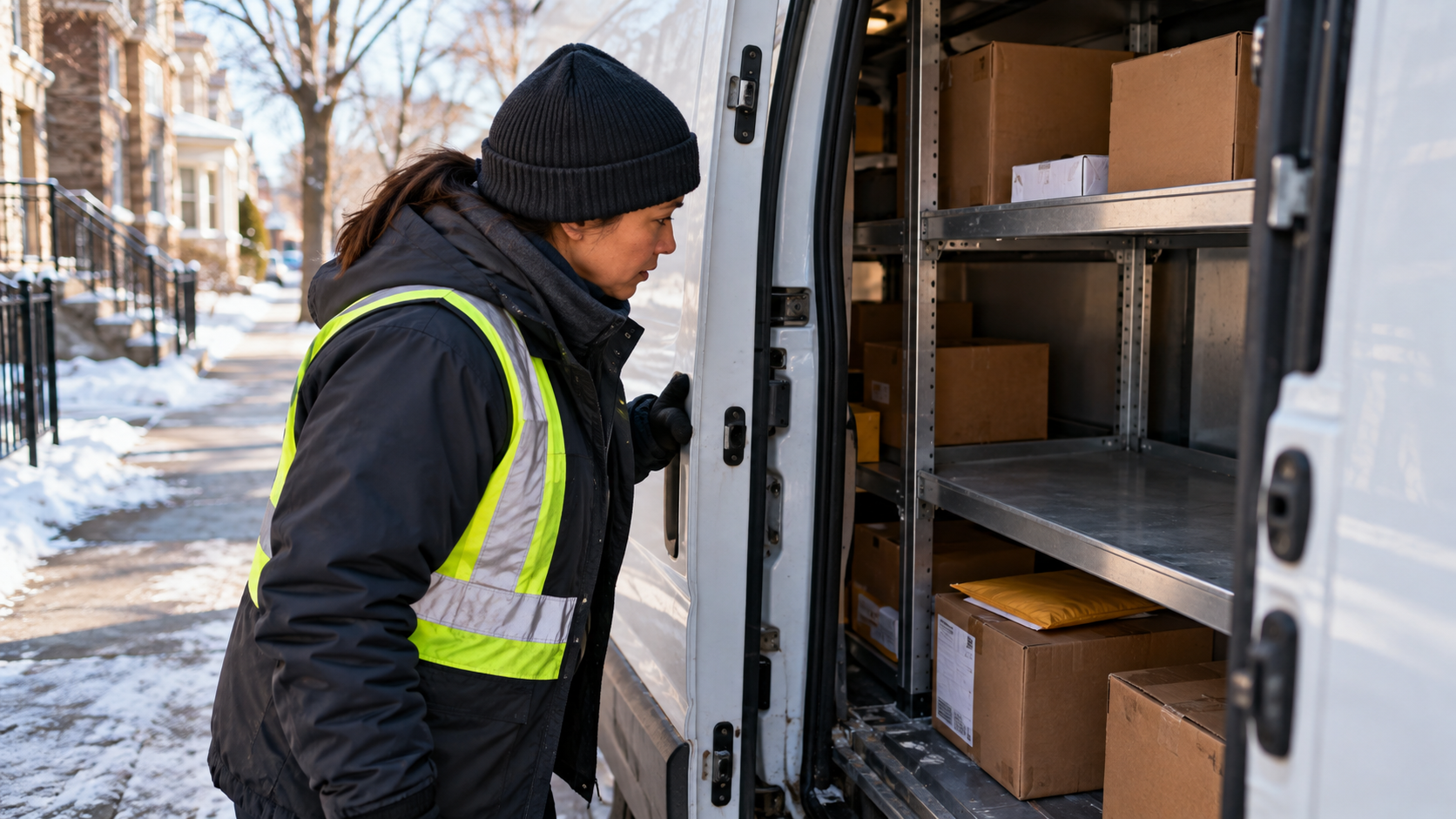
A driver returns from a building and sees the vehicle door open. One parcel that was on the front shelf is gone. The door may have been left unlocked during the stop, but the driver does not yet know who moved the package or exactly when it disappeared. A rushed attempt to finish the route can turn a custody gap into a false delivery record. The first response should protect the driver and remaining load, preserve what can still be learned, and give the right people a precise account.
To respond when a package is stolen from an unlocked delivery vehicle, move to safety, avoid confronting a suspected thief, and report the missing item through the employer's designated security and route channels. Verify the parcel identity and last known custody before calling the event confirmed theft. Follow instructions about police contact and evidence preservation. Keep the parcel's route status accurate; it was not delivered simply because it is no longer in the vehicle.
NHTSA's vehicle-theft prevention material provides general vehicle-security context. The NIST Privacy Framework provides a way to think about customer-information exposure when a label or route device may also be missing. Neither source determines what happened to this parcel or who files a police or insurance report. The employer's current security, claims, and customer-service processes decide those steps.
Make the vehicle theft scene safe
Before reaching into the vehicle, look around. Someone may still be nearby, a door may be damaged, or the vehicle may be in an unsafe traffic position. Do not chase, block, or confront a person you suspect took the parcel. If there is an immediate threat, call emergency services. Move yourself to a safe place and follow official instructions. A package can be replaced or traced; an unsafe confrontation creates a different emergency.
The vehicle theft scene may also contain information that a security or police responder needs. Note the door's position, any damage, where the parcel last sat, and anything you actually saw. Do not disturb possible evidence merely to make the vehicle look orderly. At the same time, follow safety and employer instructions for securing the remaining parcels. The scene may have to be protected while the load is kept from further exposure.
If you saw a person leave, describe observable details and direction of travel to the appropriate responder. Avoid guessing identity or intent from clothing or location. Do not post an image of the person or vehicle to a public account seeking help. Give the information through the employer and official reporting channels.
Confirm which parcel is missing
A package can be misplaced within a loaded vehicle, moved by an authorized helper, or left at the previous stop. Check the assigned manifest and the physical load with dispatch's guidance. Identify the exact package ID, last verified scan, and last place you personally saw it. Do not assume the first empty shelf space belongs to the next stop on the route; route order can change, and several parcels may look alike.
Keep the search controlled. Check the vehicle and approved nearby work area without disturbing evidence or leaving the load unsecured. Ask whether a coworker performed a documented transfer. If the package appears elsewhere, update the incident promptly with the actual finding. A report of suspected theft can be corrected; a fabricated certainty is harder to unwind.
Record the search time as well.
If the item remains missing after the bounded check, report that state precisely. “Package P-418 missing from vehicle after stop 12; last personally seen at depot loading” is more reliable than “customer's parcel stolen at 1:30” when you did not witness the removal. The employer can compare loading scans, route history, and any authorized camera evidence.
Do not turn the search into a series of unrecorded handoffs. If a supervisor asks another worker to check a storage cage or loading cart, note who took that task and what they found. A parcel discovered in an authorized staging area changes the incident, but the driver still needs to know whether it was there throughout the custody gap or moved after the report. This distinction affects the route record and the prevention review. Keep the case open until the item and its history are reconciled.
Build a missing parcel theft report
A missing parcel theft report should include route and vehicle IDs, package ID, last verified physical location, last scan, time the driver left and returned to the vehicle, door or lock condition, witnesses, and the state of remaining items. Identify which facts are firsthand and which came from someone else. Say whether a route phone, key, or other equipment is also missing. The incident owner can then decide which security and parcel tracks must run together.
Use the employer's security or loss channel and notify dispatch so the route is controlled. A generic “one box gone” message may reach neither the claims owner nor the customer-service team. Ask for a case reference and the next action. If the employer directs a police report, record the agency and case number when available. Do not assume an internal ticket automatically creates a police or insurance record.
Be candid about the unlocked door. The lock state is relevant to the sequence and prevention review. Concealing it can send investigators toward the wrong explanation and leave the next driver with no lesson. A factual report can say you found the door unlocked when you returned, or that you remember leaving it unlocked, depending on what you actually know. The employer decides accountability; the driver supplies facts.
Keep the route record truthful
The missing parcel should not be marked delivered, attempted, refused, or returned merely to clear a task card. Tell dispatch its last verified digital status and physical custody. A theft or loss code may exist in the platform, but use it only as instructed by the authorized owner. A driver who picks the nearest available status can trigger the wrong customer notification and make recovery harder.
If a scan was in progress when the parcel disappeared, the destination state may be uncertain. Preserve the attempt time and device response. Ask support to reconcile whether a write was accepted before another action is taken for that package. A screen that still shows “out for delivery” does not prove the item is physically present; a delivered flag does not prove it reached the customer.
The rest of the route needs a decision as well. Dispatch may hold the vehicle for investigation, reassign parcels, or authorize continuation after the remaining load is secured. Do not skip directly to the next stop while the missing item and open vehicle remain unresolved. If another driver takes the load, count and transfer the actual remaining parcels under the work process.
Preserve evidence without spreading customer data
Take photographs only when safe and permitted by the employer or responder. A picture of the door and shelf may help establish the vehicle condition; a full route sheet or close-up of every label is usually unnecessary for a one-parcel loss report. Keep evidence in the approved incident system. A personal group chat asking “Did anyone see this package?” can reveal the customer's name, address, and tracking code to people who have no incident role.
If the vehicle has dashcam or telematics systems, tell the owner which time window matters. Do not alter, unplug, or erase footage to save space. A nearby business may have cameras, but the driver should not pressure staff for video or promise how it will be used. Give the location and possible camera source to the employer or police contact assigned to collect it.
Preserve dispatch messages and transfer records by reference to their work-system IDs. Do not build a personal archive of route screenshots because you worry someone will later blame you. Ask for an incident acknowledgement and a way to add your factual statement. That provides a durable record without creating new uncontrolled copies of customer information.
Work through an unlocked-van example
Imagine a Saint Paul driver parks at an approved loading spot to deliver one parcel. They return four minutes later and see the side door ajar. Package P-418, which was on the front shelf, is missing. The driver moves to a safe position, sees no person nearby, and calls the employer's security and route contacts. They identify the vehicle, location, stop, time window, last confirmed scan, and the fact that the door was unlocked when found. They do not describe an unknown person as the thief.
Dispatch asks the driver to check whether a helper loaded P-418 into a second vehicle. No handoff is recorded. The driver counts the remaining parcels, leaves their statuses unchanged, and receives a case number. The employer directs the next police and claims step and decides whether the route can continue. The customer-facing owner handles the missing package message; the driver does not mark it delivered to avoid a delay notice.
Now change one fact: a depot worker confirms P-418 was removed from the van before departure under a recorded transfer. The driver updates the suspected-theft case and route owner immediately. The parcel may not have been stolen at all. The initial report was still appropriate because the custody gap was real; the correction is supported by a verified handoff. The driver should not erase the earlier observations or pretend they knew the transfer when the door was first found open.
Account for keys and route devices
If a key, access badge, scanner, or phone is also missing, report it as a separate security concern. A lost route device may expose addresses, access notes, and active sessions. The security owner may need to revoke access or manage a device, while dispatch reconciles parcel status. Do not assume a missing package means the device is missing; check each assigned asset.
If the key was left in the vehicle, say so. The vehicle may need immediate securement, relocation, or replacement access under the employer's process. Do not hand a spare key to an unverified person who offers to help. Ask the named supervisor who is authorized to collect or move the vehicle. Its state can affect the safety of all remaining parcels.
If the route phone was present but the driver used it to photograph the scene, keep those images in the approved work channel. Do not sync them to a personal photo account without permission. A theft response can create a second privacy issue if labels and customer addresses spread during evidence collection.
Respond to a customer question through the owner
A customer may see a tracking status that has not yet changed and ask where the package is. Do not tell them it was stolen as a confirmed fact unless the employer's customer-service owner has established that conclusion and authorized the message. Give the current verified status through the approved contact path and refer the case to the team handling loss and replacement. A driver should not promise a refund or replacement outside their authority.
If a customer says they saw the package at the building, pass that claim to the case owner. It may change the custody timeline. Do not ask the customer to investigate a suspected thief or search unsafe areas. The employer can compare the customer's information with scans, camera evidence, and driver observations.
Customer information may be present on the missing label. Report the type of information visible on that label through the incident channel; do not copy it into a public alert. The privacy or security team decides whether additional notification or containment is needed. The route status and information-exposure questions should both have named owners.
Check the remaining load before moving
Once the scene and reporting instructions allow, count the load against the manifest. Another parcel may be missing or out of place. Do not assume only one item was taken because only one empty shelf was noticed first. Record the count and identifiers through the authorized system. If the count does not match, keep the discrepancy open and ask for a second check before resuming.
Close and lock the vehicle according to the employer's procedure. If a door latch is damaged, a simple lock click may not secure it. Tell the vehicle owner and avoid driving a load that cannot be protected. A temporary seal or different vehicle may be required; the driver should not invent one. The route owner can arrange transfer or return of the remaining parcels.
Before the next live scan, verify the current route assignment. Dispatch may have removed the missing item, split the load, or changed stop order. A stale app view is not proof that the physical parcel is present. Match each next item to the manifest and actual vehicle. Continue only after the incident owner and route owner give a clear path.
Use the incident to improve the next stop
The immediate case should preserve evidence, but the employer should also review how the vehicle was left accessible. Was the driver required to leave the van unattended at that entrance? Did the lock fail, or was there no habit of checking it? Was the load visible from the sidewalk? These are questions for a factual prevention review, not reasons to delay reporting the missing parcel.
The driver can adopt the employer's secure-stop routine for future deliveries: check the lock, keep keys and device under control, and use approved parking and loading practices. If the vehicle's hardware is defective, report it; telling drivers to “be careful” cannot repair a latch. If route timing makes a secure stop impractical, tell the supervisor where the conflict occurs so the assignment can be changed.
Do not let a prevention discussion overwrite the incident facts. Even when the door was left unlocked, the record still needs the exact parcel identity, custody gap, and customer-facing resolution. Learning from the mistake and handling the loss are concurrent tasks with different owners.
Ask about theft support when comparing driver jobs
Applicants can ask how an employer handles missing parcels from a vehicle, who calls police, and who speaks to the customer. Is the vehicle equipped with working locks and a secure parcel area? What happens to the route while an incident is investigated? How is a driver expected to document the event without keeping customer labels on a personal phone? A useful answer names actual channels and owners.
The Saint Paul delivery driver Careers hub provides local role context. The published delivery job-offer review guide can help a candidate ask about vehicle equipment and loss support. Once working, follow the employer's current security, route, and customer-service procedures for the event.
The driver does not need to solve a suspected theft alone. They need to stay safe, identify the missing parcel and custody window, preserve observable evidence, and keep the route record honest. Security or police may investigate the removal, while dispatch protects the remaining load and customer-service staff address the missing delivery. A clear report lets each owner work from the same facts.